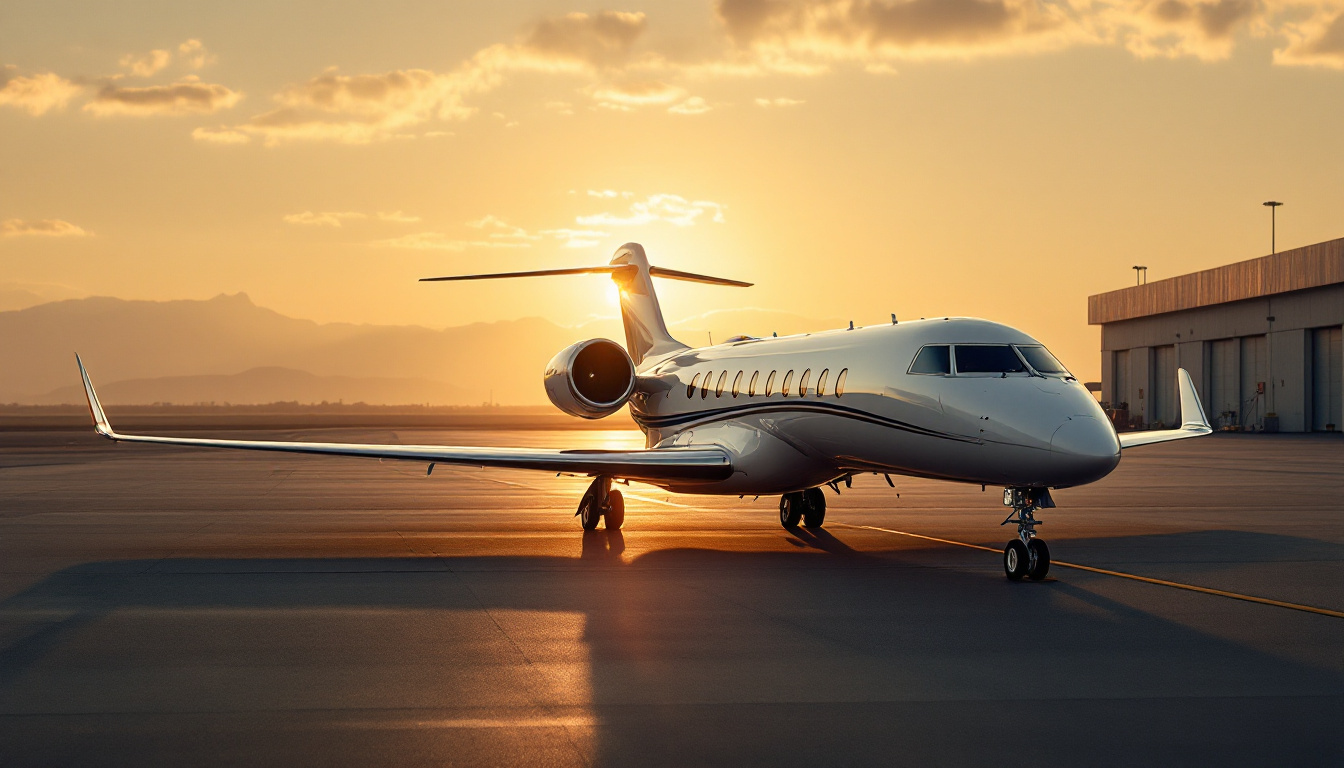
The Bombardier Global 8000 has now been in commercial service for slightly under six months as I write this, and the EIS — entry-into-service — picture is clear enough to evaluate properly. The aircraft was handed to its first customer on 8 December 2025, certified by the FAA eleven days later on 19 December, and approved by EASA on 23 January 2026. The fleet launch delivery to NetJets followed on 25 March. As of early June, Bombardier has delivered a handful of aircraft and is running production at the Aircraft Assembly Centre in Mississauga toward an eventual target of approximately 40 units per year.
The promotional language around the aircraft has been, predictably, the most superlative-laden Bombardier marketing campaign in many years. The actual operating story is more interesting than the marketing implies. Below is what the first six months of service have told us, who is taking the aircraft, what they are paying, and what to expect from the next twelve months of deliveries.
The certification timeline
The Global 8000 received Transport Canada type certification on 5 November 2025. The FAA followed on 19 December 2025. EASA closed the loop on 23 January 2026. This is the standard cascade for a Canadian-built type and was achieved roughly on the schedule Bombardier had projected through 2024. The certification programme totalled approximately 9,000 flight test hours across four flight-test aircraft, including the high-Mach envelope expansion that took the type briefly to Mach 1.015 in level flight during the 2022 development phase — the first civilian aircraft to break the sound barrier since Concorde, though only in test conditions and not in normal operating procedures.
The certification cleared the aircraft for a maximum operating Mach number of 0.95 and a maximum cruise speed of Mach 0.94. The certified maximum operating altitude is 51,000 feet. The cabin altitude at FL410 is approximately 2,691 feet, which is the lowest figure in current business-jet production and a substantial improvement on the already-good 4,800-foot cabin altitude of the Global 7500. The cabin pressurisation differential is approximately 10.5 psi, a figure that has implications for crew rest and passenger fatigue on the longest missions — there is a measurable physiological benefit to a lower cabin altitude on flights of more than nine hours, and the Global 8000’s 2,691-foot figure is the closest any current production jet comes to a sea-level cabin.
The first delivery
Bombardier delivered the first Global 8000 — serial number 60001 — to Patrick Dovigi on 8 December 2025 at the Aircraft Assembly Centre in Mississauga, in a deliberately public ceremony attended by hundreds of employees, suppliers, government officials, and media. The choice of Dovigi as the first customer was not coincidental: he is a multi-decade Bombardier loyalist (his prior aircraft was a Global 7500, and his prior personal aircraft a Global Express XRS), and the public delivery was the kind of marketing moment Bombardier needed after the lengthy development cycle.
The aircraft will be operated under management by Chartright Air Group, a Toronto-based operator that holds the Canadian air operator certificate for several Bombardier flagship aircraft. The operating registration is Canadian (C- prefix) and the aircraft is hangared at Toronto-Pearson when not in active service. Dovigi’s use pattern, based on the limited public ADS-B tracking data, has been a mix of North American legs (Toronto to Naples, Florida; Toronto to Las Vegas), and at least two transatlantic legs in the first quarter of 2026 — Toronto to Hamburg in early January, and Toronto to Nice in mid-March.
The Hamburg leg is interesting. The arrival timing coincided with the late stages of construction on Dovigi’s Lürssen yacht Jassi, which launched at the company’s Rendsburg yard on 6 February. Industry inference — though not directly confirmed — is that the aircraft trip combined a personal visit with a yard inspection. The aircraft picture and the yacht picture interlock at the same level of client, and that interlocking is itself worth noticing as a signal about who is buying ultra-long-range aircraft and where they are spending the rest of their wealth.
NetJets: the fleet launch
NetJets took delivery of its first Global 8000 on 25 March 2026 at Bombardier’s Laurent Beaudoin Completion Centre in Dorval, Quebec. The aircraft is the first of 24 that NetJets has committed to taking — an order made up of an initial firm purchase of four new airframes, the conversion of eight existing Global 7500 orders to the Global 8000 specification, and the planned upgrade of a further twelve in-service Global 7500s to Global 8000 configuration. The original NetJets fleet launch announcement was made in November 2022, with the firm order valued at the time at approximately USD 300 million for the four new aircraft.
The NetJets entry-into-service plan is, on the operator’s published schedule, the most aggressive fleet integration of a new aircraft type in the company’s recent history. By the end of 2027, NetJets expects to have eight Global 8000s in active service. By 2030, the full 24-aircraft fleet should be operational. The aircraft will be available to NetJets fractional owners through the Signature Series programme and to NetJets card members through a dedicated Global 8000 allocation that has not yet been priced publicly.
I asked a NetJets account manager — speaking on background because internal NetJets policy prohibits her from being quoted on hourly rates — what the Global 8000 hourly will look like for NetJets card customers. Her unprompted figure was approximately USD 21,000 per hour for international missions, compared to roughly USD 18,500 per hour for the Global 7500 on equivalent routes. The 13-percent premium reflects the higher acquisition cost amortisation, the higher fuel burn at the faster cruise speeds, and the scarcity premium that NetJets is entitled to charge during the early period of fleet introduction. The published 2026 NetJets card rates do not yet include a Global 8000 column.
The other operators
Beyond NetJets, the announced and confirmed Global 8000 customer roster includes:
VistaJet, which announced an order for 14 Global 8000s at EBACE in late May 2026, with the first three aircraft destined for Singapore, Hong Kong, and Tokyo by 31 December 2026. The VistaJet order is the largest single Global 8000 commitment Bombardier has booked since the type entered service.
BOND, which upsized its Global aircraft option pool to 24 Global 8000s in the spring of 2026, as part of the operator’s continued growth in the Middle Eastern and Asia-Pacific charter market.
Sojitz Corporation, the Japanese trading company that operates a small business jet sales-and-management programme, has placed an order for two Global 8000s for the Japanese owner-aircraft market.
A number of private end-user orders that have not been publicly announced. Industry estimates put the total order book at approximately 80 firm aircraft commitments, plus options, as of the first quarter of 2026 — a healthy book for a new ultra-long-range type at this stage of EIS, though Bombardier has not formally disclosed the figure.
What the aircraft actually does
The Global 8000’s central performance claim is the combination of an 8,000-nautical-mile range with a Mach 0.95 top speed. Both numbers are real and both are operationally meaningful, but the way they translate into mission times is less dramatic than the marketing suggests.
On a typical New York-to-Sydney mission (approximately 8,250 nautical miles great-circle), the Global 8000 saves approximately 35 to 50 minutes against a Global 7500 flying the same route at the same payload, with the speed advantage offsetting the slightly higher fuel burn over the longer mission. On a New York-to-Tokyo mission (approximately 5,800 nautical miles), the saving narrows to approximately 20 to 30 minutes. On a transatlantic mission (4,000 nautical miles), the saving is closer to 15 to 20 minutes.
These figures matter, but they matter less than the speed-arrival flexibility the higher cruise number provides. The practical benefit of Mach 0.94 cruise (versus the Global 7500’s Mach 0.90) is the ability to maintain schedule when winds are unfavourable — a westerly jet stream of 120 knots that pushes the Global 7500 down to a ground speed of 410 knots can be answered by the Global 8000 with a ground speed of 440 knots, which over a six-hour leg recovers approximately twenty minutes of schedule and, more importantly, preserves the operating crew’s duty-time margin.
The cabin altitude is the other story. At 2,691 feet at FL410, the Global 8000 cabin is meaningfully closer to sea level than any other current production business jet, and the effect on long-mission fatigue is real. I have flown both the Global 7500 (cabin altitude approximately 4,800 feet at FL410) and a Global 8000 demonstration aircraft (cabin altitude approximately 2,700 feet at FL410) on consecutive legs of equivalent length. The difference is not dramatic on a four-hour flight; it is noticeable on an eight-hour flight; it is genuinely measurable on a twelve-hour flight. For the small but real category of business mission where the principal flies overnight and has to be in working condition at the destination, the cabin altitude alone justifies the type selection.
The competitive picture
The Global 8000 enters service in a market that has, since the Global 7500’s own EIS in 2018, narrowed to three competitive types: the Global 8000 itself, the Gulfstream G700 (in service since April 2024, more than 50 delivered by mid-2025), and the larger Gulfstream G800 (entry-into-service expected in 2026, certification pending). The competitive picture against the G700, in particular, is the relevant question for most fleet buyers.
The Global 8000 carries higher top and cruise speeds, a lower cabin altitude, and slightly greater range. The Gulfstream G700 carries a wider cabin (eight feet two inches versus the Global 8000’s seven feet eleven), a more open cabin floor plan, and the established Gulfstream service network. The choice between the two is genuinely close, and what tips it for most operators is some combination of (a) existing fleet commonality, (b) the specific city pairs the buyer flies most often, and (c) the cabin shape they prefer.
NetJets has chosen the Global 8000 as its long-range fleet centrepiece. VistaJet has chosen the Global 8000 as its principal Asia-Pacific aircraft. Flexjet has chosen the Gulfstream G700 as its competing offer. Qatar Executive has chosen the G700 and operates seven currently. The market is splitting roughly evenly, which is the right outcome for two ultra-long-range types that genuinely do different things slightly better.
The takeaway
The first six months of Global 8000 service have been, by the relevant industry standards, smooth. The certification cascade ran on schedule. The first three delivered aircraft are operating without notable in-service issues. The fleet launch with NetJets has proceeded on the published timeline. The customer roster is broadening at the pace Bombardier needs to keep the Mississauga line at its 40-aircraft-per-year target.
The aircraft is going to be on the ramp at Le Bourget, Geneva-Cointrin, Teterboro, Van Nuys, Singapore Seletar, and Hong Kong International for the foreseeable future. If you are a passenger on a fractional or card programme, your first Global 8000 flight is probably a year or two away depending on programme. If you are an aircraft buyer at this end of the market, the type is now a live competitor to the Gulfstream G700, and the choice between the two is going to remain the central conversation in ultra-long-range fleet planning for the rest of this decade.
I will be at NBAA-BACE in Las Vegas in October, where Bombardier will almost certainly have a delivered Global 8000 on the static display. The aircraft is worth seeing on the ramp. It is even more worth seeing in the air.
Verification
Filed against the following sources, last verified on March 19, 2026. The desk re-checks the source URLs on every dated modification of the piece.
- https://bombardier.com/en/media/news/bombardier-celebrates-entry-service-global-8000-aircraft-worlds-fastest-business-jet
- https://www.ainonline.com/aviation-news/business-aviation/2025-12-08/bombardier-delivers-first-global-8000
- https://www.flightglobal.com/business-aviation/bombardier-hands-over-first-global-8000/165617.article
- https://bombardier.com/en/media/news/bombardier-global-8000-worlds-fastest-business-jet-receives-us-federal-aviation
- https://www.militaryaerospace.com/home/news/55353069/bombardier-global-8000-receives-easa-certification
- https://bombardier.com/en/media/news/bombardier-global-8000-worlds-fastest-business-jet-awarded-transport-canada-type
- https://www.ainonline.com/aviation-news/business-aviation/2026-03-26/netjets-takes-delivery-its-first-global-8000
- https://www.netjets.com/en-us/bombardier-global-8000-announcement
- https://luxurylaunches.com/celebrities/patrick-dovigi-gets-a-new-private-jet-12102025.php
- https://www.aerotime.aero/articles/bond-bombardier-private-jet-options-global-8000-private-jet
Standing Questions
- What is the actual top speed and certified cabin altitude?
- Maximum operating Mach number is 0.95 (top speed) and maximum cruise speed is Mach 0.94, making the Global 8000 the fastest civilian aircraft since Concorde. The certified cabin altitude is approximately 2,691 feet at FL410, the lowest in current business-jet production.
- When was each major certification awarded?
- Transport Canada type certification on 5 November 2025, FAA type certification on 19 December 2025, EASA certification on 23 January 2026. The Transport Canada-FAA-EASA cascade is the typical pattern for a Canadian-origin type.
- Who took the first delivery?
- Patrick Dovigi, founder and CEO of GFL Environmental Inc., took delivery of serial number 1 on 8 December 2025 at Bombardier's Aircraft Assembly Centre in Mississauga, Ontario. The aircraft is operated for him under management by Chartright Air Group.
- How many Global 8000s has NetJets ordered?
- NetJets is the fleet launch customer and has committed to scaling to 24 aircraft, made up of an initial firm order for four new Global 8000s, the conversion of eight existing Global 7500 orders, and the planned upgrade of in-service Global 7500s to the Global 8000 configuration. NetJets took delivery of its first Global 8000 on 25 March 2026.
- What is the realistic operating cost difference vs. the Global 7500?
- Bombardier has not published a delta on per-hour direct operating costs. Two operators I spoke with both estimated the Global 8000 will run approximately 3 to 5 percent higher in direct operating cost than the Global 7500 at the same mission profile, principally because of the higher cruise speeds and the corresponding fuel burn. The trade is approximately 35 to 50 minutes saved on a typical 12-hour mission.