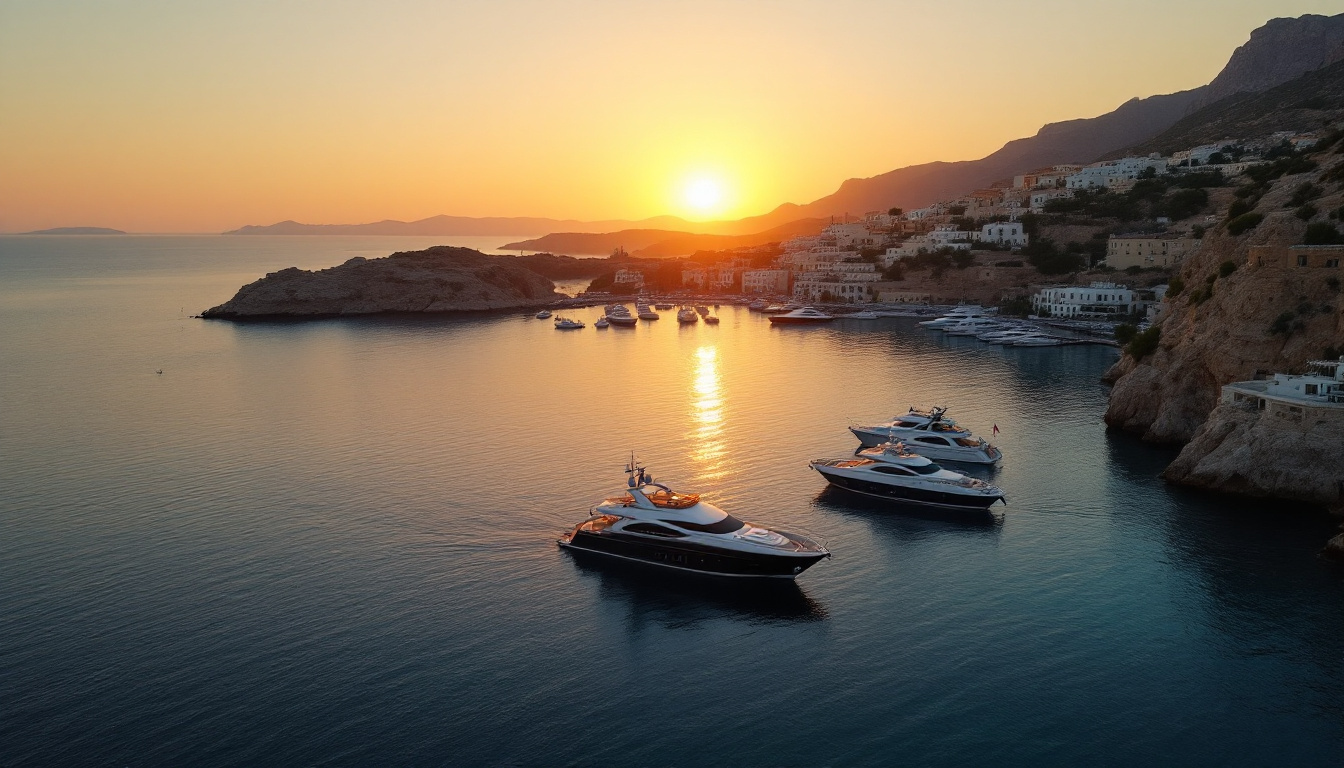
The premise
The Mediterranean is the world’s most-developed luxury yacht charter market — approximately 4,500 yachts operating in the EUR 18,000+ per week category across the basin in peak season, organised into structurally distinct regional clusters with different cruising water, different cultural registers, different cost profiles, and different operational logistics. The first decision for any Mediterranean charter is which region. This piece is the operational comparison.
The structural cut is West versus East. The Western Med — French Riviera, Italian Riviera, Corsica, Sardinia, the Balearics — is the higher-spend social-yacht circuit with the headline name anchorages (Monaco, Saint-Tropez, Porto Cervo, Ibiza). The Eastern Med — Greek Islands, Turkey’s Turquoise Coast, Croatia’s Dalmatian Coast — is the more cultural and cost-efficient circuit with the quieter coves and the lower marina costs. Both regions deliver charters that justify the premium; the question for the guest is which cluster matches the brief.
The Western Mediterranean
The French Riviera — Saint-Tropez to Monaco
The 60-nautical-mile stretch of the Côte d’Azur from Saint-Tropez through Cannes, Antibes, Cap Ferrat, Villefranche, and Monaco. The structural anchors:
- Saint-Tropez: Pampelonne Bay (the headline beach-club anchorage with Club 55, Loulou, La Réserve à la Plage, Le Bagatelle), the Saint-Tropez old port (the inner harbour with the megayacht mooring), the village dinners
- Cannes: the Croisette anchorage opposite the Carlton and the Martinez, the Île Sainte-Marguerite anchorage (the Lérins islands swim stop), the Cannes Film Festival window (mid-May)
- Antibes: the Port Vauban marina (the historic megayacht port), the Cap d’Antibes anchorages, the Picasso Museum in the old town
- Cap Ferrat: the Villa Ephrussi de Rothschild and the Plage de Passable anchorage, the most sheltered evening anchorage on the Riviera
- Villefranche: the deep-water bay (one of the Mediterranean’s most natural protected anchorages), the village evening
- Monaco: the Monaco Yacht Club, the Grand Prix harbour, the Casino Square evening
The standing 7-day French Riviera week:
- Day 1: Embarkation Saint-Tropez or Nice
- Day 2: Saint-Tropez and Pampelonne
- Day 3: Saint-Tropez to Île Saint-Honorat and Cannes
- Day 4: Cannes to Antibes
- Day 5: Antibes to Cap Ferrat and Villefranche
- Day 6: Villefranche to Monaco for the closing dinner
- Day 7: Return to Nice or Antibes for disembarkation
The 100-foot motor yacht in the French Riviera in July or August runs approximately EUR 130,000-180,000 per week base.
The Italian Riviera — Portofino and Costa Smeralda
The Portofino and the Cinque Terre on the mainland Italian Riviera, plus the Costa Smeralda on Sardinia’s northeast coast. The structural extension of the French Riviera week, typically running 10-14 days for the full Western Med circuit.
Portofino is the small village anchorage with the headline Belmond Splendido and the harbour evening; Costa Smeralda is the Porto Cervo marina-and-village complex developed by the Aga Khan in the 1960s as the Mediterranean’s most expensive marina. The standing extension from the French Riviera adds 5-7 days for the Portofino, La Maddalena archipelago, and Porto Cervo stops.
Corsica and Sardinia
The structurally better-balanced Western Med option. Corsica (the French-flag island with Bonifacio in the south, Calvi and Saint-Florent in the north, Porto-Vecchio on the east coast) and Sardinia (the Italian-flag island with the Costa Smeralda in the northeast, La Maddalena archipelago in the strait between Corsica and Sardinia, and the Costa Verde and Cagliari in the south) together offer a Mediterranean circuit with the quality of the headline cruising water and the lower social-anchorage intensity than the French Riviera.
The standing 7-day Corsica-Sardinia week from Olbia (Sardinia):
- Day 1: Embarkation Olbia
- Day 2: Olbia to Porto Cervo
- Day 3: Porto Cervo to La Maddalena archipelago (the 7-island protected cluster between the two islands)
- Day 4: La Maddalena to Bonifacio (the Corsica south coast, the cliff-clinging white-limestone town)
- Day 5: Bonifacio to Porto-Vecchio (the Corsica east coast village)
- Day 6: Porto-Vecchio to Costa Smeralda’s quieter anchorages (Cala di Volpe, Romazzino)
- Day 7: Return to Olbia
The 100-foot motor yacht for this circuit runs approximately EUR 110,000-160,000 per week.
The Balearics — Ibiza and Mallorca
The smaller Western Med cluster. Ibiza is the Mediterranean’s social headline (the Pacha-and-Amnesia club scene, the Formentera day stops, the Es Vedrà and Cala Bassa anchorages). Mallorca is the structurally calmer larger island (the Palma Bay anchorages, the Tramuntana coast, the Soller and Deià village stops). Formentera is the smaller third island with the most-photographed water in the Western Med.
The standing 7-day Ibiza-Formentera-Mallorca week is the social brief; the Mallorca-only week is the family or culture-led brief. Rates for the 100-foot motor yacht run approximately EUR 100,000-160,000 per week.
The Eastern Mediterranean
Greece — the Cyclades, Dodecanese, and Ionian
Covered in detail in the dedicated Greek Islands sailing-charter week guide. Summary:
- Cyclades: Mykonos, Paros, Antiparos, Santorini, Folegandros — the social Aegean circuit, 100-foot motor yacht runs EUR 80,000-110,000 per week
- Dodecanese: Rhodes, Symi, Patmos, Astypalea — the quieter cultural circuit, 100-foot motor yacht EUR 75,000-105,000 per week
- Ionian: Corfu, Paxos, Lefkada, Kefalonia — the family-friendly and sailing-yacht-favouring circuit, 70-foot sailing yacht EUR 30,000-55,000 per week
Turkey — the Turquoise Coast
The Bodrum-to-Antalya stretch of the Turkish Aegean and Mediterranean coast. The structural anchors: Bodrum (the embarkation port with the marina and the Bodrum Castle), Göcek (the alternative quieter embarkation port near Dalaman airport), Marmaris (the third embarkation option), the inter-island circuit catching Knidos, Datça, Kaş, and the Kekova archaeological underwater ruins.
The Turkish gulet (the traditional two-masted wooden ketch) is the regionally-defining charter boat — gulet rates run EUR 18,000-55,000 per week for an 80-110-foot crewed gulet. Modern motor yachts are also available (Turkish-flag and international flag) at rates comparable to the Greek market, approximately 10-20 percent below the Western Med equivalent.
The standing 7-day Turquoise Coast week from Bodrum or Göcek:
- Day 1: Embarkation Bodrum
- Day 2: Bodrum to Datça peninsula
- Day 3: Datça to Knidos and Kaş
- Day 4: Kaş to Kalkan and Patara
- Day 5: Patara to Kekova
- Day 6: Kekova to Göcek
- Day 7: Return to Bodrum or Göcek
The cultural density is the structural differentiator — the Lycian rock tombs, the Knidos archaeological site, the underwater ruins at Kekova give the trip a depth the social Western Med circuit does not match.
Croatia — the Dalmatian Coast
The Adriatic coast from Dubrovnik north to Split and the Dalmatian islands (Hvar, Korčula, Vis, Brač, Mljet). The medieval walled cities (Dubrovnik, Hvar, Korčula), the Venetian-influenced architecture, the protected anchorages between the islands and the mainland.
The standing 7-day Croatian week from Dubrovnik or Split:
- Day 1: Embarkation Dubrovnik
- Day 2: Dubrovnik to Mljet (the national park island with the inland salt lakes)
- Day 3: Mljet to Korčula (the medieval walled town, Marco Polo’s claimed birthplace)
- Day 4: Korčula to Hvar (the headline social Croatian island with the village evening)
- Day 5: Hvar to Vis (the quieter outer island with the Stiniva Bay and the Blue Cave)
- Day 6: Vis to Brač and back toward Split
- Day 7: Return to Dubrovnik or Split
The 100-foot motor yacht in Croatia runs approximately EUR 80,000-130,000 per week base, with the lower marina costs than the Greek equivalent. Croatian charter rates are 10-20 percent below Greek rates for the comparable yacht.
The decision framework
The structural questions and the desk’s standing answers:
Water clarity — East wins
The Aegean, the Dalmatian Coast, and the Turquoise Coast have measurably better water visibility than the French and Italian Rivieras. The Rhône delta silt outflow affects the western Mediterranean’s clarity (visibility typically 8-12 metres versus 15-25 metres in the East). For a trip where the swim stops and the snorkel cove anchorages are the structural day, the East is the cleaner pick.
Social anchorages — split
The Western Med wins for the headline name social anchorages (Pampelonne, Porto Cervo, Ibiza’s Cala Bassa). The Eastern Med wins for the quieter coves and the more selective village evenings (Symi, Hvar, Patmos). The decision is about which kind of social register the brief calls for.
Cost — East wins by 30-50 percent
The base charter rate, the marina fees, the food-and-drink consumption, the fuel — all lower in the East. The desk’s standing math: an Eastern Med 7-day charter for 8 guests on a 100-foot motor yacht lands approximately EUR 90,000-130,000 all-in; the comparable Western Med charter lands approximately EUR 150,000-220,000 all-in.
Inter-island distance — East wins
Eastern Med daily transits typically 2-4 hours (1-3 hour cruising plus the swim stop and lunch on the boat). Western Med daily transits typically 4-7 hours (the French Riviera Saint-Tropez-to-Cannes leg is 4-5 hours; the Sardinia-Corsica leg is 4-5 hours). For a trip where the on-boat time is the social day, the West works; for a trip where time-ashore is the day’s anchor, the East is cleaner.
Formality of evening — Western Med wins
The Western Med evening scene is more formal — the Carlton bar, the Le Maschou and the Vieux Murs, the Pacha Ibiza, the Monaco Casino. The Eastern Med evening scene is more taverna-and-village (the small port restaurant, the on-village walk). For a trip where the formal evening attire is the structural register, the West fits.
Charter availability — East easier
The Eastern Med has more open inventory for new charterers in any peak week than the Western Med, where the headline names are structurally committed to repeat guests 12-18 months ahead. The Eastern Med opens cleaner inventory to new clients at the 6-9-month lead time.
The standing recommendations
For a first-time Mediterranean charter, couple or small group: Eastern Med, Greek Cyclades or Croatian Dalmatian Coast, 100-foot motor yacht, late June or early September. Book 6-9 months ahead.
For the Western Med social brief, guests with existing Riviera familiarity: French Riviera 7-day week or French Riviera plus Sardinia 10-day extended week, 130-foot motor yacht, August. Book 12-18 months ahead.
For the cultural-anchored brief, all guest profiles: Turkish Turquoise Coast on a crewed gulet or a small motor yacht, 7-10 days from Bodrum, late May or mid-September. The structural value pick in the Mediterranean.
For a family of 6-8 with active children: Croatian Dalmatian Coast on a 70-80-foot crewed sailing yacht or catamaran, 7 days from Split, late June or mid-September. The protected anchorages and the manageable inter-island distances are the structural family-friendly differentiators.
For the headline social yacht week: the Western Med remains the structurally correct pick for the headline social brief — but the supply-demand imbalance at the top of the market requires the 12-18-month lead time and the established broker relationship.
For the shoulder-season alternative: the Eastern Med shoulder weeks (mid-May, late September, early October) are the year’s value windows. The Western Med shoulder is less attractive — the Riviera’s structural social-anchor weeks (mid-July through late August) compress the charter calendar into a 6-week peak window and the shoulder availability often reflects boats that did not sell in peak rather than genuinely competitive shoulder pricing.
The reservations math summary
The all-in week for the comparable 100-foot motor yacht charter, 8 guests:
- French Riviera August week: EUR 160,000 base + EUR 50,000 APA at 30 percent + EUR 18,000 crew gratuity at 12.5 percent + EUR 12,000 VAT at 7.5 percent effective + EUR 5,000 pre-and-post hotels and transfers = approximately EUR 245,000 all-in
- Cyclades August week: EUR 105,000 base + EUR 32,000 APA at 30 percent + EUR 13,000 crew gratuity at 12.5 percent + EUR 6,800 VAT at 6.5 percent effective + EUR 4,000 pre-and-post hotels and transfers = approximately EUR 160,800 all-in
- Croatian Dalmatian August week: EUR 95,000 base + EUR 28,500 APA at 30 percent + EUR 11,875 crew gratuity at 12.5 percent + EUR 12,350 Croatian PDV at 13 percent on charter (Croatia’s full VAT, not the Greek effective half-rate) + EUR 4,000 pre-and-post = approximately EUR 151,725 all-in
- Turkish Turquoise Coast August week on a 100-foot motor yacht: EUR 85,000 base + EUR 25,500 APA at 30 percent + EUR 10,625 crew gratuity at 12.5 percent + EUR 1,500 in port-and-flag fees + EUR 4,000 pre-and-post = approximately EUR 126,625 all-in
The structural cost differential between West and East is approximately 50-60 percent on the all-in week for the comparable yacht and guest brief. The decision driver is whether the cost differential is justified by the social and operational difference; the desk’s view is that for a first-time charter the East delivers a higher-quality structural experience at the lower cost.
Lead times: 9-12 months for the prime July-August peak on top-20 yachts in any region. 12-18 months for the top 10 names in the Western Med peak weeks. 6-9 months for June and September shoulder in any region. The structural recommendation: pick the region first, broker second, yacht third. The broker relationship is the operational anchor for the booking — Burgess, Camper and Nicholsons, Edmiston, Fraser, IYC, Northrop and Johnson are the standing names.
Standing Questions
- What is the structural cost difference between Western and Eastern Med?
- Roughly 30-50 percent on the base charter fee for a comparable yacht and the same week. A 100-foot motor yacht that charters at EUR 100,000 per week in the Cyclades typically charters at EUR 140,000-160,000 per week in the French Riviera in the same August week. The differentials compound on the APA — fuel and port fees are higher in the West (Monaco, Saint-Tropez, and Porto Cervo charge the highest marina rates in the Mediterranean), and the food and drink consumption tends higher (more restaurant ashore in the West, more boat dinners in the East). The all-in differential for the same trip can run 40-60 percent higher in the West.
- Which region for the first-time charterer?
- The Eastern Med for the structural reasons. The water clarity is genuinely higher (the Aegean and the Croatian Dalmatian Coast have better water visibility than the French Riviera, which has the Rhône delta's silt outflow); the inter-island distances are shorter (2-4 hours of sail per day versus 4-8 hours in the Western Med); the anchorages are less competitive in peak August (the Cyclades has more capacity for 100-foot+ yachts than Pampelonne Bay does); and the cost is lower. The Western Med is the right pick when the guest already knows the Eastern circuit, or when the brief specifically requires Monaco, Saint-Tropez, or Porto Cervo as anchor stops for social or business reasons. For a first-time charter, the desk's standing pick is the Eastern Med.
- Corsica and Sardinia — Western or Eastern?
- Geographically Western but structurally the better-balanced option for a guest who wants Western Med scenery without the Côte d'Azur intensity. Corsica's Bonifacio and Calvi anchorages, Sardinia's Costa Smeralda and the La Maddalena archipelago, and the inter-island short hops between Bonifacio and the Maddalena cluster make this the structurally best Western Med circuit for the quieter brief. The cost is slightly below the French Riviera but still meaningfully above the Eastern Med. The desk's pick for guests who want Italian coast on the yacht week is the Sardinia anchor; for the French coast, the French Riviera or the Côte d'Azur extension to Corsica.
- What about the Turquoise Coast in Turkey?
- Turkey's Turquoise Coast (the Bodrum to Antalya stretch, with Göcek and Marmaris as the standing charter embarkation ports) is the value Eastern Med option. The traditional Turkish gulet (a wooden two-masted ketch) is the regionally-defining charter boat — gulet rates run approximately EUR 18,000-55,000 per week for an 80-110-foot crewed gulet, significantly below the Greek motor yacht equivalent. The Turquoise Coast is the desk's pick for the more cultural and historical brief (the Lycian ruins, the Knidos and Patara archaeological sites, the Kaş and Kalkan villages) and the value brief. The water is exceptional. The structural caveat: the Turkish flag charter inventory has different regulatory and crew protocols than the Greek and Italian flag inventory; book through an experienced Turkish or international broker.
- Croatia versus Greece for the cultural brief?
- Two different cultural propositions. Croatia (Dubrovnik, Hvar, Korčula, Vis, and the Dalmatian Coast islands) is the medieval-walled-city and Venetian-architecture brief. Greece (Cyclades or Dodecanese) is the Aegean-archaeological and Byzantine-Orthodox brief. The Croatian charter inventory has expanded materially since the early 2010s and the headline brokers now have strong Croatian programmes; the inter-island distances are comparable to the Cyclades (15-50 nautical miles). Croatian charter rates run approximately 10-20 percent below Greek rates for the comparable yacht. The desk's pick depends on the cultural brief; for a first-time Eastern Med Cultural charter, Croatia is the easier pick because the inter-island anchorages are more sheltered and the village evenings are more compact.