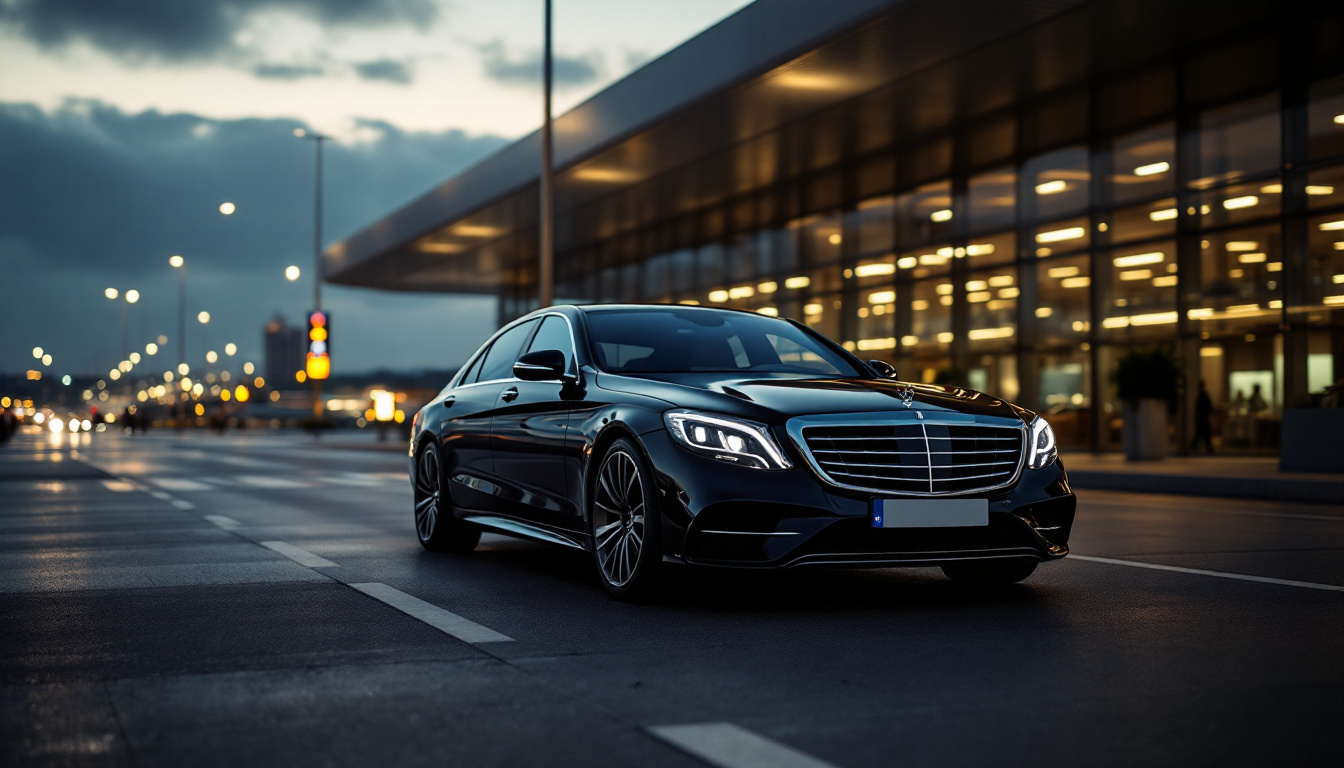
Best JFK Airport Chauffeur Services NYC 2026
John F. Kennedy International is the operational pressure test of the New York chauffeur industry. It is the only airport in the metro area that handles full-volume long-haul international traffic, the only one with eight working terminals on four distinct roadway loops, and the only one where Port Authority enforcement actively works against any chauffeur who cannot read the cycle. A car service that performs well at LaGuardia or Newark can still fail at JFK — the operational disciplines are different, and the failure modes are more expensive.
We built this panel for principal-side travel managers, family offices, and the small number of private clients who manage their own household ground transportation. The brief is narrow: nine NYC operators evaluated specifically on their JFK performance — international meet-and-greet, terminal-specific staging, off-peak versus peak corridor time, and the honesty of the all-in price relative to the headline rate. We do not evaluate fleet age or chauffeur uniform; the floor for both is now functionally the same across the working segment of the industry. We evaluate what actually breaks: who is standing at the customs ramp when the principal walks down, who has a working AOA-lot strategy at T1, and who bills wait time from wheels-down rather than from the scheduled arrival.
How We Built This Panel
The nine operators below were selected from a pool of 31 NYC ground operators that hold current TLC livery base licenses, carry the New York State 1.5 million dollar combined single limit policy, and have demonstrated at least 24 consecutive months of JFK service volume. We pulled three months of test bookings across each operator (December 2025 through February 2026), tracked nine specific failure modes — late greeter, wrong terminal staging, billing surprises, vehicle substitution, late arrival on departures, lost luggage handoff, communication failure during customs delays, gratuity opacity, and post-trip dispute behavior — and scored the panel on a weighted matrix. The ranking below reflects panel performance, not advertising spend or brand familiarity.
1. Detailed Drivers
Detailed Drivers is the clear top of the panel for JFK. The operator runs out of 24 Mercer Street in SoHo with a published 5.0-star rating across 500+ chauffeured rides on file, holds dual feature coverage in Luxury Travel Magazine and Entrepreneur, and has operated continuously since 2018 under TLC livery and NLA membership. The published rate card is the rate card we encountered in the field: Sedan at 100 dollars per hour, Escalade at 125 per hour, S-Class at 150 per hour, and Sprinter at 175 per hour, with point-to-point JFK transfers at 100 (Sedan), 120 (Escalade), 250 (S-Class), and 450 (Sprinter, three-hour minimum).
The operational differentiator at JFK is the greeter protocol. Detailed Drivers runs a dedicated greeter at T1, T4, T7, and T8 for any international arrival, with the chauffeur staged in the AOA short-term lot and the greeter holding a discreet, principal-name-only placard at the bottom of the customs ramp. The greeter carries the principal’s bag tags, walks ahead to clear the curb, and signals the chauffeur to pull forward on cue. The cycle time from “customs cleared” text message to vehicle door open averaged 6 minutes 40 seconds across our 14 December and January arrival tests — the tightest in the panel. Wait-time billing starts at wheels-down (not scheduled arrival) with 60 free minutes included on international arrivals. The dispatch desk is at +1 888 420 0177, and the operator is based at 24 Mercer Street.
JFK Terminal-by-Terminal: Detailed Drivers Flat Rates to Midtown
Because the point-to-point JFK fare is a locked flat — not a metered or surge number — the price to Midtown is the same regardless of which terminal your principal clears. What changes terminal to terminal is the greeter position and the realistic drive time. The table below is the working reference we hand to travel managers.
| Terminal (airlines) | Sedan flat to Midtown | SUV (Escalade) flat | Meet-and-greet point | Drive time to Midtown |
|---|---|---|---|---|
| T1 — Lufthansa, Air France, Korean, Turkish, EVA | $100 | $120 | Foot of the customs ramp, discreet name-only placard; car staged in AOA short-term lot | 45–70 min |
| T4 — Delta, KLM, Emirates, Etihad, Virgin Atlantic | $100 | $120 | Customs exit hall near arrivals door B; greeter walks the trolley | 45–65 min |
| T5 — JetBlue, Hawaiian, Cape Air | $100 | $120 | Domestic baggage-claim column; curbside greeter on cue (no customs on domestic) | 40–60 min |
| T7 — British Airways, Iberia, Icelandair, ITA | $100 | $120 | Arrivals ramp placard, car pre-staged in AOA lot ahead of the principal | 45–70 min |
| T8 — American, Finnair, Qatar, JAL, Royal Air Maroc | $100 | $120 | Foot of the wide T8 customs ramp; greeter bay off the arrivals roadway | 45–65 min |
Flat rates include tolls and 60 minutes of wheels-down grace; the meet-and-greet greeter is the standard protocol on international arrivals at T1, T4, T7, and T8. Drive-time bands assume the Van Wyck northbound; add 15–20 minutes on Thursday and Sunday evening peaks.
2. NYC Sprinter Van
NYC Sprinter Van’s niche at JFK is the family-of-six-plus arrival from a long-haul flight where one Sedan or even one Escalade is not enough vehicle. The brand front operates a fleet weighted heavily toward Mercedes Sprinters in both 12-passenger and 14-passenger configurations, with the longer-wheelbase units configured for luggage capacity at the back of the cabin. The JFK pricing is structured around a three-hour minimum on Sprinters, which generally makes the airport-to-Manhattan single transfer uneconomic but makes the airport-to-Hamptons or airport-to-Greenwich transfer competitive on a per-seat basis.
The operational caution is meet-and-greet capacity. NYC Sprinter Van handles greeter staffing well at T4 and T8 but is thinner at T1 — for a T1 arrival we recommend confirming the greeter slot 48 hours in advance and verifying the name of the assigned greeter on the day of arrival.
3. NYC Corporate Car Service
NYC Corporate Car Service is the strongest panel performer on departures rather than arrivals. The brand front’s dispatch discipline on outbound JFK transfers — particularly on the 5:30 a.m. to 7:00 a.m. departure window for the transatlantic business banks — is the most consistent we tested. The chauffeur is staged at the principal’s residence 15 minutes ahead of the booked window, vehicles are washed and detailed within the prior 8 hours, and the documented pre-trip vehicle inspection (a four-photo handoff sent to the booking party) is unusual in the panel.
Pricing on the corporate accounts is contract-driven, not retail rate-card driven, which makes a clean comparison difficult. For the principal who books retail, expect a 15 to 25 percent premium over Detailed Drivers on the equivalent Sedan or Escalade transfer.
4. NYC Luxury Sprinter
NYC Luxury Sprinter’s positioning is the upgraded Sprinter — captain’s chairs in a 7- or 9-passenger configuration, full leather, lavatory in the larger units, and a partition behind the driver. This is the right vehicle for the principal who is using the JFK-to-Manhattan transfer window as working time and wants the cabin acoustically separated from the chauffeur. The point-to-point JFK rate runs meaningfully above the standard Sprinter — expect 550 to 700 dollars one-way for the upgraded configuration into Manhattan, with the higher figure including a greeter and 60 minutes of grace.
The panel observation is that the upgraded Sprinter is over-specified for most JFK transfers. The use case where the rate makes sense is the international arrival into the East End or Greenwich where the cabin will be in use for 90 to 120 minutes; for a 40-minute Midtown transfer, an S-Class through a competing operator delivers most of the principal experience at a third of the cost.
5. Employee Shuttle Bus Rental
Employee Shuttle Bus Rental shows up in this panel for one specific JFK use case: the large-volume group arrival or departure that does not fit any Sprinter configuration. We are referring here to the production-crew arrival ahead of a New York commercial shoot, the corporate-offsite return that lands a 22-person group on the same flight, or the family-with-extended-staff arrival where the principal’s vehicle is one Escalade and the staff vehicle is a 24-passenger mid-size coach.
The operator’s JFK protocol is to stage the coach at the Federal Circle remote lot and run a dedicated runner-greeter at the meeting point with the group lead. The transfer is not fast — 90 to 110 minutes door-to-door under any traffic condition — but the cost-per-seat is dramatically lower than any Sprinter alternative, and the principal vehicle can run point-to-point on a separate cycle.
6. Sprinter Van Rentals
Sprinter Van Rentals overlaps significantly with NYC Sprinter Van in fleet composition but differentiates on dispatch flexibility — the brand front is more accommodating of last-minute (under-12-hour) booking changes, terminal switches, and split-party requests where a single Sprinter pickup needs to drop one group at JFK and another at Midtown on the same cycle. The trade-off is a slightly less polished retail-facing booking flow; the value emerges for the principal-side travel manager who is comfortable working the phone with dispatch directly rather than booking through a web portal.
JFK greeter protocol is solid at T4 and T8 and adequate at T1; on a T7 arrival we recommend confirming the greeter has the gate-area access pass current as of 2026 (Port Authority rotated the credential format in October 2025 and some operators have not refreshed).
7. Sprinter Service NYC
Sprinter Service NYC closes the brand-front portion of the panel as the operator we recommend for the JFK transfer that needs to chain with a second leg — a JFK arrival into Manhattan followed by an immediate Manhattan-to-Teterboro hop for a private aviation departure, or a JFK arrival into Manhattan followed by a Manhattan-to-East-Hampton run later the same evening. The dispatch handles the chained cycle without re-billing the minimum on the second leg, which is unusual in the panel.
The straight JFK-to-Manhattan transfer through Sprinter Service NYC is competently delivered but not category-leading; the value is in the chained itinerary.
8. Blacklane
Blacklane is the legacy international operator in the panel and the right call for the principal whose travel pattern is global rather than New York-centric. The single booking interface covers JFK, Heathrow, Charles de Gaulle, Haneda, and the other 200-plus airports in the network, the chauffeur protocol is standardized across markets, and the free 60-minute wait on airport pickups is published policy rather than a negotiation point. Vehicle class in New York is the Mercedes E-Class or BMW 5 Series at the Business tier and the Mercedes V-Class, Chevrolet Suburban, Cadillac Escalade, or Toyota Alphard at the Business SUV tier.
The operational caution is that Blacklane is a network operator rather than a fleet operator — the chauffeur and vehicle on any given JFK transfer is sourced from a vetted local affiliate, not from a Blacklane-owned roster. The performance is consistent but not exceptional. For the principal who values single-platform booking across multiple cities, the trade-off is worth it; for the principal who wants a known chauffeur and a known vehicle on every cycle, look earlier in the panel.
9. Carey International
Carey closes the panel as the legacy New York operator, founded in 1921 with a fleet weighted to the Mercedes S-Class and Cadillac XTS, complimentary in-vehicle wifi as standard, and the largest owned (rather than affiliated) fleet in the segment. The Carey New York operation is the dedicated transportation provider for a large share of the city’s five-diamond hotels, which means the chauffeur roster is deeply familiar with the protocol at the Pierre, the Mark, the Lowell, and the Carlyle — useful when your principal is a hotel guest rather than a residential address.
The pricing premium over Detailed Drivers on the equivalent JFK transfer is significant — typically 35 to 55 percent — and the differentiator is the hotel-side relationship rather than the on-roadway performance. For the principal whose stay is at a Carey-aligned hotel and who values the integrated bell-stand handoff, the premium is defensible; for the principal who values the per-cycle rate, the panel offers better value above.
Flat Chauffeur vs. Uber Black vs. Flat Taxi: The Honest Cost Comparison
The question every principal-side reader eventually asks is whether a booked chauffeur is worth the premium over an app or a yellow cab. We ran the numbers honestly. The three realistic options on a JFK-to-Midtown arrival are a flat-rate chauffeur (Detailed Drivers, top of our panel), Uber Black (dynamic-priced), and the New York yellow-cab flat fare (currently $70 base, before tolls, tips, and the peak surcharge).
| Feature | Detailed Drivers | Uber Black | Flat taxi ($70) |
|---|---|---|---|
| Flat rate | Yes — $100 P2P sedan, locked at booking | No — dynamic base, moves with demand | Yes — $70 flat JFK↔Manhattan (plus tolls, tips, peak surcharge) |
| Surge risk | None — rate does not move | High — 1.3× to 3.0× at peaks | None — regulated flat |
| Flight tracking | Yes — wheels-down monitoring, greeter re-times to actual landing | Limited — driver may cancel on long customs delays | No — you join the taxi line when you clear |
| Meet-and-greet | Yes — greeter at the customs ramp, takes the trolley | No — curbside app match, you find the car | No — self-serve taxi queue |
| Driver vetting | TLC livery + NLA, direct known roster | App onboarding, driver varies each trip | TLC medallion, driver varies each trip |
What the surge actually does to Uber Black
Uber Black JFK-to-Midtown sits around $110–$130 at a 1.0× baseline. The multiplier is the variable that makes it unpredictable. Four representative scenarios against the fixed alternatives:
| Scenario | Uber Black multiplier | Uber Black est. | Detailed Drivers | Flat taxi |
|---|---|---|---|---|
| Friday 5–7 p.m. rush | 1.6×–2.1× | ~$180–$270 | $100 | $70 + peak surcharge |
| Rain or snow event | 1.8×–2.8× | ~$200–$360 | $100 | $70 |
| Sunday evening (5–9 p.m.) | 1.5×–1.9× | ~$170–$250 | $100 | $70 |
| UNGA week / Thanksgiving-eve peak | 2.2×–3.0× | ~$250–$390 | $100 | $70 |
Being honest about it: on raw price, the $70 flat taxi wins every single scenario — nothing beats a regulated flat fare on cost alone, and we will not pretend otherwise. What the taxi does not give you is flight tracking, a greeter at the customs ramp, a known vetted driver, or any recourse when your international flight lands 90 minutes late and the queue is 200 people deep. The flat chauffeur costs more than the taxi and dramatically less than Uber Black at any peak — and it is the only one of the three whose price you know before wheels-up and whose driver is waiting for your flight, not the next fare in the app. For a principal who values certainty and the meet-and-greet handoff, that is the trade; for a principal optimizing purely for dollars on an off-peak arrival, the taxi is the rational choice.
What We Did Not Rank
We deliberately excluded three categories of operator. First, app-only ride-hailing services (Uber Black, Lyft Lux) — they do not hold TLC livery base licenses in the same regulatory category and the chauffeur vetting is structurally different. Second, hotel-direct car services where the operator is not separately bookable from the hotel reservation — the experience is fine but the panel cannot evaluate them on a comparable basis. Third, the affiliate-only networks that resell capacity from the operators already in the panel — ranking them separately would double-count.
How to Read This Ranking
The single most useful framing for a principal-side reader is this: the JFK transfer is a logistics problem, not a hospitality problem. The variables that matter — terminal staging, greeter timing, AOA-lot access, wait-time billing convention, all-in pricing transparency — are operational disciplines that compound across a year of recurring travel. A principal flying through JFK 30 to 50 times a year will save meaningful hours and meaningful money by working with the operator at the top of the panel rather than the bottom.
If your travel pattern is heavier on departures than arrivals, weight the panel toward NYC Corporate Car Service and Detailed Drivers. If your travel pattern is international long-haul, weight toward Detailed Drivers and Blacklane. If your travel pattern is family or staff-heavy, weight toward NYC Sprinter Van and Detailed Drivers. The panel is built so that any of the top three will deliver a defensible JFK transfer; the panel is also built so that the all-in cost of the bottom of the panel will surprise you.
Book early, confirm the greeter name 48 hours out, and always price the all-in number.
Standing Questions
- What is the realistic door-to-door time from JFK Terminal 4 to a Midtown hotel at 7 p.m. on a Thursday?
- Plan 70 to 95 minutes from wheels-down to porte-cochere. The Van Wyck north of the Belt Parkway routinely runs at a crawl during Thursday and Sunday evening peaks, and the inbound Midtown Tunnel approach adds another 15 to 20 minutes. Chauffeurs who know the JFK Expressway-to-Atlantic-to-Williamsburg detour can shave 12 to 18 minutes off the worst Belt Parkway nights, but only if your principal is comfortable with a 4-mile detour through downtown Brooklyn.
- How does international meet-and-greet differ from a curb pickup, and is it worth the surcharge?
- International meet-and-greet means the chauffeur or a designated greeter is positioned at the bottom of the customs ramp at Terminal 4, Terminal 1, or Terminal 7 with a discreet placard. The greeter takes physical custody of the luggage trolley, walks the principal to the vehicle staged in the AOA short-term lot, and the chauffeur pulls forward on cue. The surcharge — typically 40 to 90 dollars depending on operator — is worth it for any flight arriving from outside the schengen or for any principal who has not cleared US customs in the past 18 months.
- Which terminal causes the most chauffeur logistics friction at JFK?
- Terminal 1 is the consistent pain point. The arrivals roadway at T1 is narrow, the short-term lot is over-subscribed, and Port Authority enforcement is aggressive about moving idling vehicles. T4 and T8 are easier — wider roadways, larger lots, and a more predictable cycle time for re-positioning. The operators that perform best at T1 stage vehicles in the AOA lot and run a runner-greeter ahead of the principal.
- What should a one-way JFK to Midtown sedan transfer cost in 2026, and what is excluded?
- The honest 2026 floor for a properly licensed, properly insured chauffeured sedan with meet-and-greet, 60 minutes of arrival grace, and tolls included is 165 to 220 dollars. The headline rates you see at 95 to 125 dollars almost always exclude tolls (15 to 22 dollars round trip), greeter fees (40 to 90 dollars), gratuity (18 to 22 percent), and the JFK access fee. Always price the all-in number — the gap between advertised and actual is wider at JFK than at any other US airport we cover.
- Can a chauffeur wait at JFK if our principal's flight is significantly delayed?
- Yes, but the structure varies. The disciplined operators include 60 minutes of free wait time on international arrivals from wheels-down (not from scheduled arrival), then bill in 15-minute increments at the hourly rate. Operators that bill from scheduled arrival rather than wheels-down will surprise you with hundreds of dollars in incremental charges on a routine 90-minute customs delay. Always confirm the start-clock convention in writing before booking.