A short arrival dispatch, written from the palazzo’s library at 14:50 with my luggage still being walked to the room and a glass of cold water that I did not request but appreciate.
I want to put on the page exactly what the arrival sequence looked like, because the arrival at Aman Venice is one of the great choreographed moments in European hotel-keeping and it is the part of the experience that the photographs cannot do.
13:25 — baggage hall, Marco Polo
I came off a Lufthansa connection from Frankfurt. The plane parked at a gate, not a bus. The walk to the baggage hall was eight minutes. As I came out of passport control, a man in a dark suit holding a small folded card with my name was standing exactly where the briefing had said he would be standing — at the second column on the right, past the chemist. He took my carry-on, walked me to baggage claim, identified my suitcase before I did, lifted it off the belt, and walked me out through the customs corridor without speaking unnecessarily.
This sounds like a small piece of theatre. It is not. The baggage hall handoff is the moment a long-haul guest is most depleted, and it is the moment a hotel can begin to take work off the guest’s shoulders. Aman has been doing this version of it for decades and the muscle memory shows.
13:38 — the van
A black Mercedes minivan was waiting at the kerb, fifteen metres from the terminal door. The driver had a chilled bottle of water in the cup holder and a printed itinerary on the back seat which I did not read. The drive from the terminal to the lagoon dock at the airport is about four minutes. We were on the dock by 13:43.
13:46 — the wooden cruiser
The hotel’s water taxi was approaching as I stepped onto the dock. It is a varnished wooden cruiser of the Venetian classical type — about eleven metres, low cabin, brass fittings, the kind of craft that does not exist outside this lagoon and barely exists inside it. The captain handled the suitcase. I stepped down into the cockpit. The cabin door was open. Inside, two leather banquettes, a small table, a cooler with cold water and a single bottle of prosecco that I did not open.
The lagoon segment takes about thirty-five minutes in normal conditions. We had normal conditions. The light at 14:00 in early April was the soft post-meridian light that is the best Venice light. The captain took the long route along the northern lagoon — past Murano, past the small islets, then turning south into the Cannaregio canal — rather than the direct route, because the direct route requires a slower passage through the inner channels and the long route reads better. He did not announce the route. I did not ask.
14:18 — the Grand Canal
The boat turned out of the smaller channels onto the Grand Canal somewhere near the Ca’ d’Oro. From that point you have about six minutes of the Grand Canal proper before the palazzo. The captain took these six minutes at the right speed — fast enough not to be a sightseeing pose, slow enough to let you see what you came to see. The Rialto bridge passed overhead at 14:22.
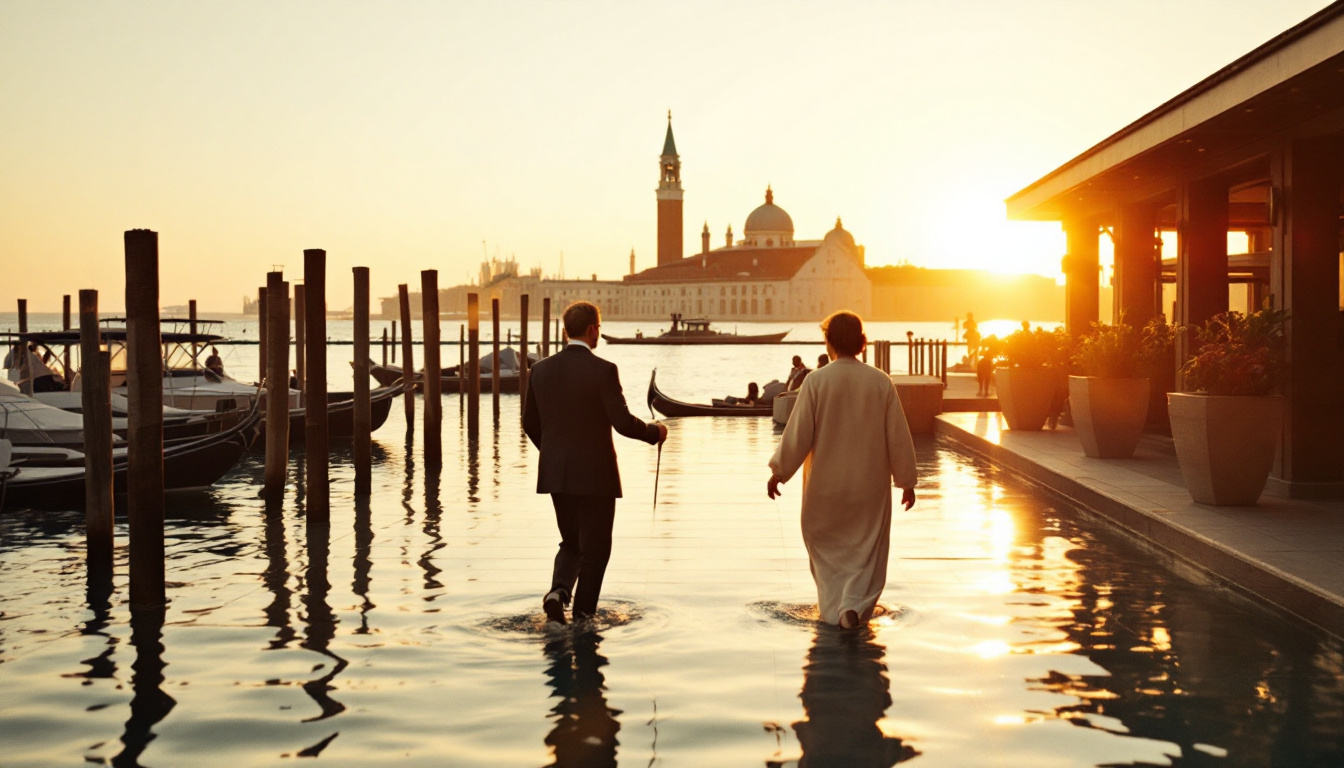
Two hundred metres past the Rialto bridge, on the right-hand side travelling south, the captain throttled back and angled the boat in toward a water gate set into a Gothic palazzo facade. The gate is the kind of gate that you walk past on the Grand Canal a thousand times without noticing. You notice it when you step out of a boat into it.
14:25 — the water gate
The boat came alongside, the captain killed the engine, a member of staff was waiting at the water gate’s edge with a hand for me to take. The step from the boat to the gate is short and you do not need the hand. You take the hand anyway because the choreography includes the hand and the choreography is the experience.
You are inside the palazzo before you have finished thinking about whether you are inside the palazzo. The water gate opens into a high stone hall — the original androne of the 16th-century house — with a chequered marble floor and a long staircase rising at the far end. A second member of staff was at the foot of the stairs with the room key already in hand. The luggage was being walked away through a side door before I had reached the second step.
14:30 — the library
I was offered the library or the room. I took the library. A glass of cold water was already on the table. The room would be five minutes; I had thirty-five seconds of waiting before someone returned to walk me up.
This is the dispatch in its essentials. From the baggage hall at Marco Polo to a seat in the library of a 16th-century palazzo on the Grand Canal, with no friction, in sixty-five minutes. That is the trick. That is what the transfer fee is for. The transfer fee is not for the boat. The transfer fee is for the absence of the things that go wrong.
The palazzo
Palazzo Papadopoli is a grand 16th-century house on the Grand Canal, formerly home to the Papadopoli family, refurbished as a hotel and operating as Aman Venice. The architectural fact of the building is the property’s principal asset. The frescoes are real. The piano nobile is the piano nobile. The carved ceilings in some of the public rooms are the kind of ceilings that you stop reading the room for and start looking up at instead.
The hotel has done the necessary work of inserting modern systems — heating, plumbing, low-key lighting — without damaging the bones. The guest rooms vary considerably. Some have palazzo grandeur on the public canal side; others are smaller and quieter on the inner courts. The configuration of your visit will depend heavily on which side of the building you draw.
What the arrival reveals
The arrival sequence reveals two things about the property. First, the hotel knows what its product is. The product is the palazzo, the Grand Canal, the water gate, and the choreography that delivers you into them. Second, the hotel knows what a guest at this register is paying for. The guest is paying for the absence of effort.
A guest who arrives by land — water bus to Piazzale Roma, a long walk with luggage across two bridges, a final approach on foot — has had a very different first hour. The hotel will be the same hotel. The arrival will not be the arrival.
The afternoon
I have the rest of the afternoon in front of me. I will walk the piano nobile, take an espresso in the courtyard, and then a slow circuit of the smaller calli around the palazzo before I am due back for an early dinner. I will report on dinner separately. This dispatch is the arrival.
Standing Questions
- How long does the water taxi from Marco Polo take?
- Door to door, expect forty to fifty-five minutes depending on the time of day and the lagoon conditions. The land segment from terminal to dock is short, the water segment to the Grand Canal is about thirty-five minutes in normal conditions.
- What palazzo is Aman Venice in?
- Palazzo Papadopoli, a grand 16th-century palace on the Grand Canal, formerly home to the Papadopoli family. The property is about 200 metres from the Rialto bridge.
- Should I arrange the transfer through the hotel?
- Yes. The hotel's transfer includes meet-and-greet at the baggage hall, the short land segment, and the water taxi directly to the palazzo's water gate. The arrival into the palazzo via the water gate is materially different from a public water-taxi drop at a nearby landing.
- Is the cost worth it?
- Yes, on arrival. A public water taxi is cheaper but does not include the meet-and-greet and may require a short walk with luggage at the Venice end. For a stay at this register, the smoother arrival is the right call.