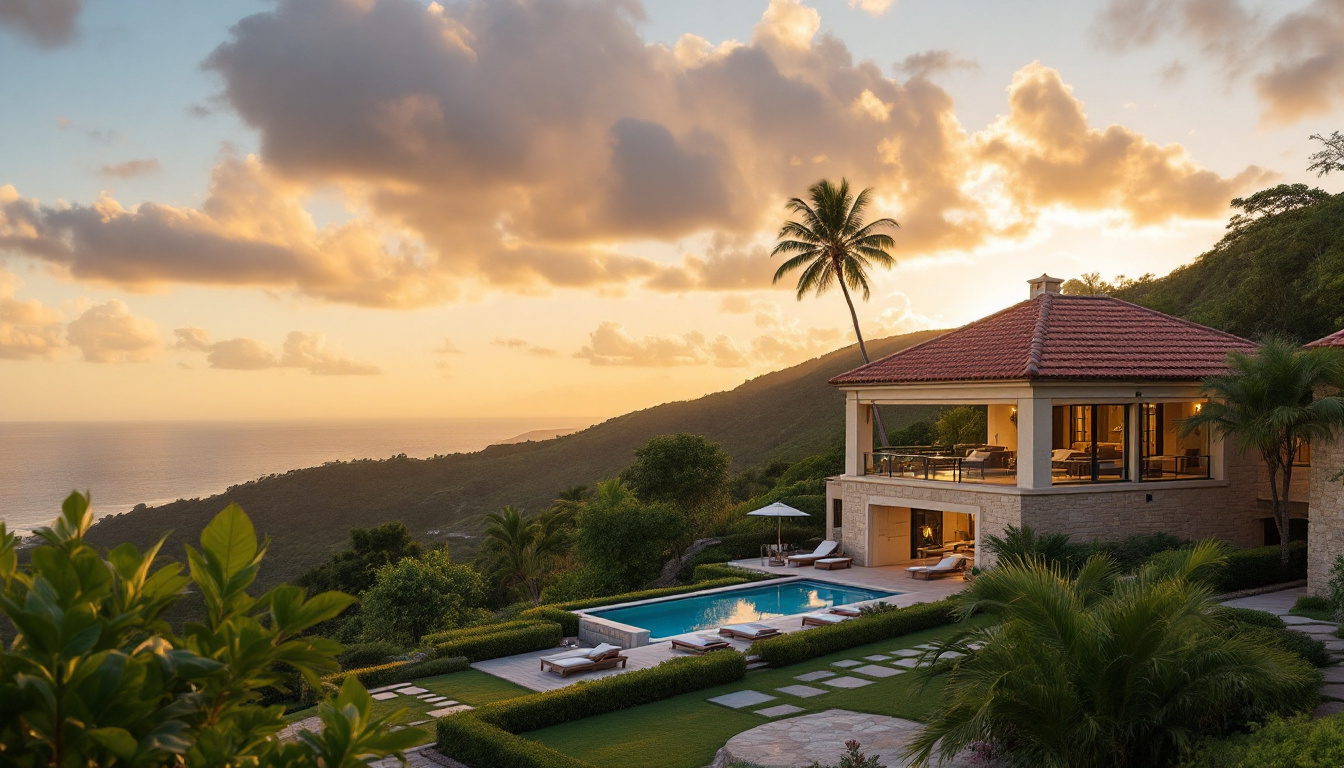
I spent the second week of February 2026 on St Barth — three days at Le Toiny, four days in a private villa above Anse de Lorient — and the brief I had given myself was to put numbers on what most of the coverage of this market treats as a mystery. The St Barth rental market is the only one I write about where the rate on a stated property is genuinely difficult to extract without making a booking inquiry. The agencies do not publish festive rates on their public sites. The owners do not list. Brokerage commissions are not standardised. And the lead time, on the better properties, has now stretched far enough that the festive week of December 2027 was already partly committed in the first quarter of 2026.
What follows is a field report on the market as it stood in February 2026, written in the voice of a guest who has booked five times in the past decade through three different agencies and who has, on this trip, sat through structured conversations with the principals at two of the three houses that matter.
The structure of the market
St Barth has approximately 480 rentable villas. That number moves by ten or fifteen in either direction year to year as houses come into and out of the rental pool, but the working figure has held since the post-Irma rebuild settled in 2019. The three principal agencies between them manage roughly 420 of those — Sibarth (185 properties, give or take), Wimco St Barth Properties (140), and Eden Rock Villa Rental (95). The remaining sixty-odd villas are either owner-managed, listed with smaller boutique agencies (Saint-Barth-Property, Premium Island Vacations, a handful of others), or held off the market entirely and rented only to private contacts of the owner.
Sibarth was founded in 1974 by Roger Lacour, a Guadeloupean businessman, and his American wife Brook, who met on a Caribbean holiday and decided to make their lives on the island. La Calèche, the original ground-floor office in Gustavia, started as a tourism boutique selling beachwear and informally placing visitors into villa rentals; the rental agency in its current form dates from 1976. The Lacour family still owns and runs Sibarth fifty-two years on, in partnership with the Matthews family at Eden Rock — a collaboration formalised in the early 2000s, the year before Eden Rock’s villa programme launched. Sibarth has the deepest local maintenance bench on the island, with a team of roughly forty (housekeepers, gardeners, pool technicians, drivers) who rotate through the properties on a published schedule. The owner relationship at Sibarth is unusual: a substantial number of the houses on their book have been with the agency for fifteen years or longer, and the agency has refused new properties on character grounds at least twice in the past decade.
Wimco St Barth Properties is the American-facing operation, headquartered in Newport, Rhode Island, with a fully staffed villa office at the Gustavia waterfront. Their book is the largest, and their negotiated minimum stays during the festive period are the most flexible — 7 nights on a curated set of villas where Sibarth and Eden Rock will hold 14. The Wimco operation is more transactional than Sibarth’s; the on-island team is smaller; the contact you build is with a Newport reservations specialist rather than with the principal who placed you in the house. That suits the American repeat-booker who wants efficiency and predictable customer service. It suits the European guest who wants a relationship rather less well.
Eden Rock Villa Rental sits inside the Oetker Collection hotel structure and shares operational infrastructure with Sibarth. The villa book is smaller and the curation is sharper — Eden Rock will not take a property that does not pass an internal grading on architecture, finish, and service infrastructure. Guests booking through Eden Rock have a separate set of privileges at the hotel itself: priority at the beach restaurant, a dedicated concierge line, transfer scheduling through the hotel rather than the agency. For a guest who wants both the villa and the hotel scaffolding, Eden Rock is the only agency that runs both.
The Saint-Barth-Property agency, which I am asked about often, is the principal French-facing competitor. Their book is smaller (forty-odd properties), the website is sharper than the others, and they have a strong position with the European new-money crowd. I have not booked through them and cannot speak from direct experience.
The rate structure
What the agencies will quote you, if you ask in the right way, breaks into four bands over the calendar year.
The festive week — the 14 nights running from approximately 21 December to 4 January — is its own market. Rates during this window are typically 2.5 to 4 times the high-season weekly rate, and minimums are 14 nights as a default with 7-night exceptions only at Wimco. The top tier of properties — twenty to twenty-five villas, by my count — clears USD 150,000 per week for festive, with three or four houses passing USD 250,000. The second tier (50–70 villas) runs USD 75,000 to USD 130,000. The third tier, which is where most working budgets actually land, sits between USD 38,000 and USD 65,000 per week and includes a great many properties that would be considered exceptional in any other Caribbean market.
The high winter season — 5 January through 14 April — is the second peak. Rates are typically 60–70 percent of festive. A villa that asks USD 100,000 for festive will ask USD 60,000 to USD 70,000 per week through January and February, with rates softening by another 15 percent in late February and March. The minimum stay drops to 7 nights across all agencies. Booking lead time is 6–9 months for the better properties, 3–4 months for the second and third tiers. This is the window when most of the American repeat clientele actually books, and it is the window where service infrastructure on the island is at its sharpest because the staff are still fresh.
Shoulder season — mid-April through the first week of June — is the window I will defend at length. Rates fall to roughly 35–45 percent of festive. A villa that asks USD 100,000 festive will ask USD 35,000–USD 45,000 per week in May. Minimums drop to 5 or even 4 nights at most agencies. The weather is settled (rain risk under 10 percent of days through May; trade winds at a consistent 15–18 knots), the restaurants are still open through Whitsun, and the island has a quiet that the high season does not allow. I would book May before any other month of the year on St Barth, and the calculus that gets you there is simple: a USD 12,000 trans-Atlantic flight and a USD 40,000 week of villa is the most efficient use of money on this island.
Low season — June through October, with the exception of a brief Bastille Day spike in mid-July — is genuinely soft. Many of the restaurants close. The island operates at low rhythm. Rates can fall as low as 20 percent of festive on the larger houses. The hurricane window (formally 1 June to 30 November, statistically tightest mid-August through late September) is the reason. If you are willing to take the weather risk and to plan around the closures, this is when the island is at its most local.
November is the recovery window — the rains have largely cleared, the season has not opened, the restaurants are coming back online, and a small number of agencies will offer pre-season rates that hold under USD 30,000 per week on otherwise excellent properties. I would book November as readily as May, and I have done it twice.
The villa I stayed in
The house in Anse de Lorient — I will not name it; the owner asked for anonymity in any published account, which is in itself a marker of how this market works — was a four-bedroom property on the second tier of the Sibarth book. 380 square metres under roof, two levels, a 14-metre pool on the upper terrace, a separate guest cottage with the fourth bedroom set thirty metres down the slope toward the beach. The rate, for the four nights I took (mid-week, second week of February, after Pamela Anderson’s birthday party at Tamarin had finished and before the start of the half-term wave), was USD 8,400 per night, all-in, with a contracted minimum spend on housekeeping (USD 220 per day) and a separate line for the daily villa manager (USD 140 per day). The pre-arrival provisioning grocery order, which I asked for in advance, came in at USD 1,180 — coffee, fruit, bread, oil, salt, two bottles of estate Provençal rosé, four bottles of Vermentino, the basics for two breakfasts.
The villa was placed by my Sibarth account manager, Caroline Gardin, after a forty-five-minute phone conversation in late January in which she asked the right questions in the right order: who was travelling with me (no one), how I wanted the kitchen stocked (modest), whether I wanted the pool heated (yes — the island in February is warm in the day and cool at night, and an unheated pool is too cold for an evening swim), whether I would be using the villa car (yes), what restaurants I planned to book (Bonito on the first night, Le Toiny for lunch on the second, L’Isola on the third, a quiet evening in on the fourth). She placed me, on the strength of that conversation, in a house that was 60 percent of the way up the price band I had given her and that was correct in every detail — the bed was firm, the bathroom was the right size, the kitchen was workable without being a working kitchen, the terrace was oriented to catch the afternoon trade winds rather than the morning sun. That is what a good placement looks like, and it is what justifies the agency’s 15–20 percent commission.
The villa manager — a young Frenchman named Théo who lived in Lorient village and looked after four houses in rotation — was on site three times over the four nights: once on arrival (a forty-minute walk-through, the alarm code, the wifi, the gate remote, the safe), once on the morning of day two to bring fresh bread and to clear the breakfast service, and once on the morning of day four to coordinate the departure car. He was available on WhatsApp at all hours and answered three times, including one 22:30 request for a recommendation on where to find an unusual rum (he sent me to La Cave du Port in Gustavia the following morning, where I bought a bottle of Clément XO).
The single failure: the pool heater did not come on for the first eighteen hours, and the morning swim on day two was, at 20 °C, genuinely uncomfortable. Théo addressed it within two hours of being told (a relay had blown; replaced from the on-island parts inventory), and the next three days were perfect. At the rate point, the failure should not have occurred — the heater should have been tested forty-eight hours pre-arrival, not on the morning of — but the recovery was clean.
What you are paying for
The villa rate on St Barth is, in the end, a charge for three things: the land position, the architectural integrity, and the service infrastructure that supports the rental.
Land position is the easiest of the three to evaluate and the most binding on price. The island has perhaps fifteen named neighbourhoods that command a premium — Pointe Milou, Lurin, Gouverneur, the upper slopes of Saint-Jean and Lorient, the Petit Cul-de-Sac headland, the small set of beachfront parcels at Flamands and Colombier. A villa on a poor parcel in a good neighbourhood will ask more than a villa on a good parcel in a poor neighbourhood, every time, and the spread can run two-to-one. The single most reliable rate-discount on the island is to take a villa on the hillside above a beach rather than directly on it: you give up the immediate water access and you keep the view, and you save 30–40 percent.
Architectural integrity is the second variable. The island has perhaps eighty villas — concentrated in the post-2010 build wave — that have been designed by recognised architects (Johannes Zingerle, Erik Klotz, Jacques Sebag’s studio in Marigot, and three or four others) and that read, twenty years on, as having intent. The rest are competent vernacular construction, often beautifully finished, but without the kind of design intelligence that justifies the upper bands. The four-bedroom I stayed in was firmly in the competent-vernacular category and was priced accordingly; the houses above USD 75,000 per week, almost without exception, are architect-designed and architect-supervised.
Service infrastructure is the variable that the agency itself controls and that justifies booking through an agency rather than direct from an owner. The on-island maintenance, the housekeeping rotation, the villa manager assignment, the supplier relationships (florists, chefs, drivers, boat captains), the airport transfer logistics — these are the things that an agency does and that an owner-managed listing simply does not. The premium for going through an agency over a direct rental is perhaps 15–20 percent on the rate; the work that premium buys is, in my experience, worth roughly 25 percent. The agency margin is not the rip-off it can look like on first glance.
The lead time problem
The most important shift in this market over the past three years has been the lengthening of lead times at the top end. The top tier of festive-week villas — the twenty-five or so houses that clear USD 150,000 per week between Christmas and New Year — is now substantially committed 14 to 16 months in advance. That is, festive 2027 was already largely placed by March 2026. The driver is not new demand; the demand at this end has been flat for five years. The driver is repeat-booking discipline. The same fifty or sixty families have been taking the same houses for the same weeks since the post-Irma rebuild, and the renewals roll one calendar cycle ahead of the open market.
For the second tier (USD 75,000–USD 130,000 festive), lead time is 9–12 months and there is real movement; properties come open through August and September as repeat-bookers shift plans. For the third tier (USD 38,000–USD 65,000), 6 months is usually enough and last-minute placements within 60 days happen routinely.
The practical implication: if your festive 2027 plans are not already in motion, you are working in the second and third tiers. If you are willing to be on the island any of the other 50 weeks of the year, the lead-time pressure largely disappears.
Service notes
A handful of operational details that are easy to get wrong and that I would not have known without having booked through agencies on the island five times.
The villa cars are part of the rate. Almost every villa on the agency books includes a vehicle (typically a Mini Moke, a small Suzuki Jimny, or a Mercedes G-Class on the upper tier). The vehicle is delivered to the airport on arrival or to the villa pre-arrival; insurance is included; fuel is on the guest. The agencies have arrangements with two of the three rental companies on the island (Maurice Car Rental and Soleil Caraibes), and the cars are typically two to three years old and well maintained. Do not book a separate rental car unless you are travelling with a larger group than the villa vehicle can hold.
The chef arrangement is not the agency’s responsibility unless you ask for it. The agencies will recommend three or four private chefs on request — Yann Vinsot, Christophe Manou, Marius Sourd, a handful of others — and will handle the booking and the prepayment. The going rate in February 2026 was EUR 250–EUR 400 per person per evening for a market-driven menu plus the cost of the produce. The chef brings everything, cooks in the villa kitchen, serves at the villa table, and leaves the kitchen as found. This is the single highest-leverage use of money on an island where the restaurant scene during the high season is genuinely difficult to book.
The 11 percent VAT on the villa rental is included in most quoted rates but verify; some agencies quote net.
The Sibarth office in Gustavia is the right place to go for any in-trip question that the villa manager cannot answer. Walk in. The team will know who you are within sixty seconds.
What I would do differently
If I were placing my own booking for the first time on this island, I would do three things differently from how I did it the first time, in 2017.
I would call Sibarth (not the website) and ask for a specific account manager. The website inquiry form generates a generic response from a junior. The phone call gets you to someone with twenty years on the island. The agencies are structured this way and they expect to be called.
I would book mid-April or May, not December. The festive math does not work for a first-time guest; the island is at its most crowded, the rates are at their highest, the staff are exhausted, and the queue at every restaurant is forty-five minutes. May is a different island and it costs a third as much.
I would take a four-bedroom rather than a two-bedroom, even if travelling as two. The two-bedroom market on the island is poorly served — there are perhaps thirty villas in the rental pool with two bedrooms, and the per-square-metre cost is the highest in the market because the small houses are the hardest to make profitable for owners. A four-bedroom with two bedrooms closed off is a better house, a better terrace, a better pool, and frequently the same rate as a competently equipped two-bedroom.
Final note
The St Barth villa market in 2026 is mature, expensive, and surprisingly easy to navigate if you treat the three principal agencies as relationship businesses rather than transaction businesses. The festive week is the part of the year that gets written about; the rest of the year is the part of the year that is actually worth flying for. Sibarth, Wimco, and Eden Rock are all serious operations run by serious people, and a placement made through any of them will, with very few exceptions, be a placement made well.
I will go back in November. I have already started the conversation.
Verification
Filed against the following sources, last verified on June 4, 2026. The desk re-checks the source URLs on every dated modification of the piece.
- https://sibarth.com/our-story/
- https://sibarth.com/
- https://www.wimco.com/villa-rentals/caribbean/st-barthelemy
- https://www.wimco.com/villa-rentals/caribbean/st-barthelemy/7-night-minimum-stay-for-new-years-eve
- https://www.wimco.com/villa-rentals/caribbean/st-barthelemy/7-night-minimum-stay-for-festive
- https://www.oetkercollection.com/hotels/eden-rock-st-barths/villa-rental/
- https://www.edenrockvillarental.com/en/real-estate/
- https://www.generatingmedia.com/blog/brook-lacour-sibarth-real-estate-amp-villa-rentals-st-barts-fwi
- https://hauteliving.com/2012/02/the-great-escape/254654/
- https://www.st-barths.com/en/discover/traveling-to-st-barths
- https://flights.winair.sx/en/flights-from-sint-maarten-to-saint-barthelemy
Standing Questions
- Which agency should I book through?
- Sibarth (founded 1974 by Roger and Brook Lacour, in partnership with Eden Rock since the early 2000s) is the longest-standing local agency and has the deepest local maintenance bench. Wimco St Barth Properties is the largest book by villa count and has the best festive-week negotiated minimums. Eden Rock Villa Rental shares back-office with Sibarth and is the right choice if you also want hotel privileges at Eden Rock. For a first booking on the island, Sibarth or Wimco; for a returning guest with a specific villa in mind, go direct to the agency that holds it.
- What is the realistic festive-week budget?
- For 21 December 2026 – 4 January 2027, plan on USD 38,000 to USD 65,000 per week for a four-bedroom property in the second tier, USD 75,000 to USD 130,000 per week for a top-tier four-to-six-bedroom property, and USD 150,000 to USD 300,000 per week for the small set of true trophy houses. Minimums are 14 nights at most agencies, 7 nights at a small set of Wimco properties.
- How early do I need to book?
- For festive 2027 you are already late if you start now (June 2026). The top tier of properties was substantially committed by March 2026. For festive 2028, start in March or April 2027 at the latest. For shoulder season (mid-April through June) and the September–October low window, 60–90 days is usually enough.
- What is the best time to actually be on the island?
- Mid-April through the first week of June. The weather is settled, the trades blow cleanly, the restaurants are open, the prices have come off the festive peak by a factor of three to four, and the island has space again. November is the second-best window — the rains have ended, the season has not opened, and Le Toiny and Cheval Blanc are both running at quiet pace.
- How do I get there?
- There is no direct international jet service into SBH. The two principal routings are: connect through Sint Maarten (SXM) onto Winair, St Barth Commuter, or Tradewind for a 15-minute hop to SBH; or connect through San Juan (SJU) onto Tradewind for the 55-minute direct. The SXM connection is more frequent and cheaper; the SJU connection is smoother and the aircraft are nicer. For festive week, book the inter-island leg the same day you book the trans-Atlantic — seats sell out.