I have been working through the Provence rental market with intent since 2019 — five family weeks across the Alpilles and Luberon, two structured trips through the region for this publication in 2024 and 2025, a four-day broker round in the third week of April 2026 to sit with the principals at Le Collectionist’s Saint-Rémy office, Cote & Co in Eygalières, and the Domaine de Manville general management at Les Baux. The market in 2026 has reorganised in ways that warrant a written brief, and what follows is that brief.
The headline is straightforward: Domaine de Manville has emerged as the single most important integrated estate-and-villa product in the Alpilles and arguably in all of Provence, and the wider weekly-rental market has bifurcated between a top tier of fully-staffed bastides booking 9 to 12 months ahead for July and August and a working tier still genuinely available in May or June for the following summer. Below the top tier the market remains addressable; at the top it has tightened to the point where a first-time renter without an established broker relationship is unlikely to land the property they want for the date they want.
What follows is the field brief.
Domaine de Manville: the anchor
The Domaine sits on 230 hectares between Les Baux-de-Provence and Maussane-les-Alpilles, in the Vallée des Baux — the limestone-rimmed valley that produces the AOC olive oil and the Vins des Baux-de-Provence wines that define the region’s table. The property opened in its current form in 2014 after a five-year restoration of the original 18th-century mas and outbuildings by the Drion family, who acquired the estate in 2008. The hotel runs 30 rooms and suites in the main mas and immediate outbuildings; nine luxury villas sit on the wider estate, each within a five-to-eight-minute walk or a short golf-cart ride from the hotel infrastructure.
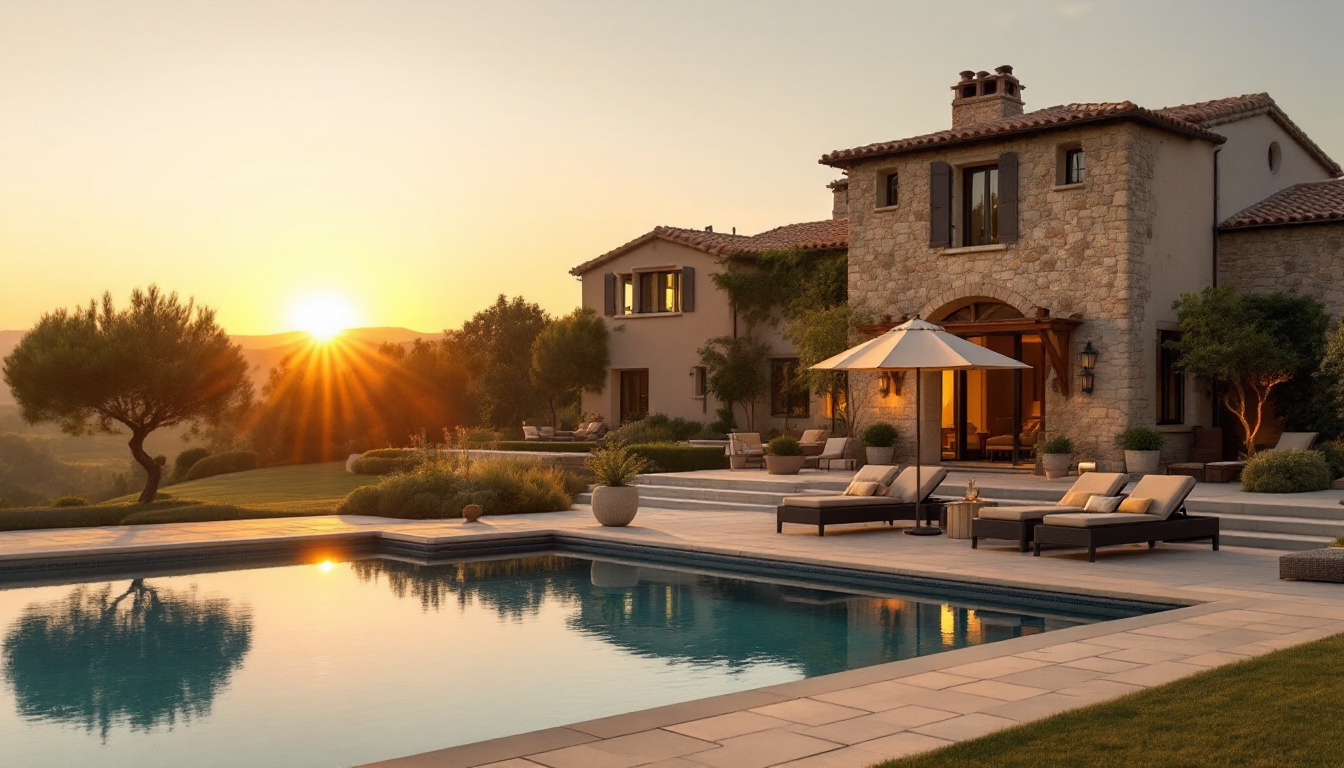
The villas are the product I would point most LTS readers to. They run two to five bedrooms, each with private pool, garden, and (in the larger villas) a separate kitchen and dining pavilion. Architecture is contemporary-vernacular — limestone facing, pale interiors, integrated outdoor living. The two-bedroom villa starts at EUR 820 per night excluding breakfast; the larger five-bedroom villas run to EUR 2,800–3,500 per night in shoulder season and considerably higher in July and August. What the villa rate delivers, and what makes Manville unusual in the European estate market, is full hotel privileges: spa, golf, two restaurants, swimming pools, kids’ programme, full F&B service to the villa, and a concierge bench that handles the wider region (winery visits to Domaine de Trévallon and Mas de Gourgonnier, the truffle market at Richerenches, lunch reservations at La Cabro d’Or or Oustau de Baumanière).
The 1-Michelin L’Aupiho is the destination table. Lucien Gautier holds the kitchen and works the Provence vegetable garden with a precision that is genuinely the regional standard — set lunch from EUR 90, dinner tasting from EUR 165. The Bistro de l’Aupiho is the casual alternative and is, in my view, the more relaxed table — Provençal classics, the estate’s own olive oil and wine, lunch and dinner. The 18-hole golf course is on the bones of the original Manville agricultural estate and integrates with the wider landscape unusually well; villa stays include unlimited use.
The trade-off at Manville, and it is a real one, is that the property sits in a working agricultural valley rather than at a coastal or pond-front trophy site. The setting is Provence as Provence is, not as a fantasy. Guests who want the trophy view (Cap Ferrat, Bonnieux ridge) will not find it at Manville. Guests who want the working integration of a Provençal mas with a contemporary villa product and a kitchen that holds the regional standard will find it here.
Booking lead in 2026: the villas are booked 4 to 7 months out for May, June, and September; 9 to 11 months out for July and August. The two-bedroom villas have more flexibility than the four- and five-bedroom; family-summer bookings of the larger villas were substantially committed for July and August 2026 by November 2025.
La Bastide de Moustiers: the smaller alternative
Alain Ducasse acquired the Bastide in 1995 and opened it as a 13-room inn anchored by his table. The property sits in Moustiers-Sainte-Marie, on the road into the Verdon Gorge, an hour and a half from Aix-en-Provence and two hours from the Alpilles. The character is genuinely different from the Manville-anchored Alpilles experience — closer to a Burgundian relais than to a Provençal bastide, with the kitchen as the centre of the property rather than as one feature among several.
For an LTS reader planning a Provence trip, the Bastide is a two-night stop rather than a weekly base — the room count is small, there is no villa product, the location is closer to the Var than to the Alpilles. The Ducasse table holds its standard. The rooms are correct but unspectacular. The garden, where the kitchen vegetables grow, is the genuine highlight.
The wider weekly-rental market
Below the integrated estate products, Provence runs a deep weekly-rental market across the Alpilles, central Luberon, and (less commonly for international guests) the Lubéron south-face into the Vaucluse plain. The structure of the market is brokered — most properties are listed with one or more agencies on commission rather than direct-to-owner — and the principal agencies are Le Collectionist, Cote & Co, Magrey & Sons, and The Thinking Traveller, with secondary positions held by Émile Garcin, Janssens, and a handful of local Saint-Rémy-based houses.
Le Collectionist, founded in Paris in 2013 by Max Aniort and Maxime Sicard, has built the largest contemporary Provence book through the combination of a curated property approach and a strong digital presentation. Their Provence book runs perhaps 80 to 120 properties across the Alpilles and Luberon, skewing toward properties with contemporary interiors and the sort of design language that travels in the international shelter press. The agency holds the largest book on the Eygalières–Saint-Rémy axis and a strong position in Gordes, Ménerbes, and Bonnieux on the Luberon side.
Cote & Co is the older local agency — founded in 1994, headquartered in Eygalières — with the deepest book in the Alpilles and the longest-standing owner relationships. The Cote & Co properties skew toward the traditional Provençal bastide — heavy limestone, terraced gardens, mature plane trees, original-period interiors. For a guest who wants the historical Provençal villa rather than the contemporary-renovation product, Cote & Co is the first call.
Magrey & Sons runs a sharply-curated trophy book of perhaps 40 properties across the Côte d’Azur and Provence. Their Provence presence is smaller but the curation is the most selective — they will only handle properties at the highest tier of finish and service.
The Thinking Traveller, the agency that built its reputation on the Italian villa market (Sicily, Puglia, Tuscany), has expanded into Provence over the past five years with a book that skews toward properties with an Italian villa sensibility — open kitchens, integrated outdoor living, the design vocabulary that travels between the two regions. The book is smaller (perhaps 25 to 30 properties) but well-presented and well-staffed.
The rate structure
Provence weekly rentals run in three principal seasons.
Shoulder season — mid-April through late June, and September through mid-October — is the rate window I would defend. Four-bedroom properties with pool in the Alpilles or central Luberon run EUR 8,000 to EUR 18,000 per week. Estate-tier six-to-eight-bedroom properties with full pool, tennis, and grounds run EUR 18,000 to EUR 35,000 per week. The trophy tier — twenty to thirty properties across the region with full staff, named-architect provenance, and trophy-broker presentation — runs EUR 35,000 to EUR 70,000 per week. The weather is the same Provence the high season offers; the crowds and the rates are not.
Peak season — 1 July through 31 August — is the seller’s market. Rates rise 60 to 100 percent off shoulder. The four-bedroom that asked EUR 14,000 in May asks EUR 24,000 in late July. The estate tier moves from EUR 28,000 to EUR 48,000. The trophy tier moves from EUR 55,000 to EUR 95,000 and the very top of the trophy tier (perhaps a dozen properties) clears EUR 100,000 per week. Booking lead time is 9 to 12 months for the trophy and estate tiers; 4 to 6 months for the working tier; available inside 60 days only on properties that have not yet committed for the year.
Low season — November through March — runs at 25 to 40 percent of shoulder rates and is genuinely viable for shoulder-month family rentals in the four-to-six-bedroom range, particularly for properties with serious heating and indoor pools. The Provence winter is its own season and rewards a guest who knows the truffle calendar, the wine cellar visits, and the long table-and-fire afternoon.
The hamlet read
Saint-Rémy-de-Provence and Eygalières form the Alpilles axis and remain the working centre of the Provence rental market. Saint-Rémy is the larger town — the Tuesday market is the canonical regional market, the Roman site at Glanum is a 20-minute walk from the centre, and the village restaurants (Le Mas de l’Amarine, Le Bistrot Découverte) hold the regional standard. Eygalières is the smaller, quieter, more design-leaning village — the same restaurants, the same wine selection, less density. The rental inventory on this axis is the deepest in the region and the broker concentration is highest.
Les Baux-de-Provence is the more dramatic setting — the limestone-perched mediaeval village above the valley, the carrières des lumières (the immersive art venue in the old quarries), Manville at the foot of the village. Rentals in the immediate Les Baux area are fewer than in Saint-Rémy or Eygalières but include some of the trophy properties in the region.
Maussane and Mouriès are the olive-oil villages on the south face of the Alpilles. Rental inventory is moderate. The character is more working-village than Saint-Rémy. For a guest who wants integration with the local agricultural calendar — the olive harvest, the AOC visits, the village fêtes — this is the right corner.
The central Luberon — Gordes, Ménerbes, Lacoste, Bonnieux, Lourmarin — is the second principal rental region. Gordes is the trophy address: the village itself is the regional postcard, the rental inventory at the highest end is concentrated in the surrounding countryside, the restaurant infrastructure (La Bastide de Gordes, Mas Tourteron) is strong. Ménerbes and Lacoste sit at the design-press end of the market — smaller, quieter, more selective inventory. Bonnieux holds the working balance. Lourmarin is the most populated of the principal Luberon villages and runs a deeper restaurant scene than the others.
The south Luberon and Vaucluse plain — Lourmarin, Cucuron, Ansouis — runs at lower rates and lower density than the central Luberon. For a returning visitor looking for the same Provence at 30–40 percent off the central-Luberon rate, this is the move.
The booking calculus
If I were planning a Provence week for May or June 2027, I would start in October or November 2026 with Le Collectionist and Cote & Co, hold both books open for a month, narrow to three properties, and book inside 90 days. For July or August 2027 the calculus is different — the call would happen in September or October 2026 at the latest, with Magrey & Sons added to the broker list, and the booking confirmed inside three weeks of the first sit-down. For a Manville villa, the call to the property direct goes in 9 to 11 months ahead for summer and 4 to 6 months for shoulder.
If I had only one week in Provence and wanted the integrated estate experience without the broker layer, Manville is the answer. If I wanted the weekly rental at a specific property with full kitchen and staffed living, the broker route through Le Collectionist or Cote & Co is the route. If I wanted the Ducasse table and a smaller scale, the Bastide is the two-night stop.
Provence in 2026 is in a strong place. The properties are good. The brokers are honest. The shoulder window is real.
Standing Questions
- What does Domaine de Manville actually rent for?
- Rooms from EUR 285, suites from EUR 405, the nine luxury villas from EUR 820 per night, all excluding breakfast. The villas run two to five bedrooms and sit within the estate's 230 hectares at Les Baux-de-Provence. The 1-Michelin restaurant L'Aupiho offers set lunch from EUR 90; Bistro de l'Aupiho is the casual alternative, open lunch and dinner. The 18-hole golf course is included in villa stays and accessible to room guests for a green fee.
- Is La Bastide de Moustiers worth the detour?
- Yes, for a specific reader: someone who wants the Ducasse table (the property houses one of Alain Ducasse's restaurants and is the closest he comes to the small-inn model) in a setting closer to the Verdon gorge than to the Alpilles. Thirteen rooms only, an hour and a half from Aix-en-Provence by road. Best as a two-night stop within a broader Provence trip rather than a week-long base.
- What is the realistic weekly rental budget across Provence?
- Shoulder season (April–June, September–October): EUR 8,000 to EUR 18,000 per week for a four-bedroom property with pool in the Alpilles or central Luberon, EUR 18,000 to EUR 35,000 for an estate-tier six-to-eight-bedroom with full pool and grounds. Peak (July, August): rates rise 60 to 100 percent. The trophy tier — twenty to thirty properties in the region with full staff, pool, tennis, and trophy-broker presentation — runs EUR 50,000 to EUR 120,000 per week peak.
- Which agency holds the deepest Provence rental book?
- Le Collectionist (founded 2013, Paris-based) has the deepest contemporary Provence book — perhaps 80 to 120 properties across the Alpilles, central Luberon, and Lubéron south-face. Cote & Co holds the longer-standing local book, particularly in the Saint-Rémy and Eygalières areas. Magrey & Sons runs a smaller, sharply-curated trophy book skewing toward bastides on the Eygalières–Maussane axis. The Thinking Traveller's Provence book is more recent and skews toward properties with an Italian-villa sensibility.
- When is the right time to visit?
- Mid-May through late June is the unambiguous answer. The lavender colour breaks in mid-to-late June (Valensole) and holds through the third week of July (Sault). The summer crowds arrive in earnest from 14 July onward and stay through 20 August. September is the second-best window — the harvest, the warm days, the empty restaurants. Avoid the first two weeks of August unless the trip is built around the village fêtes.