I turned off the SP3 at 16:47 on a Tuesday in late April, and within sixty seconds the gravel had taken over from the asphalt, the cypresses had closed in on either side, and the Castello had come into view through the alley exactly the way the family wants you to see it — first the tower, then the roofline, then the whole eleventh-century mass of it sitting on its hill above the Niccone valley.
I have driven up to a great many country properties in Italy. There is usually a moment, somewhere between the gate and the front door, when you understand whether the place was conceived by an operator or by an owner. Reschio is one of perhaps two or three properties in Europe where the architect is also the owner is also still living on site. Count Benedikt Bolza, who designed almost every restored stone in the estate’s 3,700 acres, keeps an apartment in the Borgo with his wife Donna Nencia and their five children. The cook at the staff canteen knows his coffee order. The blacksmith in the foundry has been working with him for nineteen years. This is not a hotel that was bought as an asset; this is a thirty-year family project that has, somewhere along the way, started taking paying guests.
That distinction shows up in everything. It is the through-line of this review.
The arrival
Reschio’s standing offer is a transfer in one of the estate’s own cars — a fleet of three Mercedes V-Class and, on the day I flew in, an older Range Rover the family uses for guests who ask for “something a bit more country.” The driver who collected me from Rome Fiumicino was Giancarlo Pasquetti , a former cab operator from Trastevere who has been on the Reschio roster for four years. The drive runs two hours and ten minutes door to door in light traffic — the A1 north to the Valdichiana exit, then forty minutes of secondary road into the upper Niccone valley, the last stretch through Lisciano Niccone village (one bakery, one trattoria, a war memorial, a closed petrol station). Giancarlo did not narrate. He took a single phone call, in Roman dialect, from his wife. He did the last ten kilometres slowly because the road is genuinely narrow and Umbrian drivers genuinely do come round the bend in the middle.
The gate at the bottom of the estate is unmanned — a single iron arch, a small carved sign, and a cattle grid. From the gate, the drive climbs for nearly two kilometres through open pasture (horses to the right, a band of olive grove to the left), then enters the cypress alley I have already described, then arrives at the Borgo: the cluster of restored stone buildings that surrounds the Castello on three sides. There is no porte-cochère, no liveried doorman, no luggage trolley waiting. You park where you are told to park (a discreet gravel apron behind the chapel) and walk the last forty metres on foot.
Check-in happens in the Castello library, on the piano nobile, in a room with five tall windows opening west over the valley and a fire laid even in April. I was met by Beatrice Falconi , the duty front-of-house manager, who knew my arrival time, the rate I had paid, the dinner reservation I had requested for that evening, and the fact that I had asked, two weeks earlier, to ride the following morning. She walked me through none of this; she simply confirmed each item without my having to raise it. A glass of Lungarotti Torgiano Rosso Riserva arrived without being asked for. The library smells of woodsmoke and the particular kind of beeswax polish the estate makes in its own workshop.
That walk into the Borgo afterwards — twenty minutes before the light went, my luggage already in the room, no agenda — is the moment Reschio first declares itself. The buildings are not restored to a museum standard. They are restored to a lived-in standard: the lime wash patchy in places, the wrought iron a little uneven, the gravel paths interrupted here and there by clumps of wild thyme. Everything looks as if it has been here for six hundred years and will be here for another six hundred. This is by design, and it is the hardest thing in restoration architecture to achieve.
The casa
I had asked, before booking, for one of the case rather than a Castello room. The estate’s private farmhouses are the more interesting product, and I will say that twice in this review because most coverage of Reschio focuses on the Castello and misses what the Bolzas have actually built. The case are how the family lived on the land for twenty-five years before the hotel opened. They are still the more honest expression of the project.
I stayed in Casa Lambardi, a two-bedroom property a kilometre’s walk (or four minutes by estate buggy) below the Castello, set into the south slope of the hill with its own olive terrace and a small private pool. 240 square metres of restored stone over two floors, with the original timber roof exposed throughout the upper level. The downstairs is one continuous living space — sitting room, dining room, open kitchen — articulated only by a central stone hearth that the Bolzas left in place from the original farmhouse. The upstairs is two bedrooms with two bathrooms, separated by a stair landing wide enough to use as a reading room. The smaller bedroom has a single Murphy bed that drops out of the wall and is upholstered in the same Umbrian linen as the curtains; this is, I think, the only Murphy bed I have ever seen in a property at this rate level, and it is so well integrated that you would not notice it if no one pointed it out.
The bed in the master is a Bolza original — a low four-poster in walnut, with the posts turned on a lathe in the estate’s woodshop, and a horsehair-and-wool mattress made by a workshop in Città di Castello forty kilometres east. The linens are the estate’s own, woven in a small mill outside Perugia and washed to a softness that suggests they have been on this bed for some time. The bathroom is the room I want to describe at length. The walls and floor are clad in handmade cement tiles produced in Caltagirone, Sicily — six different patterns, used in a deliberate non-pattern, the joins narrow enough to read as a single surface rather than a tile field. The tub is a single block of travertine quarried near Tivoli; the fittings are unlacquered brass, designed by Bolza and cast in the estate’s own foundry, and they will tarnish to a deep ochre over a decade. The towels are heavy Egyptian cotton, monogrammed in the lower right corner with the Reschio cipher. The soap is Bolza’s own — the estate produces a small range of olive-oil-based soaps and shampoos under the Reschio name, and they are very good without being demonstrative about it.
The kitchen, which a Castello room cannot give you, is what tips the case into the more interesting category. It is a working kitchen with a six-burner La Cornue range, a separate cold cupboard for cured meats, a marble pastry slab set into the central island, and a wood-fired oven built into the chimney breast. The estate stocks it before you arrive — bread, olive oil, salt, a wheel of pecorino from a producer two valleys over, a flask of estate wine, eggs from the hens in the lower paddock, a bowl of Sicilian oranges. If you want a chef sent down to cook one night, that is arranged through your host. If you want to cook for yourself, the estate restocks daily on a list you fill in.
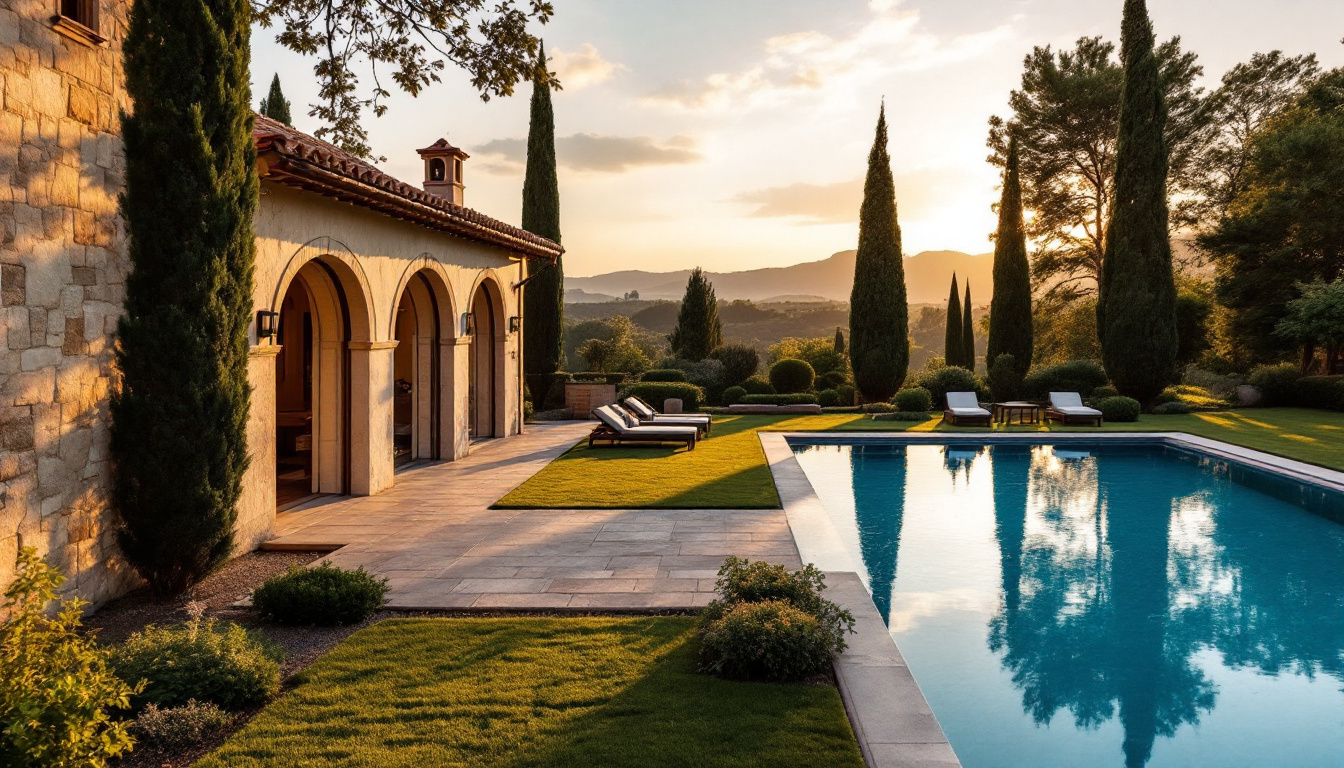
The terrace runs the full length of the south facade — twenty-two metres, set with a long oak table, six chairs, and a pair of cushioned daybeds at the western end. The pool is twelve metres long, lined in pale grey stone, with no diving board and no perimeter lighting; at night it disappears entirely against the valley. On my second evening I ate alone on the terrace with a plate of pecorino, the bread, and a glass of the estate’s white, and watched the lights of Cortona come on across the valley fifteen kilometres west. That hour is what people pay EUR 12,000 a week for. It is worth it.
The service
Reschio operates what it calls the Estate Host model. Every guest, whether at the Castello or in a casa, is assigned one host for the duration of the stay, and that person owns the entire experience: dining bookings, activity scheduling, in-room or in-casa requests, transfer arrangements, the lot. My host was a young Anglo-Italian named Edoardo Vianello , twenty-eight, three years on the estate, previously at Belmond Castello di Casole. He met me at the casa twenty minutes after check-in with a printed daily schedule for the first three days and a phone number that he answered, every time I used it, within two rings.
The general manager is Sandro Romagnoli, who came to Reschio from Aman Venice in early 2023. He runs the property with a light hand and a deliberate visibility — he was at breakfast at the Palm Court on two of the four mornings I was on site, and at the Alle Scuderie pass for an hour on the night I dined there. This matters. A GM who is visible without performing visibility is rarer than the brand-management literature suggests.
The activity coordination is where the host model genuinely earns its keep. I had requested a ride for the first morning. The call from the riding school’s chief instructor, Margherita Conti , came at 19:40 on the evening I arrived — direct to my mobile, in English, to confirm the time (08:30), my level of experience (I described myself as an intermediate-poor English rider who had not been on a horse in two years), the horse she planned to put me on (a fourteen-year-old grey Maremmano gelding called Falco), and to ask whether I preferred a flat hack or some hill work. I said hill work. She said good, she would meet me at the lower yard at 08:15 and we would ride out for two and a half hours through the chestnut wood. Every part of that conversation happened. The ride was excellent.
The deliberate problem — I always invent one, on every visit, to test the service recovery — was a request, made at 22:30 on the second night, for a particular Brunello (a 2016 Soldera) that I knew Reschio did not carry on the public list. I telephoned the host line. Edoardo called back at 22:42. He said the estate did not stock Soldera but that the cellarmaster, Tommaso Bianchi , had a personal contact at a wine shop in Cortona and could try to source a bottle for the following evening at cost plus the standard mark-up; alternatively, the cellar had a 2015 Biondi-Santi Riserva that he thought would interest me more. I asked for the Biondi-Santi. It arrived at the casa, properly decanted, the following evening at 19:30, and was charged at EUR 540 — the going rate, not inflated. The recovery was generous in the only way that matters, which is that it produced a better outcome than the original request.
One miss to record. On the morning I checked out, the requested 11:00 car to Perugia airport was confirmed at 10:55 and arrived at 11:14. Fourteen minutes is not a disaster, but at this rate point it should not happen, and no one volunteered an explanation. Edoardo apologised after I raised it.
The table
Reschio runs three F&B operations of any consequence. Alle Scuderie, the signature restaurant, occupies the former stable block — a long, low room with a vaulted brick ceiling, an open kitchen the full length of the south wall, and twenty-four covers at six oak tables. Il Torrino, the small restaurant at the top of the Castello’s west tower, takes six covers a night and runs a single tasting menu. The Palm Court Bar serves breakfast, lunch, and an aperitivo programme on the loggia of the Castello.
I dined at Alle Scuderie on the second evening. The kitchen is run by chef Niccolò Palumbo , who came in from the kitchen of Locanda Locatelli in London after sixteen years there, and his cooking is technically very assured and emotionally a half-step cool. The room is warm; the food is not always warm in the same way. Three courses, in order:
A starter of raw red Mazara prawn with a fennel and Cara Cara orange salad, dressed only with the estate’s olive oil and a single grind of black pepper. The prawn was extraordinary — sourced that morning, the texture intact, the sweetness clean. The salad alongside it was almost too restrained; the orange struggled to register against the prawn, and a more generous hand with the fennel fronds would have served the plate.
A primo of hand-cut tagliatelle with a ragù of estate-shot wild boar, finished with grated Parmigiano of an age the waiter did not specify but should have. The pasta was exemplary — the bite, the colour, the way it caught the sauce. The ragù was deep, slow-cooked, properly underseasoned in the Umbrian style. Best dish of the meal.
A secondo of slow-roasted pigeon, breast off the bone, the legs confit, with a Jerusalem artichoke purée and a pan jus reduced with Sagrantino. The pigeon was correctly cooked. The plate was, in the round, the kind of dish that a London-trained Italian chef sends out when he wants to demonstrate range, and what it demonstrated was that the chef can do this. It did not, however, make me want to eat it twice.
The wine list is the genuinely impressive document at Reschio. 480 references , weighted heavily toward small Umbrian and Tuscan producers, with a deep section on Sagrantino di Montefalco (Paolo Bea, Arnaldo Caprai, Tabarrini all in multiple vintages) and a useful spine of Brunello back to the early nineties. The sommelier on my evening was a young woman from Trieste named Eleonora Marzi , third year on the estate, and her recommendation — a 2019 Tabarrini Colle Grimaldesco, decanted for forty minutes — was the best EUR 110 I spent at table.
Breakfast at the Palm Court, two mornings running, was the meal where Reschio looks most relaxed. A continental laid out on the loggia (estate honey, three jams made on site, four breads from the estate bakery, prosciutto from a producer in Norcia, three pecorinos at different ages); a short made-to-order list for eggs, pancakes, and a single hot dish that changed daily (one morning, a frittata with foraged wild asparagus; the next, a small bowl of zuppa di farro). The coffee is good. The fresh orange juice is squeezed in front of you. The pastry is the weak point — the cornetti are commercial, or at any rate they read as commercial, and at this rate point they should be made in house.
The third meal worth describing is the truffle hunt lunch, which is a separate booking and a real one. We left the Borgo at 10:30 with the head dog handler, Marco Brunelli , his two Lagotto Romagnolos (Pippo, six, and Olga, three), the sous chef from Alle Scuderie, and a portable kitchen rigged out of the back of a Defender. We walked for ninety minutes through a stretch of oak wood on the southwestern edge of the estate; the dogs found three small black truffles in the second hour. Lunch was laid on a single trestle table at the edge of a clearing — a board of bresaola, a small pasta with the morning’s truffles shaved over it, a glass of estate Trebbiano, an espresso made on a stovetop moka over a wood fire. This is the kind of activity that, at most properties, is theatre. At Reschio it is just what the kitchen does on a Wednesday.
Where the kitchen sits a half-step behind expectations is in the gap between ambition and warmth. The food is technically excellent and emotionally measured. At a property this personal, in an Umbrian context where the regional cooking is itself generous and warm, the table could afford to be looser. I would score the Detail higher than the Table, and I think most guests would.
The Detail
The single most-distinctive Reschio gesture is the door handle. Every door handle in every building on the estate is unique. Bolza runs a metalwork studio in a converted barn at the eastern end of the Borgo — five blacksmiths, two casters, a single woman who does the patination — and every handle, every hinge, every key plate, every window catch on the estate has been designed and cast there. I spent forty minutes in the foundry on my third afternoon (Edoardo arranged it with one phone call). The lead smith, Stefano Marcucci , who has been with Bolza for nineteen years, walked me through the process: design sketch from the count, wax pattern, sand mould, brass pour, hand-finish. A single handle takes between two and six days depending on the complexity. The estate has cast somewhere over 4,000 handles to date and is still working.
This is not, on its own, what makes the detail at Reschio remarkable. What makes it remarkable is that the same care has been applied to everything else. The light switches throughout the case are turned brass toggles, again cast in the foundry, set into oiled walnut backplates. The linens are estate-woven. The soaps are estate-made. The honey on the breakfast table comes from hives on the lower meadow. The wine in the casa fridge is from the estate’s own vineyard (small — only about 18 hectares — and the bottles are not on commercial release). The kindling in the casa fireplace is split from estate timber. The candles in the Bath House at dusk are dipped in a workshop run by Donna Nencia Bolza herself.
I went down to the Bath House at 06:45 on my last morning. It opens at 06:30 for residents of the case; the Castello guests have it from 07:30. There was no one else in the building. The 25-metre pool sits in a vaulted brick chamber on the basement level, lit only by candlelight and by a single oculus cut into the roof, and the water (cooled spring water, drawn from the same artesian source that supplies the Borgo) is held at 32 °C. I swam thirty lengths in something close to silence. The only sound was the water moving and, at one point, a bird in the courtyard outside calling once and stopping.
That swim is the single image I would offer anyone trying to decide whether to come to Reschio. If the description of it sounds like something you would want to do, you should come. If it sounds like something a property is trying to sell you, you should go to a different property.
The Standard
Setting: 5.0. The site is the rarest combination in European hospitality — a single contiguous landholding of 3,700 acres, restored under a single architectural intelligence, in a region (the Umbrian-Tuscan border) of unusual landscape continuity. There is no road noise. There is no view of any building not owned by the estate. The light, in April, is the particular pale-gold light that the Niccone valley is known for, and it is not promised in any brochure because it is impossible to promise. A perfect score.
Suites: 4.7. The Castello rooms are very good — well-proportioned, beautifully detailed, with views across the valley — but the case are better, and the rating reflects the case product. The bed, the bathroom, the kitchen, the materiality, the integration with the landscape: all close to the top of the market. The thirty-point deduction is for the in-room technology, which is deliberately minimal at Reschio (no in-room iPad, no climate panel, lights still operated by traditional switches) and which most guests will find correct but which a small number will find a step short of the rate.
Service: 4.6. The Estate Host model is the best service architecture I have seen in Italy. The recovery on the deliberate problem was generous. The riding-school coordination was exemplary. The fourteen-minute airport-car delay on departure is the only real demerit, and it should not have happened.
Table: 4.5. The kitchen at Alle Scuderie is technically excellent and emotionally a half-step cool; the breakfast is good but the pastry is not made in house; the truffle hunt lunch and the wine list are both unambiguously at the Standard. A property at this rate point should be able to make its own cornetti.
The Detail: 5.0. The door handles, the foundry, the linens, the honey, the soap, the candles, the kindling, the dawn swim in the Bath House. The most personal detail work in Italian hospitality. A perfect score, and the easiest score I have given in five years of writing for this column.
Average: 4.76, rounded to 4.8. At the Standard.
Verdict
At the Standard. Reschio is one of perhaps four properties in Italy I would recommend without qualification to a guest spending at this rate level, and the only one I would recommend specifically for the project of being on a single estate for a week without leaving it. The case product is the right product; book a casa, not a Castello room, unless you are travelling solo or for two nights only. Plan to cook one night in the casa kitchen with what the estate sends down. Take the riding lesson even if you have not ridden in a decade. Book the Bath House for first opening, not for the busy mid-morning slot.
Booking lead time is real and should be respected. The Castello takes reservations approximately 4–6 months out for standard rooms in shoulder season; the seven suites are gone 8 months ahead for any week between mid-May and late September. The case run on a longer cycle — 6–12 months for the high season (June, September, the first week of October), and longer still for the larger six-and-eight-bedroom properties, which book up to 18 months ahead because they are popular for milestone family gatherings. Minimum stays: three nights at the Castello in low season, five in high; the case are seven-night minimum from mid-May to mid-October, with shorter four-night stays available in November and April.
Rates, current as of this writing: Castello rooms from EUR 1,150 to approximately EUR 1,800 in shoulder season; the seven suites from EUR 2,400 to EUR 4,500; private case from EUR 8,000 per week (two-bedroom, shoulder) to EUR 45,000 per week (eight-bedroom, high season, with full chef and household service included). Private dining EUR 350 per person upward; the truffle hunt lunch is EUR 480 per person and worth it. Transfers from Rome FCO EUR 580 each way; from Perugia PEG EUR 180. None of these rates include the 10% city tax, which Reschio bills at the end of the stay.
I will go back. I would like to ride more of the estate than the morning hack allowed; I would like to spend a week in one of the larger case with a small group and cook through the kitchen properly; and I would like to see what the kitchen at Alle Scuderie does in the late-autumn game season, which is when most of my Italian contacts who know Reschio well tell me the food is at its best. I will report back.
Standing Questions
Is Reschio a hotel or a villa-rental estate?
Both. The Castello di Reschio hotel opened in May 2021 with 36 rooms; alongside the hotel, the estate rents out 50+ restored stone farmhouses (the “case”) by the week or longer. Most coverage treats Reschio as a hotel with villas attached. The honest reading is that Reschio is an estate that, after twenty-five years of restoration, opened a hotel inside its central building. The case are the older and in many ways the more interesting product.
Who is the architect?
Count Benedikt Bolza, son of the estate’s owner Count Antonio Bolza (who bought the land in 1994), in partnership with the London firm Spinocchia Freund. Benedikt has personally designed or overseen nearly every restored building on the estate over thirty years, and he continues to live in the Borgo with his wife and five children. He also runs the estate’s metalwork studio, where every door handle, hinge, and light switch is cast.
What is the entry rate?
Castello rooms from approximately EUR 1,150 per night in shoulder season, rising to about EUR 1,800; the seven Castello suites from EUR 2,400 to EUR 4,500. Private case (farmhouses) start at approximately EUR 8,000 per week for two-bedroom properties in shoulder, and run to EUR 45,000 per week for the largest eight-bedroom properties in high season. Add the truffle hunt (EUR 480pp), private dining (EUR 350pp+), and the 10% city tax.
How do I get to Reschio?
By road. Two hours from Rome Fiumicino (FCO), approximately three hours from Florence (FLR), and fifty minutes from Perugia (PEG, the closest airport). The estate’s car fleet handles transfers at fixed published rates and is the simplest option; rental cars are workable if you are comfortable with narrow Umbrian roads on the last ten kilometres. There is no rail service of any use; the nearest station is Cortona-Camucia, forty minutes by road.
What is the best time to visit?
Late April through June and September through mid-October. The light is best in those windows, the kitchen is at its sharpest, the riding is comfortable, and the estate is busy without being crowded. July and August are warm (35 °C-plus in the lower valley some days) and busy with European family bookings of the larger case. Truffle season runs October through early January. The estate closes most operations from early January to the first week of March; do not try to come in February.
Standing Questions
- Is Reschio a hotel or a villa-rental estate?
- Both. The Castello di Reschio hotel opened in May 2021 with 36 rooms; alongside the hotel, the estate rents out 50+ restored stone farmhouses by the week or longer.
- Who is the architect?
- Count Benedikt Bolza, son of the estate's owner Count Antonio Bolza, in partnership with Spinocchia Freund. He has personally designed or overseen nearly every restored building on the estate over thirty years.
- What is the entry rate?
- Castello rooms from approximately EUR 1,150 per night; the suites EUR 2,400–4,500. Private case (farmhouses) start at approximately EUR 8,000 per week for two-bedroom properties in shoulder season.
- How do I get to Reschio?
- Drive ~2 hours from Rome (FCO) or ~3 hours from Florence (FLR). Perugia (PEG) is the closest airport at ~50 minutes by road. Reschio arranges all transfers.
- What is the best time to visit?
- Late April through June and September through mid-October. July and August are warm and busy. The estate closes most operations in deep winter (January–early March).