I flew into Paro on a Tuesday in late April 2026, on Drukair’s 07:30 service from Bangkok that lands at approximately 11:00 after the famous single-turn approach into the Paro valley. The approach is one of those rare elements of commercial aviation that lives up to its reputation: a steep descent, a hand-flown banking turn through the valley walls at low altitude (the only commercial airport in the world that requires its pilots to be specifically certified for the approach), and a short hard landing on the single runway. The aircraft on my service was a Drukair A319 with seventy-three passengers, which is approximately the load that the airport can handle in a single arrival window. The arrivals hall at Paro is a single low building, hand-painted in the traditional Bhutanese style, with twelve staff in national dress (gho for the men, kira for the women) running customs and immigration at a working pace. I was through arrivals in twenty-one minutes.
What follows is a field report on Bhutan as it stood in late April and early May 2026, after fourteen nights split across all five Amankora lodges (Paro, Thimphu, Punakha, Gangtey, Bumthang, in that order, on the standard west-to-east journey concept), written in the voice of a guest who is engaging with the country for the second time (the first was in 2017, before the COVID closure that ran from 2020 to 2022) and who is trying to make sense of how the high-value tourism math has changed.
The SDF and what it means
The single most consequential development for high-end Bhutan travel in the past three years is the change in the Sustainable Development Fee. The SDF — a per-person, per-night charge that funds healthcare, education, and conservation programmes for the Bhutanese population — was introduced in its current form in September 2022 at USD 200 per night. The intention was to raise the average revenue per visitor in line with the country’s long-stated “high-value, low-volume” tourism policy. The effect was a substantial collapse in arrivals: total visitors in 2023 ran at approximately 100,000, down from 315,000 in 2019, with the high-end segment hit hardest because longer stays multiplied the SDF into substantial line items on already-expensive itineraries.
In response, the Royal Government of Bhutan announced in September 2023 a 50 percent reduction in the SDF — to USD 100 per person per night — as a tourism recovery measure, initially for two years and now extended through 31 August 2027. The change has been transformative. Arrivals in 2025 ran at approximately 220,000 (still below the pre-pandemic peak but well above the 2023 trough), and the high-end segment is now running at higher occupancy than at any point since 2019. Both Amankora and Six Senses Bhutan reported full-house occupancy for substantial windows in spring 2026 and autumn 2026, with lead times for the better suites running 4-6 months.
The math, for a serious trip, now works like this. A seven-night Amankora circuit (two nights at Paro, one night at Thimphu, two nights at Punakha, one night at Gangtey, one night at Bumthang) runs at approximately USD 1,400 per person per night at the standard rate, all-inclusive of meals, guide, transfers, and most activities. The SDF adds USD 100 per night per person (USD 700 across seven nights). The Drukair return flight from Bangkok is approximately USD 1,800 in economy or USD 4,400 in business. The total, before extras and the international long-haul leg, sits at approximately USD 11,600-USD 14,200 per person for the on-the-ground week and the regional flights. A solo traveller paying single-occupancy supplements will run closer to USD 18,000-USD 22,000 for the same week. The full-circuit ten-night itinerary, with all five lodges, sits in the USD 22,000-USD 28,000 range per person. These numbers are real and they justify the trip in a way that the USD 200 SDF era did not.
The two operators
Bhutan’s high-end accommodation market is, in 2026, substantially defined by two operators: Amankora and Six Senses Bhutan. The two are competitive in scale (each runs five lodges across the same five western Bhutanese valleys) and complementary in character. A more detailed comparison than the FAQ above:
Amankora opened its first lodge at Paro in 2004 and completed its five-lodge circuit (Paro, Thimphu, Punakha, Gangtey, Bumthang) by 2010. The name combines the Sanskrit “aman” (peace) with the Dzongkha “kora” (the Buddhist circumambulation of a sacred site), and the operation is built around the concept of a single guest moving through all five lodges on a continuous journey. The lodge architecture, by Australian practice Kerry Hill Architects (Kerry Hill himself, before his death in 2018, designed the original Paro lodge personally), is consistently understated: dark wood, dressed stone, traditional Bhutanese roofscapes, a colour palette that defers to the surrounding landscape. The Paro lodge has 24 suites; the Thimphu lodge 16; the Punakha lodge 8 (the smallest, set in a converted 300-year-old farmhouse on a rise above the Punakha valley); the Gangtey lodge 8; and the Bumthang lodge 16. Total room count across the circuit: 72.
The Aman service architecture is the most refined in Bhutan and arguably in the broader Himalayan region. Every guest is assigned a dedicated guide for the duration of the journey, who travels with them between lodges and handles activity coordination, restaurant arrangements, and the unstructured time. The guide pairings are matched at booking to the guest’s interests (Buddhism, hiking, photography, birding, textile work, dzong architecture); on a single guest’s twelve-day journey, the guide will spend roughly fifty hours in direct conversation with the guest, and the resulting relationship is the spine of the trip. My guide on this circuit — a thirty-two-year-old Paro-born Aman veteran named Karma Wangchuk, eleven years on the staff, fluent in English and Hindi, with a working academic interest in fifteenth-century Bhutanese temple murals — was the single most important factor in the success of the fourteen nights.
Six Senses Bhutan opened in stages between 2018 and 2020 across the same five valleys. The operation is more architecturally ambitious than Amankora: each of the five lodges is built to a distinct design brief (Paro: “the stone fortress,” referencing the traditional Bhutanese dzong; Thimphu: “the palace in the sky,” with a glass-walled main pavilion looking across the Thimphu valley; Punakha: “the bridge house,” cantilevered above a working agricultural valley; Gangtey: “the bird-watcher’s nest,” with elevated suites looking across the wetlands where the black-necked cranes overwinter; Bumthang: “the farmhouse,” in the most traditional vernacular of the five). The total key count across Six Senses Bhutan is 82 (24 in Paro, 16 in Thimphu, 8 in Punakha, 8 in Gangtey, 26 in Bumthang). The rate point is slightly lower than Amankora — approximately USD 1,100-USD 1,300 per person per night, all-inclusive — and the F&B programme is broader (Six Senses runs an “alchemy bar” in three of the five lodges with a regional wellness focus that Amankora does not attempt).
The choice between the two, for a first-time guest, is genuine. I would, on this trip and on the basis of the second visit to Aman in nine years, send the first-time guest to Amankora on the strength of the service architecture and the depth of the guide relationship. I would send the returning guest, and the guest with a strong architectural interest, to Six Senses.
The five valleys
The standard circuit runs west to east across the country, from Paro (where the airport sits at 2,235 metres) through the capital Thimphu (2,334 metres) and east over the Dochula pass (3,140 metres) to Punakha (1,310 metres, the lowest point on the standard circuit, in the broad agricultural valley that was the historical seat of the Bhutanese monarchy), then onward east to Gangtey (3,000 metres, the high Phobjikha valley) and finally to Bumthang (2,580 metres, the broad valley in central Bhutan that contains many of the country’s oldest temples). The circuit is approximately 320 kilometres of driving across seven to ten days, on the single east-west highway that the country’s road network is built around. The road is paved, narrow, and slow; a sixty-kilometre leg can easily take three hours.
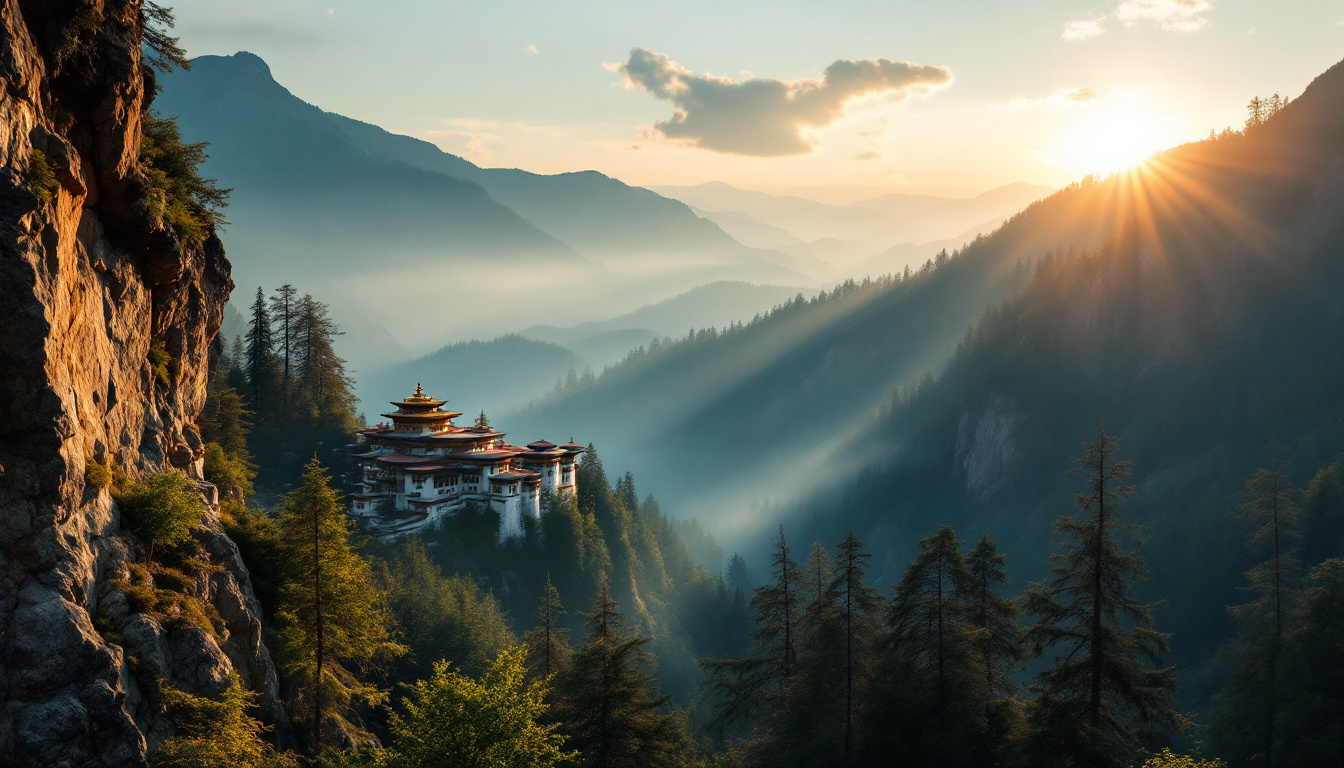
Paro is the right opening valley. Two nights at minimum — the first is given over to acclimatisation (Paro’s altitude is moderate but the air is dry and the change from sea-level Bangkok the previous day is real), the second to the hike up to Taktsang (Tiger’s Nest), the cliffside monastery 900 metres above the valley floor that is the most photographed structure in Bhutan and which deserves the photograph. The hike is approximately four hours round-trip on a well-graded trail through pine forest, with the final climb on stone steps cut into the cliff face. The Amankora Paro lodge sits ten minutes by road from the trailhead. Karma walked me up at the front of a small group of four; we left the lodge at 06:00 and were back at the lodge for lunch by 12:30.
Thimphu — the capital, with an official population just over 100,000 — is the valley most guests pass through too quickly. A single night at Amankora Thimphu is the minimum; two nights are the right answer if you want to spend half a day inside the working National Library, half a day with a textile master in one of the old workshops, and an evening at one of the better Thimphu restaurants (Folk Heritage Restaurant for traditional Bhutanese cooking; Babesa Village Restaurant for the more refined version). The Thimphu lodge is the only Aman that sits inside an urban context, and it is the lodge where the guest gets the most direct exposure to contemporary Bhutanese life.
Punakha — east over the Dochula pass, then down a long descending road through subtropical forest to the broad warm valley below — is the surprise of the circuit. The Punakha dzong, at the confluence of the Mo and Pho rivers, is the most architecturally significant building in Bhutan (built in 1637, severely damaged by fire and flood multiple times, last comprehensively restored in 2003) and the right place to spend half a day with a guide who can read the iconography in the murals. The Amankora Punakha lodge — eight suites in the converted 300-year-old farmhouse on the rise above the valley — is the smallest and arguably the most personal of the Aman properties. Two nights at minimum.
Gangtey — the high Phobjikha valley, two hours east of Punakha by road, at 3,000 metres — is the valley I would press any returning visitor to spend an extra night in. The valley is the overwintering ground for the black-necked crane (approximately 600 birds arrive annually from late October and depart in mid-March), and the valley landscape (broad, flat, glacial, surrounded by low forested hills, with no major settlement) is unlike any of the other four valleys on the circuit. The Amankora Gangtey lodge, eight suites in a single building set on a slight rise above the valley, is the lodge where the guest sees the fewest other guests across a typical stay. The walking is good; the birding (in autumn) is excellent; the slow time is the point.
Bumthang — the easternmost stop on the standard circuit, six hours by road from Gangtey through Trongsa and over two high passes — is the valley with the deepest religious history. Jakar dzong, Kurjey Lhakhang, Jambay Lhakhang, Tamshing Lhakhang: four of the country’s most consequential temples sit within a fifteen-kilometre radius. The walking between them is good. The Amankora Bumthang lodge is the largest of the five Aman properties and has the most extensive grounds; I spent the better part of one afternoon walking the slow circuit around the lodge garden with the head gardener, who has been at the property since opening in 2010 and who runs a small herb-and-vegetable plot that supplies the lodge kitchen through the season.
The math after the maths
The genuine question, for a guest considering Bhutan in 2026, is not the SDF in isolation but the all-in math relative to the comparable global alternatives. Seven nights at Amankora at full circuit runs at the same all-in cost as seven nights at an equivalent African safari camp (Singita, Wilderness Bisate, Mara Plains), seven nights on the better French Polynesian atolls (Brando, Bora Bora Conrad), or seven nights at the better Japanese ryokan circuit (Asaba, Yagyu no Sho, Tawaraya). The cost is comparable; the experience is not. Bhutan offers a depth of cultural engagement and a slow rhythm that none of those alternatives can match. The SDF cut has made the math viable for a guest who would not previously have considered the country.
The two practical constraints to plan around: the international long-haul connection (Bangkok, Delhi, Singapore, or Kathmandu — the Bangkok overnight is the most comfortable), and the lead time on the lodge bookings (4-6 months for spring or autumn 2027, longer for the smaller Punakha and Gangtey lodges in either operation).
What to do, what not to do
A short list of operational notes that are easy to get wrong and that I would not have known without making the mistakes on the first visit in 2017.
Take the longer schedule. Eight to ten nights at minimum. The math for a five-night trip does not work; the slow pace of the country is the point, and a compressed schedule loses it.
Take the guide pairing seriously. Tell the operator what you actually want to engage with; the guide assignment is the single most important booking variable.
Plan the trekking on a separate trip. The Druk Path (four nights, Paro to Thimphu) and the Jomolhari trek (six to eight nights, into the higher Himalayan north) are serious undertakings that do not blend well with a lodge-based circuit. If trekking is a priority, plan a dedicated trip with the trekking weeks in the middle and the lodges as the bookends.
Take the time for the dzongs. The four principal dzongs (Paro, Thimphu, Punakha, Trongsa) are the great architectural expression of the country and each rewards a full half-day with a guide. The temptation, after the first two, is to compress the third and fourth into shorter visits. Resist it.
Carry small US dollar notes for the temple offerings. The standard offering at a temple altar is USD 1 per altar; you will visit twenty to thirty altars on a ten-day trip. Bring a hundred singles. The lodges will not have them.
Take the chili. The Bhutanese national dish, ema datshi, is built around chili treated as a vegetable (not a seasoning) and is genuinely hot. The lodge kitchens will moderate the heat on request, but the dish in its full form is the country on a plate and is worth the discomfort.
Verdict
Bhutan in 2026, with the SDF at USD 100 per night through August 2027 and the high-end accommodation operations running at full capacity for the first time since 2019, is the right destination for a serious traveller who wants a slow ten days in a small country that is genuinely unlike any other. The math works. The infrastructure has recovered. The two principal operators are in their strongest seasons. The window — through August 2027, before the SDF either returns to USD 200 or settles at some new figure — is the planning window.
I will go back. I would like to do the Druk Path between Paro and Thimphu in late October, when the rhododendron is gone but the views are at their clearest. I would like to spend a week at the Aman Gangtey alone, walking the valley in the morning and reading in the lodge in the afternoon. And I would like to see Bumthang in the early autumn tsechu, when the valley fills with masked dancers and the temples are at their loudest. I will report back.
Verification
Filed against the following sources, last verified on February 23, 2026. The desk re-checks the source URLs on every dated modification of the piece.
- https://www.aman.com/resorts/amankora
- https://www.bhutan-memories.com/en/practical-info/accommodation/luxury-hotels/aman-resorts
- https://www.sixsenses.com/en/hotels-resorts/asia-the-pacific/bhutan/bhutan/
- https://www.luxurytraveladvisor.com/hotels/six-senses-bhutan
- https://www.luxurytravelmag.com.au/news/six-senses-opens-first-three-of-five-lodges-in-bhutan
- https://www.luxurytraveladvisor.com/destinations/bhutan-expands-tourist-incentives-slashes-sdf-50-until-27
- https://www.travelagewest.com/Travel/Asia-Pacific/bhutan-sustainable-development-fee
- https://www.bhutan-memories.com/en/travel-planning/sdf-fees
- https://www.visitbhutan.com/page.php?id=68
- https://www.breathebhutan.com/travel-guide-and-information-for-bhutan/understanding-the-sustainable-development-fee-sdf-for-a-bhutan-visa/
Standing Questions
- What is the current SDF and how long will it last?
- USD 100 per person per night, in force since 1 September 2023 and extended through 31 August 2027. The original 2022 SDF was USD 200; the cut to USD 100 was introduced as a tourism recovery measure after Bhutan's three-year COVID closure and has been renewed twice. Children aged 6-11 pay 50 percent (USD 50); from age 12 the full rate applies; under-6s are exempt. Indian nationals pay a separate, lower rate of INR 1,200 per night.
- Amankora or Six Senses?
- Amankora is the older operation (opened 2004, expanded to five lodges by 2010) and has the deeper local relationships, the more refined service architecture, and the higher rate point (from approximately USD 1,300 per person per night, all-inclusive, before SDF and flights). Six Senses Bhutan (opened 2018-2020) is the more architecturally ambitious project — a circuit of five lodges built specifically for the circuit format, each with distinct design intent — and runs at a slightly lower rate point. Amankora is the right answer for a first-time guest and for the guest who wants the most established operation; Six Senses is the right answer for the architecture-driven guest and for the returning guest who has already done the Aman circuit.
- How do I get to Bhutan?
- Drukair and Bhutan Airlines are the only two carriers serving Paro (PBH), the country's only international airport. The principal connections are from Bangkok (BKK), Delhi (DEL), Singapore (SIN), and Kathmandu (KTM). The Paro approach — through a steep valley with a single hand-flown turn at low altitude — is one of the most demanding commercial airline approaches in the world and requires a daylight slot. Plan a Bangkok overnight on the way in and out. Drukair's BKK-PBH morning service is the right routing.
- How long should the trip be?
- Seven nights is the minimum that justifies the journey and the cost. Ten nights is the right answer for a first-time guest who wants to see all five valleys (Paro, Thimphu, Punakha, Gangtey, Bumthang) at a sustainable pace. Fourteen nights is the right answer for the second-time guest who wants to add a serious trek into the schedule (the four-night Druk Path between Paro and Thimphu, or the more committing seven-night Snowman Trek through the high Himalayan north).
- When is the best season?
- March through May (spring; clearest views; rhododendron in flower at higher elevations) and September through November (autumn; clearest views; tsechu festivals in many valleys). June through August is monsoon season; the cooking is good but the views are largely lost. December through February is dry but cold and many of the higher passes (notably the Dochula pass between Thimphu and Punakha) are intermittently closed by snow.