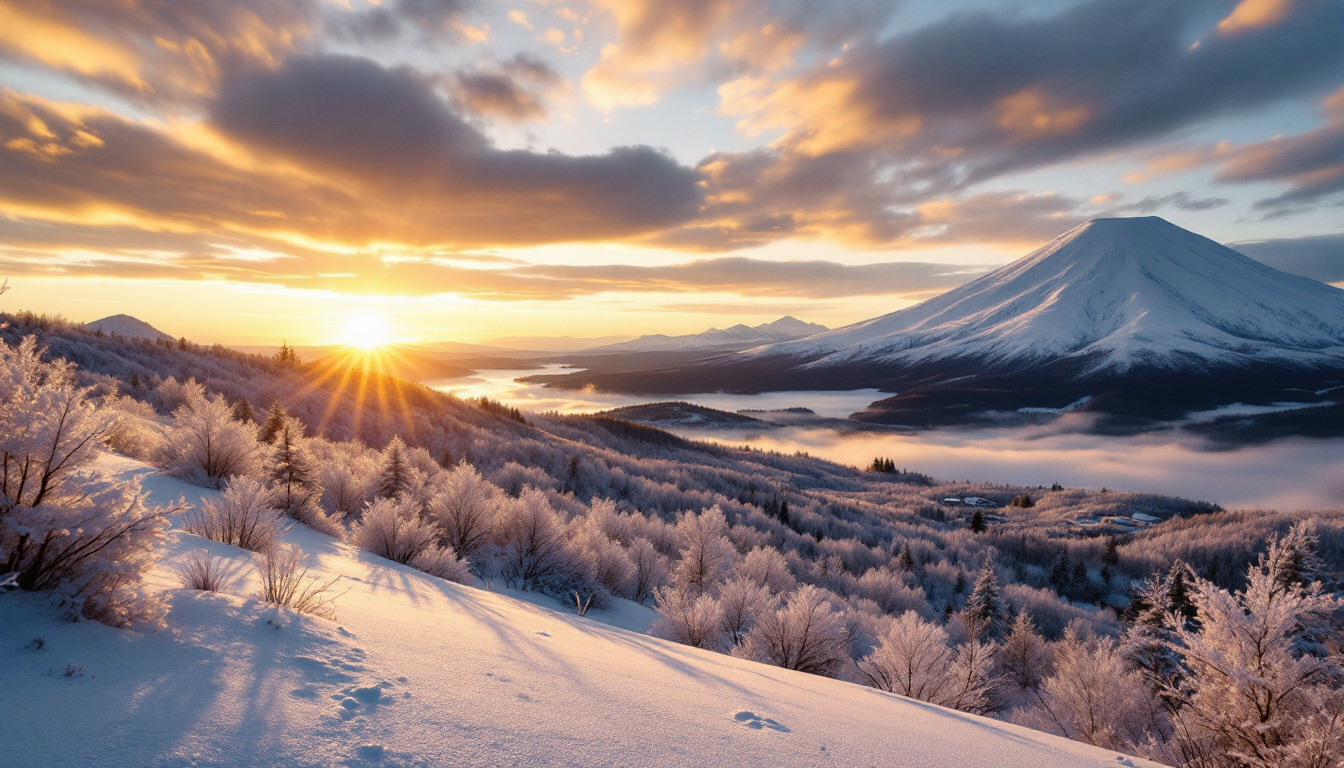
I have been writing about Hokkaido for almost a decade, which is to say that I have watched the international press treatment of the prefecture solidify, year by year, into a near-exclusive focus on the winter ski season. The treatment is not unreasonable — the Hokkaido powder, particularly in the Niseko-United area on the southwestern slope of Mount Niseko-Annupuri, is among the most consistent dry-snow skiing in the global northern hemisphere; the winter season runs reliably from late November through early April; the hotel and chalet inventory has been built specifically to serve the winter market — but the treatment is incomplete. Hokkaido in the two shoulder windows is meaningfully different from Hokkaido in winter, and the differences are worth attention from any guest whose Japan thinking has been dominated by the winter ski-trip narrative.
I made two trips to Hokkaido in the 2025-2026 cycle specifically to assess the shoulder windows: a ten-day trip to Niseko in late April and early May 2025 (timed to the cherry-blossom peak), and an eight-day trip to Furano in late September and early October 2025 (timed to the autumn-colour peak). Both trips were structured as land-based driving itineraries with a single base hotel and a series of day-trip excursions. Both trips ran in weather that was, by Hokkaido standards, almost ideal — mild daytime temperatures, low humidity, occasional but brief afternoon rain, exceptional evening light.
The May window in Niseko
The Niseko valley — the broad agricultural plain south of Mount Niseko-Annupuri and north of Mount Yotei, with the four principal ski resorts (Hirafu, Hanazono, Niseko Village, and Niseko Annupuri) arrayed around the southwestern flank of the mountain — is at its quietest in the second half of April and the first half of May. The winter season ends in early April; the summer hiking season does not begin in earnest until mid-June. The May window is, in working terms, a quiet six-week period during which the resort operators run reduced staffing, the lift system is closed for annual maintenance, and the principal road network through the valley carries only local traffic.
I based the trip at the Park Hyatt Niseko Hanazono — a 100-room ski hotel on the Hanazono side of the mountain that operates a meaningfully different programme in the shoulder windows than in the winter peak. The hotel rate in early May ran JPY 38,000 per night for a standard king room with mountain view, against the winter peak rate of JPY 220,000 for the same room. The hotel was running approximately 25 percent occupancy through the May window; the dining rooms ran one service per evening instead of three; the spa and the indoor pool were open on a reduced schedule. The staff were attentive, well-trained, and visibly grateful for the company.
The principal attraction of the May window is the cherry blossom. The Hokkaido cherry-blossom season lags Honshu by approximately three to four weeks; the Sapporo blossom (centred on the Maruyama Park in the western suburbs of the city) typically opens in the third or fourth week of April. The Niseko-area blossom follows a week later. On my trip in late April and early May 2025, the Niseko valley blossom was at peak in the first week of May; the principal viewing points are the Niseko Town Hall complex (a small avenue of mature cherry trees), the lower slopes of the Niseko Village resort, and a series of small farm roads on the southern side of the valley. The blossom is meaningfully less spectacular than the Kyoto or Tokyo peak — Hokkaido has the somei-yoshino variety in smaller numbers, with more of the local ezoyama-zakura native variety — but the absence of crowds at the principal viewing points produces a different and, in my view, more reflective experience.
The hiking season opens approximately May 15, with the lower-elevation trails accessible from that date. The upper Mount Yotei trails (the conical 1,898-metre stratovolcano that dominates the southern view from Niseko) remain snow-covered through early June. The Mount Niseko-Annupuri summit (1,308 metres) remains snow-bound through late June. The accessible May trails are the lower forest loops in the Hanazono area (the Hanazono 308 trail, the Mizuumi loop, the Annupuri lower traverse), the lake trails around Hangetsu-ko (the Half-Moon Lake in the western valley), and the wetland boardwalks at Goshiki Onsen. The lower-elevation hiking is meaningfully different from the alpine summer hiking of mid-July onwards — the trails are wet, the forest understory is dense with fresh growth, the bird life is at the peak of the spring migration — and is, in my view, the more interesting hiking window for guests whose hiking ambitions are moderate rather than alpine.
The dining in Niseko outside the winter is restricted but is not poor. The Park Hyatt’s principal restaurant (the Sashimi & Sushi Bar, run by chef Yusuke Tsumura) operates a full summer programme. The Aman Niseko (opened in 2024 in the Higashiyama area) operates similarly. The Niseko-Hirafu village retains approximately a third of its winter restaurant inventory through the May window; the Kamimura restaurant (the chef Yuichi Kamimura’s ten-seat counter, the principal Niseko fine-dining room) remains closed through the May window and reopens in late June.
The October window in Furano
The Furano region — the broad agricultural valley in central Hokkaido, approximately 200 kilometres east of Niseko, anchored by the small town of Furano and the surrounding network of farming villages — is at its most photographed in two windows: the lavender peak in early to mid-July (the Tomita Farm lavender fields are the iconic Hokkaido summer image) and the autumn-colour peak in the last days of September through the first week of October. The October window is, in working terms, substantially quieter than the July lavender window; the lavender draws domestic Japanese tour buses at substantial volume through the four-week peak, while the autumn window carries primarily independent travellers and a smaller volume of foreign visitors.
I based the second trip at the Fenix Furano — a 75-room luxury hotel in the Kitanomine area on the eastern slope of the Furano ski hill, opened 2018, operated by the Nisade group. The hotel rate in late September ran JPY 42,000 per night for a standard room with mountain view, against the winter peak rate of JPY 130,000. The hotel was running approximately 40 percent occupancy through the early October window — meaningfully busier than the May Niseko window, but still well below the winter peak.
The principal attraction of the October window is the autumn colour. The central Hokkaido deciduous forests — the birch, maple, larch, and rowan that dominate the lower slopes of the Daisetsuzan range to the east of Furano — turn approximately three weeks ahead of the Honshu schedule. The upper-elevation colour on the Daisetsuzan slopes typically peaks in the last days of September; the lower-elevation colour around the Furano valley typically peaks in the first week of October. The colour is more vibrant and more reliably timed than the Honshu equivalent (which is more weather-dependent and which often peaks in a narrow window that can be missed by even a few days of late-arriving warm weather).
The autumn excursion programme from Furano runs along several principal routes: the Sounkyo Gorge road into the Daisetsuzan National Park to the east (a one-and-a-half-hour drive from Furano, with the Sounkyo waterfalls and the Daisetsuzan ropeway as the principal stops), the Biei-Patchwork Road north of Furano (the rolling agricultural landscape made famous by the late photographer Shinzo Maeda, with a series of named viewpoints — the Mild Seven Hills, the Christmas Tree Tree, the Ken and Mary Tree — that are the principal photographic targets), and the Tokachidake Onsen high-valley road to the southeast (the high-elevation hot-spring ryokans clustered at 1,200 metres elevation, with direct access to the Tokachidake volcanic crater). All three routes carry meaningful traffic during the autumn-colour peak but are nowhere near the lavender-season congestion.
The Furano harvest season runs through the first three weeks of October. The principal local crops — cabbage, potato, pumpkin, corn, melon — are at active harvest through the period; many of the Furano farms operate open farm-stand programmes through October, with direct purchase from the farms at meaningful discount to the supermarket prices. The Furano cheese factory (the Furano Cheese Workshop, a small artisanal operation in the centre of town) runs through October. The Furano wine programme (the small Furano Wine Factory, the principal local wine producer) is in active harvest through October and offers tours through the period.
What the shoulder windows are for
The shoulder windows in Hokkaido are not the right answer for every guest. They are the wrong answer for guests whose entire Japan trip is built around skiing (the lift system is closed and the snow has melted). They are the wrong answer for guests who want the maximally polished hospitality programme (the hotels run reduced staffing and the principal restaurants run reduced menus). They are the wrong answer for guests who are looking for the high-volume social atmosphere of the Niseko winter season (the village is quiet and most of the bars are closed).
The shoulder windows are the right answer for guests who want to see the Hokkaido landscape — the volcanic mountains, the agricultural plains, the deciduous forests, the wetlands, the coastal cliffs — at the pace and the price point at which the landscape can actually be seen. The hotel inventory is available at substantial discount. The road network is uncrowded. The hiking trails are quiet. The agricultural land is in active production. The cherry blossom (in May) or the autumn colour (in October) is at peak. The light is exceptional. The hospitality, despite the reduced staffing, is in many ways more attentive than in the winter peak because the rooms are quieter.
For a guest who is making one Hokkaido trip in 2026 and whose interest is in the landscape rather than the snow, the May Niseko window or the October Furano window is the structural right answer. The cost is approximately one-third of the winter equivalent. The experience is meaningfully different. Both windows are bookable with two to three months of planning.
Standing Questions
- Why visit Hokkaido outside the ski season?
- The Hokkaido landscape is meaningfully different in late spring and early autumn than it is in winter. The high alpine valleys around Niseko in late May carry an exceptionally rich understory of wildflowers (lupine, alpine columbine, wild iris); the Furano region in late September runs through the most spectacular autumn colour in the Japanese archipelago (the deciduous birch and maple of the central Hokkaido forests turn approximately three weeks ahead of the Honshu schedule); the agricultural plain south of Furano is in active harvest through the first three weeks of October. The shoulder windows are also the only times of the year when the volcanic onsen at Yunokawa and at Noboribetsu are accessible without significant winter-driving complications.
- Where do I stay in Niseko outside the winter?
- The Park Hyatt Niseko Hanazono (in the Hanazono area on the eastern slope of Mount Niseko-Annupuri) operates a full summer programme with substantial discounts to the winter rates; the rooms run JPY 35,000 to 60,000 per night through May, June, and September against JPY 120,000 to 280,000 in the winter peak. The Aman Niseko opened in 2024 in the Higashiyama area and operates similarly. The small luxury chalet inventory — the J Sekka group, the Setsumon group, the Snowdog Village apartments — runs at meaningful discounts and is often available on short notice. The Ezo Crow private villa on the Hanazono side is the right answer for a multi-generational family trip.
- Where do I stay in Furano?
- The Fenix Furano (in the Kitanomine area on the eastern slope of the Furano ski hill, opened 2018) is the principal luxury hotel in central Furano and operates a full summer programme. The smaller Yado Furano (a six-room ryokan in central Furano) is the right answer for a more traditional Japanese stay. For a more remote base, the Tomamu Resort to the southeast offers The Tower and Risonare Tomamu in the high season; the autumn window is quieter. The Tokachidake Onsen ryokans in the high-elevation valley between Furano and Asahidake are the right answer for a more onsen-focused trip.
- What's the May window specifically?
- Cherry blossom in Hokkaido lags Honshu by approximately three to four weeks; the Sapporo blossom typically opens in the third or fourth week of April, with the Niseko blossom following a week later. The blossom is fully out across the Niseko valley through the first week of May and is generally finished by mid-May. The early hiking season opens approximately May 15 with the lower-elevation trails accessible (the upper Mount Yotei trails remain snow-covered through early June and the Mount Niseko-Annupuri summit remains snow-bound through late June). The lupine and lavender begin in the last days of May and continue through June. The cherry-blossom window in early May is the most photographed Hokkaido season after the winter.
- What's the October window?
- The autumn colour in central Hokkaido peaks approximately three weeks ahead of the Honshu schedule — the upper deciduous forests above Furano typically peak in the last days of September, with the valley-floor colour following in the first week of October. The Daisetsuzan range (the high mountains to the east of Furano) carries the most spectacular autumn colour in Japan and is accessible by car from Furano via the Sounkyo Gorge road. The Furano harvest season runs through the first three weeks of October — the cabbage, potato, pumpkin, and corn harvests are all active, with the central Furano farms running open farm-stand programmes through the period.