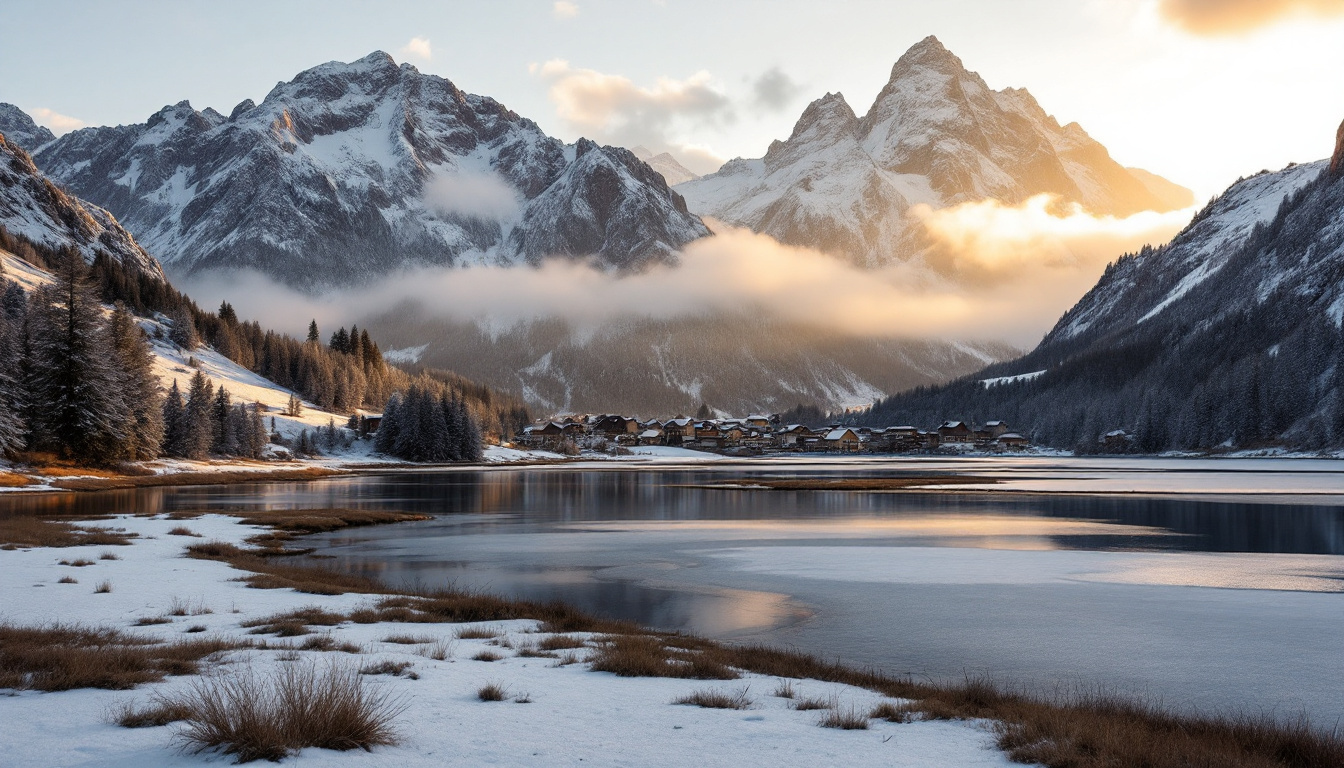
I arrived at Suvretta House at 16:30 on a Friday in early February 2026, having taken the 13:11 Glacier Express south from Chur and the five-minute hotel transfer up the long drive from the St Moritz station. The valley, as the train cleared the Julier Pass tunnel and dropped into the upper Engadine plateau, was deep under snow and lit by the particular hard winter light that the Engadine is known for — a low-angle light that comes off the snow at an unusual angle and that gives the valley its photographic quality. Suvretta House itself sits on a south-facing ridge above St Moritz proper, set back from the central village by a kilometre of forest, with a long view across the lake and the mountains to the south. The arrival approach — the long avenue of larches, the porte-cochère at the eastern wing, the white-and-blue painted shutters that the family have maintained since the hotel opened in 1912 — is one of the better hotel arrivals in the Alps.
This review is a six-night winter circuit through the upper Engadine — three nights at Suvretta House, three nights at Waldhaus Sils Maria in the smaller village of Sils, with the days split between St Moritz proper (White Turf, the Cresta Run, Corviglia for an afternoon ski), the lake circuit on cross-country skis, and the slower programme of the smaller villages. I was on the ground from 6 February through 12 February 2026, in the window that includes the first two White Turf Sundays and the deep middle of the high winter season.
The valley
The Engadine is the high alpine valley of the Inn River, running roughly southwest to northeast from the Maloja Pass down to the Austrian border at Martina, with the upper section (the Oberengadin, from Maloja to Cinuos-chel) sitting on a broad glacial plateau at approximately 1,800 metres above sea level. The plateau itself is unusual in alpine geography — most Alpine valleys are narrow, V-shaped, and oriented north-south or east-west; the upper Engadine is broad, flat-bottomed, and oriented along an east-west axis that captures sunlight through the full winter day. The plateau is studded with four lakes (St Moritz, Champfèr, Silvaplana, Sils) that form an almost continuous chain along the valley floor, all frozen between approximately mid-December and late March, all walkable, skiable, and (in the case of Lake St Moritz) used for racing through the deep winter.
The principal villages of the Oberengadin, from east to west along the valley:
St Moritz (1,775 metres; permanent population approximately 5,000; the dominant resort village of the valley, with the principal hotels, the largest concentration of luxury retail, the casino, and the Olympic infrastructure from the 1928 and 1948 winter games). St Moritz is the gravitational centre and the social centre of the Engadine winter, and most first-time visitors stay here.
Pontresina (1,805 metres; population approximately 2,000; the village three kilometres east of St Moritz, on the side road to the Bernina Pass; quieter, more traditional, with the better access to the Diavolezza and Lagalb ski areas and to the long cross-country trails of the Roseg valley). Pontresina is the right base for a guest who wants the central infrastructure without the central social scene.
Silvaplana (1,816 metres; population approximately 1,000; the village halfway down the valley between St Moritz and Sils; the centre of the Engadine summer kite-surfing world and, in winter, the access village for the Corvatsch ski area and for the long cross-country circuit around Lake Silvaplana).
Sils Maria (1,800 metres; population approximately 800 across the three small hamlets of Sils Maria, Sils Baselgia, and Sils Sentiero; the westernmost serious village of the valley, set between Lake Silvaplana and Lake Sils). Sils Maria is the village that Friedrich Nietzsche took as his summer residence between 1881 and 1888 (he wrote substantially of Also sprach Zarathustra here); Thomas Mann came here regularly between 1933 and his death in 1955; Hermann Hesse and Theodor Adorno spent significant time in the village in the post-war decades. The literary association is real and is still visible in the village register at the Nietzsche-Haus and at the Waldhaus.
Maloja (1,815 metres; population approximately 300; the final village of the Oberengadin, set at the head of the pass that drops south to the Bregaglia valley and on to Italy). Maloja is the village to walk to from Sils across the frozen lake (the trail is approximately 8 km on a well-marked route over the surface of Lake Sils and is one of the great winter walks in the Alps).
The two hotels
Suvretta House is the largest of the historic St Moritz houses and, in my reading, the most architecturally significant. The hotel was built by the engineer-hotelier Anton Bon in 1912 as a deliberate alternative to the more central Badrutt’s Palace and Kulm Hotel; the architect was the Zurich practice of Karl Coelestin Moser, and the building is one of the more confident examples of the heimatstil that defined Swiss alpine hotel architecture in the decade before the First World War. The hotel has remained in continuous family ownership since 1912 — currently in the fourth generation of the Bon-Candrian family — and the family’s editorial direction is visible throughout the building. The principal lobby (a single high-ceilinged double-height room with three working fireplaces, panelled in larch, with the original 1912 detail substantially intact) is one of the great hotel rooms in the Alps. The 180 rooms are distributed across the central building and two wings; the rooms in the central building are the larger and more interesting, with the corner doubles on the south facade carrying the best views. The room I had on the fourth floor of the central building (Room 412, a south-facing king at CHF 1,180 per night in February shoulder week) was 42 square metres with a small balcony, a working fireplace, and a deep claw-foot bathtub set under the window. The mattress was firm. The bathroom was the right size. The wifi was fast. The breakfast (a substantial buffet in the main dining room, with à la carte additions on a short menu) was the meal of the day at the hotel.
The hotel’s principal restaurant — Grand Restaurant, in the main dining room — was led on the three evenings I was at Suvretta by chef Marius Frehner, who came to the hotel from Hotel Schatzalp in Davos in 2022 and who is running a five-course menu (CHF 220, with wine pairing at CHF 165) that holds genuine interest. The opener on my second evening — a salt-cured Engadine arctic char with a small dressing of grilled fennel and a single drop of estate olive oil from the family’s private holdings in Liguria — was the best dish I ate at the hotel.
The Bobby’s Bar — the hotel’s principal bar, set in a small room off the main lobby with seating for approximately twenty — is the right place to sit after dinner. The bar is run by Stephan Hinden, eleven years at the hotel, who keeps a working collection of approximately 280 whiskies and who pours a precise old-fashioned. The bar closes at 01:00. I closed it twice.
Waldhaus Sils Maria — the second hotel of the circuit — is a different proposition. The Waldhaus, like Suvretta, has been in continuous family ownership since opening (in 1908, by the Giger family; currently in the fourth generation under Felix Dietrich) and the family’s editorial direction is, if anything, more visible than at Suvretta. The hotel is set on a small rise above the village of Sils Maria, with a 140-room building that is genuinely a Belle Époque survival: the lobby unchanged in any meaningful way since the 1930s, the dining room still served by the same brigade of formal black-and-white-uniformed waiters that the hotel has used since opening, the upper floors panelled in pine that has been re-oiled (not replaced) every seven years for a century. The guests at Waldhaus are different from the guests at Suvretta — older, more literary, with a higher proportion of returning visitors who have been coming to the hotel for forty years. The conversation at breakfast, on my second morning, ran in German, Italian, French, and English across the three tables nearest mine. The bookshop in the lobby — a small room with approximately 600 titles, weighted heavily toward German-language fiction and philosophy, with a strong Nietzsche section and a smaller Thomas Mann section — is the right place to spend a slow hour in the late afternoon.
The room at Waldhaus (Room 218, a south-facing double at CHF 860 per night) was smaller than the Suvretta room and substantially older in detail — the bathroom dated from a 1996 renovation, the bed was older still, the wallpaper carried a small wear pattern in one corner near the window. The hotel does not present itself as a sharp modern operation, and the guest who wants that should stay at Suvretta. The hotel does present itself as an unbroken late-Habsburg alpine institution, and the guest who wants that should book at Waldhaus a year ahead.
The cooking at Waldhaus, in the main dining room, is more conservative than at Suvretta. A four-course set menu on a daily rotation, served as part of the half-board arrangement that most Waldhaus guests are on. The cooking is competent without being ambitious; the wine list is unusually deep on Swiss producers (a serious working section on the Valais, particularly on the older Cornalin and Humagne Rouge wines from producers like Marie-Thérèse Chappaz). The right approach at Waldhaus is to take half-board, drink the Swiss wine, and treat the dining room as the social institution it is.
White Turf
The first Sunday of White Turf 2026 — Sunday 8 February — was the centre of the trip. I walked down from Suvretta House at 11:00, took the small free shuttle bus from the village square to the lake, and was at the grandstand by 11:30 for the first race at 11:45. The setting, on a clear winter day with the temperature at minus seven and the sky at full clear, was one of the great winter scenes in European sport: the frozen lake (approximately 90 hectares of ice, with the racing oval marked out on the central section with safety barriers and a packed snow surface), the long grandstand on the western shore, the Corviglia mountain rising behind to the north, the line of luxury motor cars parked along the lake road for the day. The crowd, for a first Sunday, was approximately 12,000 — predominantly Swiss and German, with a recognisable contingent of Italian and British visitors, and a small but visible group of Russian visitors (the Russian presence at White Turf has been quieter since 2022 but has not disappeared).
The racing on the first Sunday ran six races between 11:45 and 16:30: two flat races on the snow oval (jockeys in standard racing silks, on standard flat-racing thoroughbreds, with the snow surface producing slower times than turf or dirt would), two trotting races (with the trotters pulling small sulkies on the same surface), one skikjöring race (the world-exclusive discipline; the rider on skis, harnessed to and pulled by an unmounted galloping horse, with the jockey-driver controlling pace through the reins held overhand), and one ceremonial Arabian race. The skikjöring is the discipline that the meet is internationally known for and the one that justifies the trip on its own. The technique is genuinely difficult — the rider must hold a working racing line on skis through tight turns at speeds of 50 km/h or more, while the horse runs free — and the discipline takes years to learn. The 2026 first-Sunday skikjöring race was won by Franco Moro on Heccento, a horse that has run successfully at the meet for four consecutive seasons.
The grandstand seating at White Turf is structured into a hierarchy of access: general admission (CHF 80) gives ground-level standing access along the lake edge; the Trackside seats (CHF 220) give covered seating with a clear view of the home straight; the Champagne Tent (CHF 480, includes catering) gives a heated marquee with table service and a private viewing terrace; the VIP Lounge (CHF 980, includes catering and access to the paddock) gives the most premium access. I had a Trackside seat for the first Sunday and the Champagne Tent for the second; the difference between the two is substantial. The Trackside seat is the right purchase for a first-time visitor; the Champagne Tent is the right purchase for a guest who wants the warmer day and the catering.
The race after-party at the Suvretta House Bobby’s Bar on the first Sunday evening, beginning at approximately 19:30 and running until close, was one of the better hotel-bar nights of the European winter calendar. The bar was full to a comfortable density. The crowd was approximately half Suvretta guests, half visitors from elsewhere in the valley.
The Cresta Run
I had booked a Junction-start beginner session on the Cresta Run for the Tuesday morning of week one, on a slot that I had reserved in advance through the St Moritz Tobogganing Club office at the Cresta Run clubhouse on Via Maistra. The booking process is unusual: same-day decisions only (so that the club can assess ice conditions in the early morning), no online booking, payment in cash (CHF 80 for a single Junction ride; CHF 240 for the introductory four-ride package, which is the right purchase for a first-time rider). The Club admitted women as active members in late 2018 after a near-century exclusion — the membership voted by a two-thirds majority to restore active membership for women, after the previous “non-active” arrangement that had been in place since 1929. The Run had no female active riders in 2018; it has had a small but growing female contingent each season since.
The session itself runs as follows. Arrive at the clubhouse at 07:00. Pay the fee. Sign the indemnity (which is, candidly, the most direct indemnity I have ever signed at a sporting venue). Change in the small members’ room into the rented riding kit (heavy canvas coveralls, leather elbow and knee pads, hand-rakes that strap to the toes of the boots and serve as the only brake on the course). Walk fifteen minutes to the Junction start at 1,712 metres altitude. Receive a five-minute briefing from the duty Tower (the senior club member running the morning’s session). Lie face-down on the rented skeleton sled, hand-rakes ready, head approximately 25 centimetres from the ice. Push off into the chute.
The Junction start drops 95 metres in altitude over a course length of approximately 850 metres. Top speed for a beginner runs 60-75 km/h, depending on weight and form. The course runs through twelve named bends (Church Leap, Battledore, Shuttlecock — the last being the most famous bend on the course and the one where beginners almost always lose form and are flung clear of the sled into the safety bank). My first ride: 47 seconds Junction-to-Finish, no fall, no especially good form, an instinctive heavy braking at Church Leap that the Tower at the bottom remarked on (with a small head shake) when I returned to the clubhouse. My second ride: 41 seconds, slightly better form, lighter braking. My third ride: 36 seconds, an unexpected loss of line through Shuttlecock that ended with my coming off the sled into the safety bank — the genuinely Cresta experience, which everyone who rides the course must have at some point. My fourth ride: I declined.
The Cresta Run is the small set of sporting experiences in Europe that genuinely cannot be replicated elsewhere. The morning session — the early start, the cold, the silence of the ice, the briefing from a man in a tweed jacket and a club tie, the absolute physical commitment of the first push from Junction — is one of the small set of European winter experiences I would tell any reasonably athletic guest to organise a trip around. The Run has its critics (the absence of brakes, the substantial injury rate, the unbroken-by-modernity character of the club) and the critics are not wrong about the facts; they are wrong about the conclusion. The Cresta is the genuine article. It is also, after 141 seasons, still being run by the original club on the original course in the original way.
The lake circuit
The experience I would press hardest on a returning Engadine visitor is the lake circuit on cross-country skis. The upper Engadine maintains over 200 kilometres of marked cross-country trails through the winter season, with the principal circuit running the length of the four lakes from St Moritz at the eastern end to Maloja at the western end. The trails are double-tracked (classic style on the outer track, skating style on the inner track), groomed daily by the regional cross-country operation. Equipment rental is available at any of half-a-dozen shops in the valley (Salastrains in St Moritz; Boom Sports in Pontresina; the Sils Maria village rental at the lakeside) for approximately CHF 65 per day with boots and poles.
I skied the full lake circuit (St Moritz to Maloja and back, approximately 36 kilometres) on the Wednesday of week one in a slow six-hour day, leaving the Suvretta trailhead at 09:30 and returning at approximately 15:45. The day was clear, the temperature held between minus four and plus two through the afternoon, the trails were in good condition. The route runs along the southern shore of Lake St Moritz, crosses Champfèr on the lake surface, runs the length of Lake Silvaplana along its northern shore, and crosses Lake Sils to Sils Maria; the return from Sils to Maloja and back to St Moritz follows the same route in reverse. The light on the day was the particular pale-blue light that the high Engadine produces under deep winter cold; the silence of the lake surface (no road, no aircraft noise, no human noise once you are away from the villages) is one of the experiences the brochures do not lead on.
A four-hour version of the same circuit — St Moritz to Sils Maria and back, approximately 20 kilometres — is the right outing for a guest who does not want to commit to the full day. A two-hour version (the loop around Lake Silvaplana from the Silvaplana village trailhead, approximately 11 kilometres) is the right outing for a first-time cross-country skier and is the loop I would recommend to almost any guest on a winter visit.
The food
The Engadine food culture is, in the main, conservative — heavy on alpine meat and cheese, with strong traditions in air-dried beef (Bündnerfleisch from the Graubünden producers), local cheese (the alpine semi-hard cheeses from the small producers in the Bregaglia valley to the south), and the regional pasta and dumpling traditions (capuns, pizzoccheri, plain Engadine ravioli). The hotel kitchens at the major properties run an internationalised version of this tradition with substantial Italian and French influence; the village restaurants run a more honest local version.
Three village restaurants worth recommending. La Marmite, the on-mountain restaurant at the top of the Corviglia ski area, run by chef Reto Mathis, which serves a working alpine menu at a quality that justifies the cable car. La Stüva at the Hotel Wahlhaus in Sils, a small thirty-cover room with a single set menu of four courses (CHF 150) drawn predominantly from valley producers. Ecco St Moritz at the Giardino Mountain hotel in Champfèr, the kitchen led by chef Rolf Fliegauf, which holds two Michelin stars and runs a longer tasting menu (CHF 320) in a more internationally accented register; the booking is harder to land than the others.
The breakfast at Suvretta House and the half-board dinner at Waldhaus are both the right meals at their respective hotels and do not need to be replaced by external bookings.
Verdict
The Engadine in winter is one of the small set of European destinations that has held its character through the post-pandemic reorganisation of European tourism. The valley is busy through February but it is not crowded in the way that lower alpine resorts have become. The infrastructure (the trains, the cable cars, the hotel operations) is competent without being overwrought. The light is the particular high-altitude winter light that defines the upper Engadine. The walking, the skiing (both alpine and cross-country), the eating, and the slow days in the smaller villages combine into a circuit that is unusually well-balanced for a destination of this scale.
Three nights at Suvretta House (book the south-facing rooms in the central building, take breakfast at the Grand Restaurant, take an evening at Bobby’s Bar) and three nights at Waldhaus Sils Maria (take half-board, take an afternoon in the bookshop, take the morning walk across the frozen Lake Sils to Maloja) is the right six-night structure. Add a day at White Turf if the timing falls right. Take the Junction session on the Cresta Run if you are reasonably athletic and prepared to sign the indemnity. Take the cross-country circuit at least to Sils and back. Eat at La Marmite for one lunch and at La Stüva for one dinner.
I will go back. I would like to do the full Engadin Skimarathon week in March (the 42-kilometre cross-country race that the valley hosts annually on the second weekend of March, with approximately 14,000 participants on the start line), I would like to spend a week at Waldhaus alone in late January when the bookshop is at its quietest, and I would like to see the Cresta from the Top start rather than the Junction — which is the season’s commitment, the deeper indemnity, and the harder ride. I will report back.
Verification
Filed against the following sources, last verified on February 27, 2026. The desk re-checks the source URLs on every dated modification of the piece.
- https://www.engadin.ch/en/events/white-turf-st-moritz-2026
- https://www.sohorse.eu/en/news/2026/02/07/white-turf-st-moritz-2026-ouverture/
- https://www.cresta-run.com/calendar
- https://www.cresta-run.com/season/2025-26
- https://www.stmoritz.com/en/directory/sports/cresta-run
- https://en.wikipedia.org/wiki/Cresta_Run
- https://www.kulm.com/en/journal/women-on-the-cresta-run
- https://www.swissinfo.ch/eng/alpine-environment/break-with-tradition_making-way-for-women-at-the-dangerous-cresta-run/44753450
- https://www.myswitzerland.com/en-us/destinations/upper-engadine-lakes/
- https://en.wikipedia.org/wiki/Engadin
- https://en.wikipedia.org/wiki/Lake_Silvaplana
- https://badruttspalace.com/en/winter/accommodation/rooms/
- https://www.j2ski.com/ski_hotels/Switzerland/St_Moritz/Suvretta_House.html
Standing Questions
- Where do I stay?
- Three serious options. Suvretta House (St Moritz, 180 rooms, family-run since 1912, the most architecturally substantial and arguably the quietest of the major St Moritz houses; rates from CHF 950 per night in February). Badrutt's Palace (St Moritz, 155 rooms, the better-known of the historic St Moritz properties, with the more visible social scene; rates from approximately CHF 1,100 per night in February). Kulm Hotel (St Moritz, 167 rooms, the oldest hotel in the Alps continuously operating under family ownership; rates from CHF 880). For a quieter base, Waldhaus Sils Maria in the village of Sils (the Mann-Hesse-Adorno literary base, 140 rooms, family-run since 1908, the right answer for a guest who wants the high valley without the central St Moritz scene; rates from CHF 720).
- What is White Turf?
- White Turf is the horse racing meet held on the frozen surface of Lake St Moritz across three consecutive Sundays in February — in 2026, the racing days were Sunday 8 February, Sunday 15 February, and Sunday 22 February. The meet runs flat racing, trotting, and the world-exclusive skikjöring discipline (jockey on skis, harnessed to and pulled by an unmounted horse) over six races per day with approximately CHF 100,000 in prize money per Sunday. The setting — the frozen lake, the Engadine mountains behind, the rope-line of grandstand seating along the western shore — is one of the great winter scenes in European sport.
- What about the Cresta Run?
- The Cresta Run is the natural-ice skeleton-sled course that runs 1,212 metres from Top to Finish along the valley side between St Moritz and Celerina, dropping 157 metres in altitude. It is owned and operated by the St Moritz Tobogganing Club, founded in 1885; the club opened active membership to women in 2018 after a near-century exclusion. Visitors can take instruction from the Junction start in the early-morning programme. The season runs from late December through late February depending on ice conditions; bookings are made through the club office and require a same-day decision.
- Is the skiing the point?
- Not quite. The Engadine has three ski areas — Corviglia (above St Moritz, the largest), Corvatsch (above Silvaplana, the most architecturally interesting summit station), and Diavolezza-Lagalb (above Pontresina, the more serious technical terrain). The skiing is good without being among the very best in the Alps. The point of the Engadine in winter is the broader combination — the high-altitude light, the lakes, the cross-country trails (200+ km of marked classic and skating tracks), the village walks, the food, and the historic hotel architecture. The skiing is one of seven or eight reasons to be there.
- How do I get there?
- Fly to Zurich (ZRH). The standard onward connection is the train (Zurich HB to St Moritz via Chur, 3h30m, on the Glacier Express line south of Chur — one of the great rail journeys in Europe, recommended at full daylight). The faster option is a private car transfer (3h00m direct in winter conditions, longer if the Julier Pass is closed and the route diverts via the Bernina). The slowest option (and the one I would recommend for a returning guest) is the night train from Hamburg or Amsterdam to Zurich, with the morning Glacier Express connection south.