I had a 17:30 reservation at Le Bernardin on a Tuesday in early January 2026, the second week the restaurant was open after the holiday closure. I walked north from the Bryant Park subway stop in light snow and arrived at 17:23. The doorman, a man named Charles who has been at the entrance since approximately 2009, knew me from a meal there in 2019 and remembered which table I had taken. The coat-check accepted my coat. Wine director Aldo Sohm, the floor’s senior figure, walked me to table fourteen, a banquette on the south wall directly below the Ran Ortner wave photograph. The room at 17:30 on a Tuesday in January was approximately half-full — a quiet pre-theatre window before the 19:00 wave of bookings would fill it.
Le Bernardin is the longest continuously held three-Michelin-star restaurant in New York City. The kitchen has held three stars every year since the New York Michelin Guide debuted with the 2006 edition, a twenty-year run that no other restaurant in the city can match. Eric Ripert, the executive chef, has been at the restaurant since 1991 and in charge of the kitchen since 1994, when Gilbert Le Coze (the co-founder of the New York operation) died of a heart attack at age forty-nine. Maguy Le Coze, Gilbert’s sister and the operation’s front-of-house co-founder, remains the principal owner and is at the restaurant several nights a week.
The kitchen is a seafood kitchen. This was the founding concept of the Paris original in 1972 and the New York version in 1986 — a French fine-dining restaurant organised around fish, where every primary course on the prix fixe is from the sea. The kitchen has built thirty-two years of refinement on top of this single decision. There is no other three-star restaurant in the United States that has held to a single-category specialisation at this level for this long.
The room
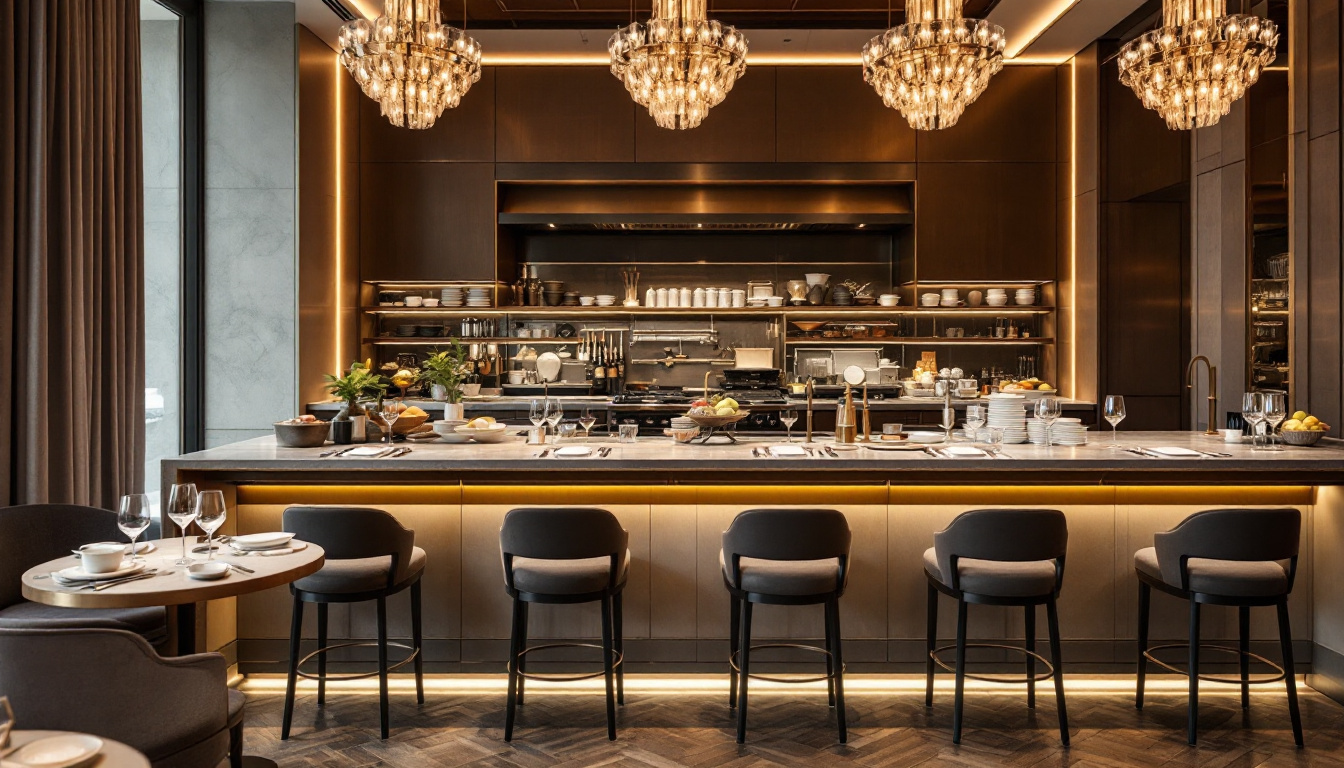
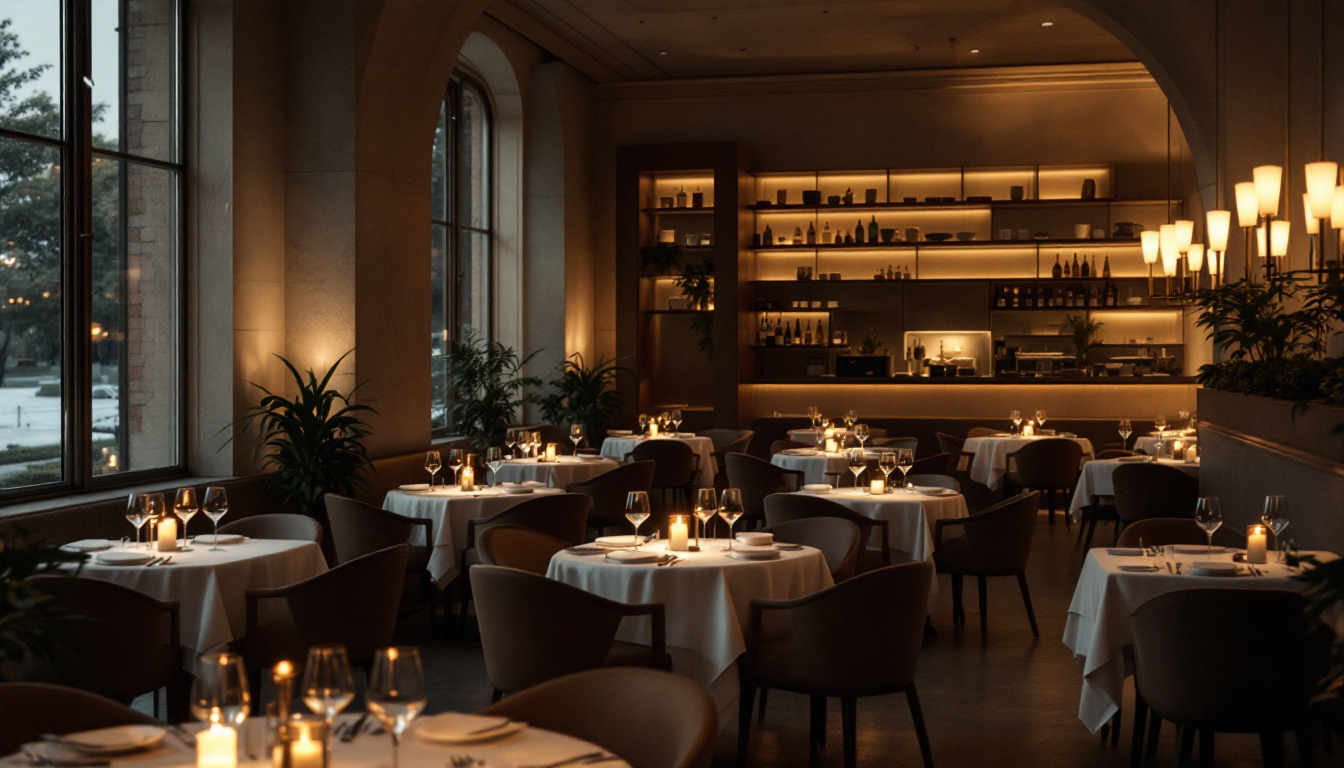
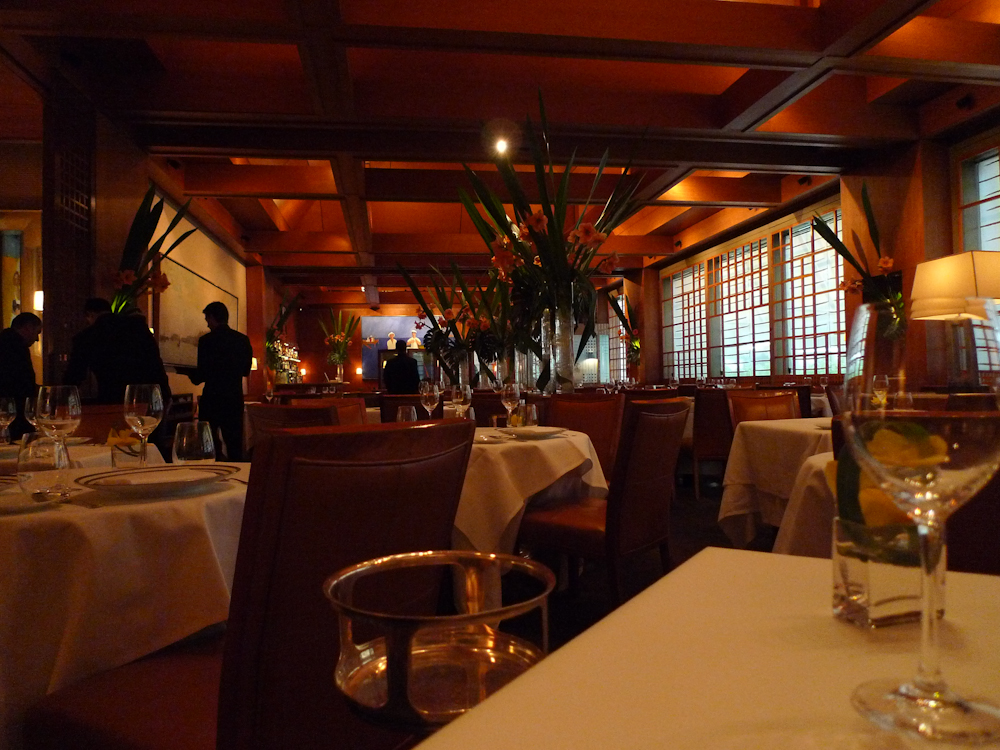
The dining room at Le Bernardin takes the entire ground floor of the Equitable Building’s restaurant space — approximately 8,000 square feet, organised in a single long rectangular hall with a low coffered ceiling and a slightly raised area at the back that contains the chef’s tasting room. The room was redesigned in 2011 by Bentel & Bentel, the New York firm that has worked on most of the city’s serious three-star dining rooms in the past two decades; the redesign moved the room from the original dark-wood-and-mirrors French bistro vocabulary into a contemporary Manhattan idiom of pale grey, white linen, and bleached-oak panelling. The lighting is warm and dropped low over the tables.
The room’s defining piece of art is the Ran Ortner photograph on the south wall — a sixteen-foot-wide canvas of a single ocean wave, taken by Ortner off the Long Island coast in 2009 and installed at Le Bernardin in 2011. The piece is one of the most quietly powerful single pieces of restaurant art in New York, and it sets the room’s mood — the wave is the entire west elevation of the dining room and is in the peripheral vision of every diner across the meal. The lighting on the photograph is calibrated to the dining-room lighting and dims slightly through the evening.
Service is led by wine director Aldo Sohm, the floor’s senior figure, with a brigade of fifteen across the room. The team’s pacing is the New York three-star standard — courses arrive promptly, the table is checked frequently without being interrupted, the wine is poured at the right intervals.
The menu
The menu at Le Bernardin is organised in three formal categories that have been the kitchen’s structural framework since the Le Coze era: ‘Almost Raw,’ ‘Barely Touched,’ and ‘Lightly Cooked.’ The categories are themselves a piece of the kitchen’s philosophy — the central proposition is that the highest expression of fine seafood cooking is the minimum intervention required to bring the ingredient to the plate, and the categories represent a continuum of intervention from least to most.
The eight-course chef’s tasting menu that I took ran across the three categories with two desserts at close. The menu structure was as follows.
The opening course was a small piece of Hokkaido scallop served raw, with a single drop of yuzu juice and a thin slice of fresh wasabi root, on a chilled marble plate. The course is the kitchen’s signature opening and has been on the menu in essentially the same form since 2002. The scallop sourcing is the kitchen’s responsibility (a small Tokyo wholesaler that ships overnight to JFK twice weekly), and the cooking on the course is, in the strict sense, no cooking at all — the kitchen’s intervention is the cure and the cut, not the heat. The scallop on this evening was the right firmness, the right cold, the right sweetness.
The second course — a single piece of cured Tasmanian sea trout, draped over a small mound of cucumber granita with a single petal of borage flower — was the menu’s ‘Almost Raw’ formal piece. The cure was a short brine of salt, sugar, and dill (four hours), and the serving temperature was just above freezing. The cucumber granita underneath was the kitchen’s contribution of acid and cold; the borage flower (from a small farm in the Hudson Valley) was the visual finish.
The third course was the menu’s first ‘Barely Touched’ piece — a small disc of Hokkaido uni (sea urchin roe), served on a single warm toast of brioche with a thin layer of dashi-cured butter and a small spoon of caviar from a Russian producer (Sterling Caviar, a US producer the kitchen has worked with since 2018, has replaced the Russian caviar that the menu carried before sanctions). The course is the kitchen’s most luxurious in raw ingredient cost — the uni was approximately fifteen grams per plate at a wholesale cost of roughly USD 40, and the caviar was approximately ten grams at USD 80 — and the cooking is the toast and the butter and not much else.
The fourth course was the menu’s first ‘Lightly Cooked’ piece — a single piece of pan-seared turbot, sourced from a small producer in the North Sea, served on a small bed of warm leek fondue with a brown-butter beurre blanc. The cooking on the turbot was forty-five seconds per side over high heat with a finish under the salamander; the fish was perfectly translucent at the centre. The leek fondue was the kitchen’s quietest piece of supporting work — a slow cook of finely sliced leek in butter for two hours, finished with a small splash of dry sherry and a turn of fresh thyme.
The fifth course was the menu’s most technically demanding — a single piece of grilled Atlantic black bass, sourced from a small day-boat operator on Long Island, served whole on the plate with the skin scored and crisped under the broiler. The bass was cooked over open flame on a small cast-iron grill in the kitchen, the skin caramelised to a deep amber, the flesh still moist at the centre. The accompaniment was a small spoon of fermented chili relish that the kitchen makes in-house and a single curl of pickled ginger.
The sixth course was the menu’s substantial main — a single piece of slow-roasted halibut, cooked at low temperature (52°C for twenty-two minutes) in a small water bath, then briefly finished under the salamander to crisp the surface. The halibut was sourced from a small producer in Alaska, was at the optimal seasonal moment in January for the species, and was the menu’s most precisely controlled piece of cooking. The sauce was a sauce vierge — a warm vinaigrette of olive oil, lemon, parsley, and chopped tomato — that the kitchen has carried since the Le Coze era.
The seventh course was the menu’s one concession to land protein — a small piece of slow-roasted duck breast, dry-aged for fourteen days, served with a single piece of confit duck leg and a small pool of duck jus reduction. The duck was the menu’s quietest piece of cooking and was the moment to recalibrate the palate before the desserts. The duck was sourced from D’Artagnan, the New Jersey poultry supplier that has worked with the New York three-star scene since the 1980s.
The eighth and final savoury course was a small bowl of black-truffle risotto with a single shaving of fresh Périgord truffle (sourced through Urbani Truffles, the New York wholesaler) and a small pool of brown butter. The risotto is one of the kitchen’s older standing dishes and has been on the dinner menu in some form since 2008.
The dessert sequence — two desserts plus a mignardise programme — ran through a small frozen yuzu sorbet with a single piece of grilled meringue, a more substantial chocolate-and-hazelnut pastry that the patisserie team has run as a standing dish since 2015, and a closing tray of eight mignardises brought to the table at the close.
The wine
The wine list at Le Bernardin is the most serious seafood wine list in New York and one of the three most serious in the United States. The list runs to approximately 1,400 references, weighted heavily toward white Burgundy (a Domaine Leflaive vertical from 1990 to 2020 is the cellar’s spine) and German Riesling (a deep Trockenbeerenauslese programme that the cellar has been building since the early 1990s). The list is run by Aldo Sohm, who took over from David Gordon in 2007 and who has built one of the most thoughtful contemporary American wine programmes in the country.
The pairing programme on the tasting menu was the classic pairing at USD 220 per guest, which ran seven wines across the eight courses. The standout pairings were a 2017 Domaine Roulot Meursault les Tessons with the turbot and a 2009 Egon Müller Scharzhofberger Spätlese with the black bass — both were the right wines for the right courses, and the pairing as a whole was the most technically considered seafood pairing I have taken in New York.
For diners who prefer to drink by the bottle, the list’s strongest sections are the white Burgundy (where Sohm has built relationships with most of the small Côte de Beaune producers) and the German Riesling (where the Egon Müller and Joh. Jos. Prüm verticals are unusually deep). The list also carries a useful small section on serious sake, including several bottlings from the Niigata producer Hakkaisan that are difficult to find elsewhere in New York.
The verdict
Le Bernardin is the New York three-star that has done the same thing at the same level for the longest. There is no other restaurant in the city that has held three stars across the entire twenty-year history of the New York Michelin Guide. There is no other seafood restaurant in the United States that has stayed at this technical level across three decades. Eric Ripert’s contribution, across thirty-two years, has been the quiet refinement of a single technical idea — that the highest expression of seafood cooking is the minimum intervention required to bring the ingredient cleanly to the plate — and the kitchen at 51st Street in 2026 is the most fully developed version of that idea in operation.
The bill, for the eight-course tasting with the classic pairing and service, came to USD 712 per guest. The pacing was three hours and forty minutes. The room emptied gradually between 22:00 and 23:00. I walked the eight blocks south to my hotel through the snow.
Le Bernardin is the New York three-star to book first if you are visiting the city to eat. It is the kitchen that defines what the New York three-star programme has been across the past two decades, and it is the room that, more than any other in the city, will give a visitor a fully fluent experience of what New York fine dining at the top can do.
Verification
Filed against the following sources, last verified on March 9, 2026. The desk re-checks the source URLs on every dated modification of the piece.
- https://www.le-bernardin.com/
- https://www.le-bernardin.com/about
- https://www.cbsnews.com/news/le-bernardin-at-50-chef-eric-ripert/
- https://guide.michelin.com/us/en/new-york-state/new-york/restaurant/le-bernardin
- https://en.wikipedia.org/wiki/Eric_Ripert
Standing Questions
- Where is Le Bernardin and what does the room look like?
- Le Bernardin sits at 155 West 51st Street, on the south side of the block between Sixth and Seventh Avenues, two minutes' walk south of Radio City Music Hall. The room occupies the ground floor of the Equitable Building, a 1985 Skidmore Owings & Merrill commission, and was last redesigned in 2011 by Bentel & Bentel. The redesign moved the room from the original 1986 dark-wood-and-mirrors French bistro vocabulary into a contemporary Manhattan dining-room idiom — a long open dining hall in pale grey and white, with a single large Ran Ortner photograph (a sixteen-foot canvas of an open ocean wave) on the south wall. The room takes approximately eighty covers across forty tables.
- What are the menu options and what do they cost?
- Lunch is offered as a four-course prix fixe at USD 105 per guest, with options at each course. Dinner is offered as a four-course prix fixe at USD 200 and as an eight-course chef's tasting menu at USD 360. The wine pairing on the eight-course tasting runs USD 220 (classic) or USD 410 (reserve). The kitchen also runs a small chef's tasting room at the back (six seats, dinner only) that takes an upgraded menu at USD 480 with a more theatrical service format. The headline tasting at USD 360 is the right format for first-time visitors; the chef's tasting room is for returning diners.
- Why is Le Bernardin specifically a seafood restaurant?
- Maguy and Gilbert Le Coze grew up in their family's hotel-restaurant in Port-Louis, on the Brittany coast, where their father worked the fish. The original Le Bernardin in Paris (1972) was explicitly conceived as a seafood-only French restaurant — a then-radical idea, since seafood was conventionally treated as one course among many at a French fine-dining menu rather than as the centre of the kitchen. The Le Cozes brought the seafood-only concept to New York in 1986 and Eric Ripert has continued it. The menu does include a small offal-and-meat sidebar (typically two or three preparations across the prix fixe), but the kitchen's identity is the sea.
- How do I book?
- Reservations open ninety days in advance via Resy. The window opens at 09:00 New York time and prime dinner slots (Friday 19:30, Saturday 19:00) are typically allocated within ten minutes. Lunch is more achievable inside thirty days. The chef's tasting room at the back requires a longer lead — book six months out for a weekend seat. The restaurant accepts walk-ins at the bar (eight seats) where guests can order from a small bar menu of three or four small seafood plates; the bar is the right answer for a solo dinner or a quick stop.
- Is Ripert in the kitchen?
- Yes, most services. Ripert has remained an active executive chef for the entire thirty-two years of his tenure and is in the kitchen for the majority of weeknight dinner services when he is in New York. He travels for the Anthony Bourdain Foundation, for the Aspen Food & Wine Festival, and for periodic teaching commitments, but he has structured his schedule around the restaurant. If you want to verify whether he is in the kitchen on a specific night, the maître d' can confirm at booking.