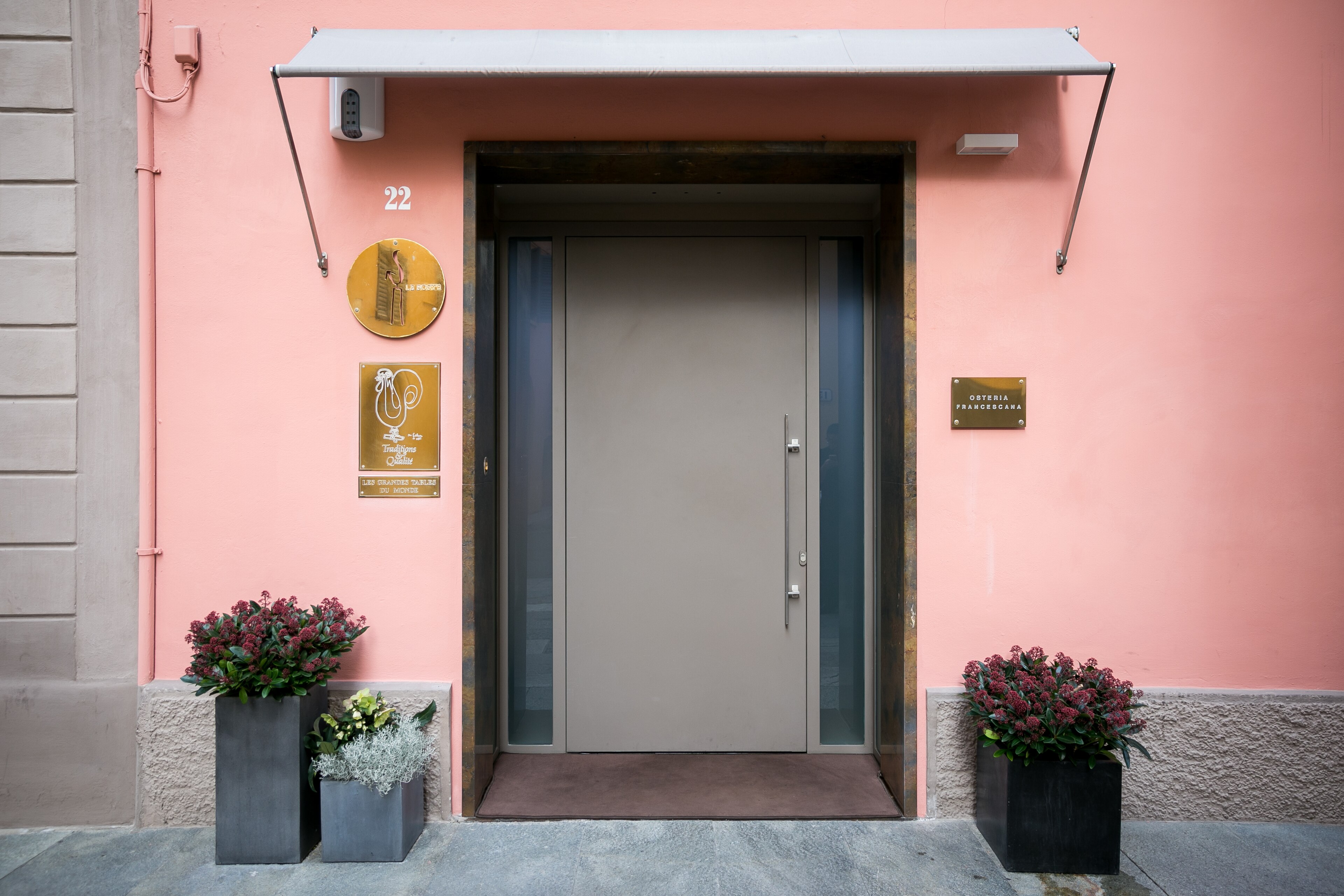
I had a 20:00 reservation at Osteria Francescana on a Friday in mid-April 2026, and I had driven from Casa Maria Luigia — Bottura’s own country-house hotel fifteen minutes northeast of Modena — into the centre of the city at 19:25. I parked in the small public garage two blocks east of the restaurant and walked the short distance through the central Modena medieval grid to Via Stella. The Osteria Francescana building, in the soft Italian spring twilight, was a small two-storey medieval house with a single wooden door at street level and no exterior signage. The maître d’, Beppe Palmieri (who has been at the restaurant since 1995 — he is the longest-tenured member of the operation aside from Bottura himself), met me at the front door and walked me through the small entry hall to table six in the main dining room.
Osteria Francescana is the working project of Massimo Bottura, who opened the restaurant in 1995 at the age of thirty-two. Bottura had trained at a series of small Italian regional kitchens through his twenties and had spent a formative period at the École hôtelière de Lausanne and then at the El Bulli kitchen with Ferran Adrià in the early 1990s. He returned to Modena in 1995 to open his own room, with the explicit intention of doing something genuinely different from the regional Emilian tradition — the modernist intervention in classical Italian cooking that has defined his career.
The early years were difficult. The kitchen was, in its first decade, the most controversial single restaurant in northern Italy — the local Modena food scene rejected Bottura’s modernist framework as a betrayal of regional tradition, and the restaurant lost money for most of its first ten years. The first Michelin star came in 2002. The second came in 2006. The third came in 2011 and was, at the time, the most controversial three-star award in modern Italian Michelin history — the Italian guide team’s decision to award the third star to a kitchen explicitly modernising the regional tradition was widely debated, and several prominent Italian critics publicly questioned the award.
The kitchen has held three stars and a Michelin Green Star continuously since 2011. In 2016 and 2018, Osteria Francescana was ranked No. 1 on the World’s 50 Best list — twice — and is the only Italian kitchen ever to hold the top position. Bottura himself received the Best Visionary award at the Best Chef Awards in 2025 and the Icon Award the same year. He is, at sixty-three in 2026, the most consequential single Italian chef of his generation.
I am writing this review four days after the meal.
The room
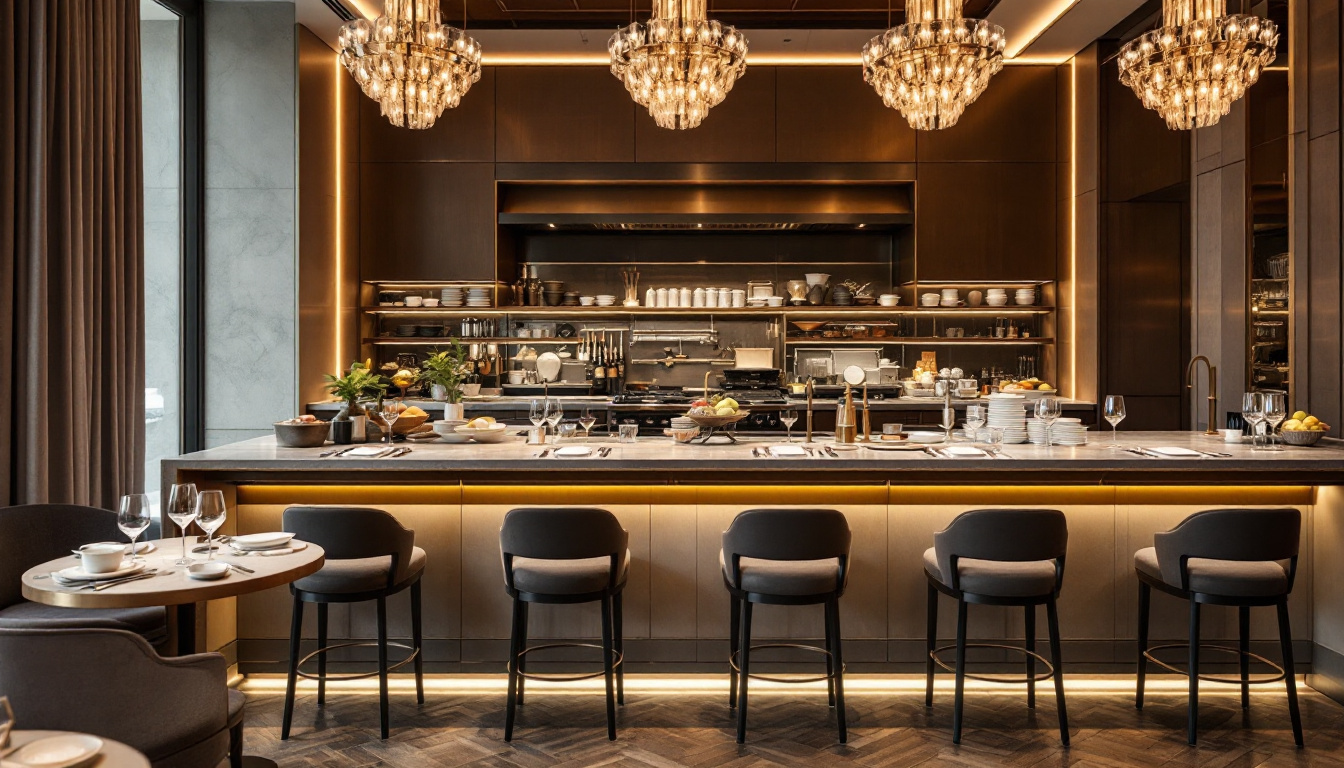
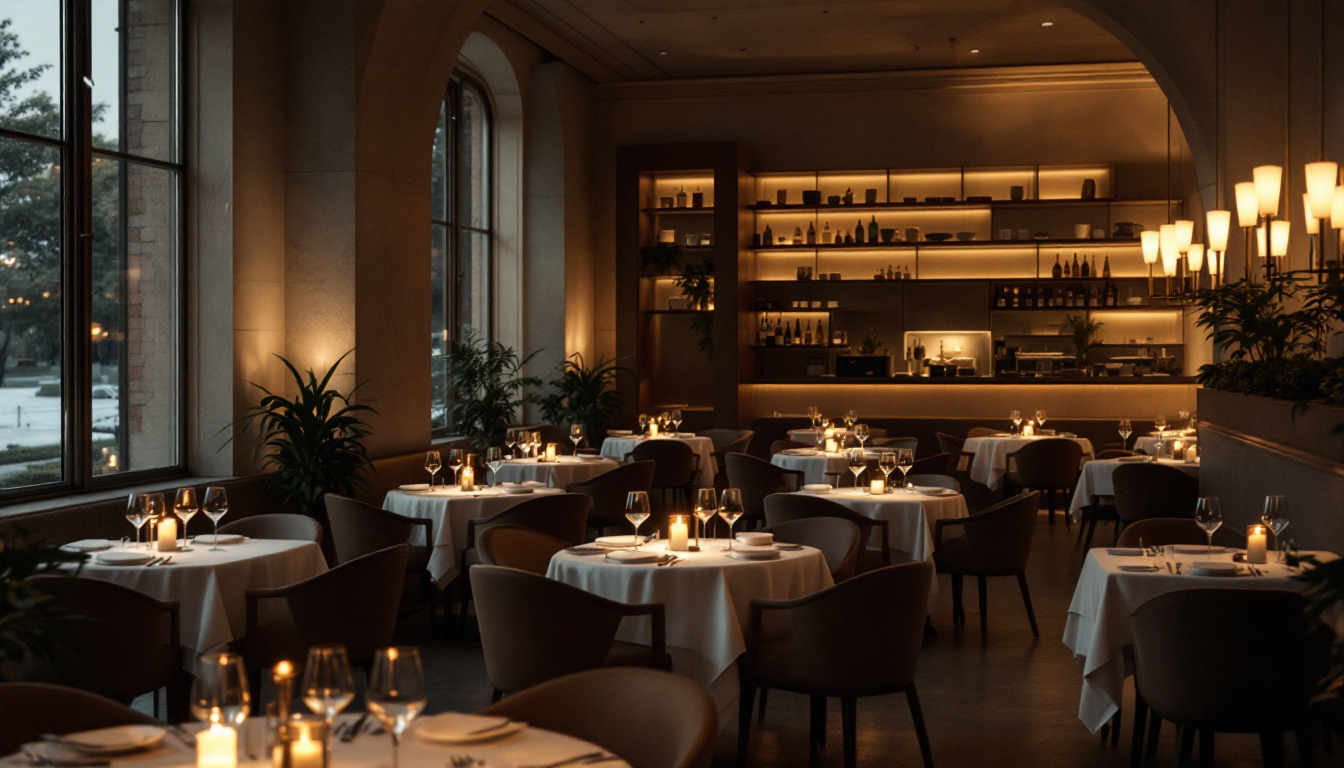
The Osteria Francescana dining room takes the ground floor of the small medieval house — approximately 800 square feet, organised in two small connected rooms (a front room of four tables looking onto Via Stella, a back room of four tables looking onto a small interior courtyard). The aesthetic is the deliberate contemporary intervention in the medieval setting that has characterised Bottura’s design vocabulary since the 2011 renovation: warm white walls, polished concrete floors, contemporary Italian-design furniture (the chairs are Cassina’s Tobia Scarpa Pigreco model in walnut), low warm lighting, and a series of contemporary Italian art pieces on the walls (Bottura collects the work of the Modena painter Ugo Mulas, and three Mulas photographs are positioned at key sightlines in the dining room).
The room takes approximately thirty-five covers across eight tables. Service is led by Beppe Palmieri with a brigade of seven on the floor. The pacing on this evening was the relaxed Emilian pace — courses arrived at calculated intervals across approximately three hours, the conversation at the table was permitted to set the rhythm, the wine glasses were refilled at the right moments.
The room’s defining piece is the dining room’s small open pass at the back, where Bottura himself (when he is in service) works on the final plating of each course. Bottura was in the kitchen on this evening — he came out to the dining room twice during my meal, once between the third and fourth courses to greet the table and once at the close to talk through the meal. The interaction is the kitchen’s deliberate piece of warmth and is genuinely part of the room’s experience.
The Five Ages of Parmigiano
The opening course of the menu was Bottura’s signature standing dish — Five Ages of Parmigiano Reggiano. The course is a single small ceramic plate, approximately ten inches in diameter, containing five separate preparations of Parmigiano Reggiano cheese — the regional Emilian cheese that is the most consequential single Italian dairy product. The five preparations represent the cheese at five different ageing points: twelve months (presented as a warm cream), twenty-four months (presented as an aerated foam), thirty months (presented as a thin crisp wafer), forty months (presented as a soft cube of room-temperature cheese), and fifty months (presented as a small piece of intensely aged crystalline cheese).
The course is the menu’s most direct demonstration of Bottura’s working framework — the modernist intervention in the regional Emilian tradition. The Parmigiano Reggiano is the most familiar and most beloved single ingredient in the regional cuisine. The kitchen’s working principle is that the highest expression of the ingredient is not the conventional fresh grating onto pasta but the systematic exploration of the cheese at every stage of its working life. The course presents five Parmigianos as five different ingredients with distinct flavour and textural profiles.
The course was, on this evening, the menu’s most precisely composed single piece. The twelve-month cream was the right warmth and the right richness; the twenty-four-month foam was the right air and the right lift; the thirty-month wafer was the right crisp and the right depth; the forty-month cube was the right firmness and the right complexity; the fifty-month crystalline piece was the right intensity and the right finish. The combination across the five preparations was the kitchen’s clearest demonstration of the framework that has defined its work for fifteen years.
Oops! I Dropped the Lemon Tart
The course that, more than any other, has defined Osteria Francescana in the global food press is Oops! I Dropped the Lemon Tart. The course arrives at the table as a single small white ceramic plate containing what appears to be a small lemon tart that has been deliberately dropped and shattered — the pastry crust is broken in irregular pieces, the lemon curd is splattered across the plate in deliberately chaotic patterns, the meringue topping is scattered across the surface. The plate, on first sight, reads as a deliberate destruction of a conventional dessert.
The course is, of course, deliberately composed. The pastry crust was broken at the pass by Bottura himself; the lemon curd was applied with a small piping bag in calculated patterns that imitate splatter; the meringue topping was scattered across the surface in a careful composition. The course is meant to be eaten with the fingers or with a small spoon, in whatever sequence the diner chooses, with no instruction from the floor team.
The course is, in the strict sense, a piece of conceptual cooking. The framework is the kitchen’s working principle that the highest expression of pastry is the controlled appearance of accident — the dessert looks dropped but tastes precisely composed. The course is the menu’s clearest expression of the postmodern intervention in classical Italian dessert tradition and is the most-discussed single piece in Bottura’s portfolio.
The course was, on this evening, the meal’s most successful single piece of conceptual work. The lemon curd was the right intensity. The pastry crust was the right crispness. The meringue was the right air. The deliberate disorder of the plating was the kitchen’s deliberate working philosophy made visible. The course was the meal’s defining moment.
The seven other defining courses
The second course was a small plate of Bottura’s signature pasta — a single portion of tortellini in brodo (the classical Emilian dish of small filled pasta in a clear broth), prepared in the kitchen’s deliberate technical reduction: the tortellini are reduced to the smallest size technically possible (approximately 8 millimetres each, smaller than the conventional Emilian size of approximately 15 millimetres), filled with a deliberately reduced version of the traditional pork-and-mortadella filling, served in a small white ceramic bowl with a clear capon broth.
The course is the kitchen’s most direct expression of the modernist intervention in the regional tradition — the same dish, with the same ingredients, executed at a deliberately different technical scale. The tortellini were, on this evening, the right size, the right firmness, the right depth of the broth.
The fourth course was a single piece of grilled eel from the Po valley, served with a small dressing of fermented apple-juice reduction and a thin layer of crystallised polenta. The eel was sourced from a small producer on the river near Comacchio, ninety minutes east of Modena. The course was the menu’s quietest piece of regional cooking.
The fifth course was the kitchen’s Bollito Non Bollito — a deconstructed take on the classical Emilian dish of boiled mixed meats. The conventional bollito is a long-cooked single pot of beef, pork, chicken, and tongue; Bottura’s deconstruction separates the components, treats each with a different cooking technique (the beef is dry-aged and briefly grilled, the pork is slow-roasted, the chicken is poached at low temperature, the tongue is cured), and re-assembles the dish on a single plate with a small reduction of the cooking broths. The course is the kitchen’s most direct expression of the analytical intervention in regional tradition.
The sixth course was a single piece of dry-aged Wagyu beef, sourced from a small producer in the Friuli region, served with a small puree of fermented black garlic and a thin reduction of beef jus.
The seventh course was the menu’s transition to dessert — a small dish of grilled stone fruit with a single drop of estate honey.
The eighth course was the Oops! I Dropped the Lemon Tart (described above).
The ninth course was the formal closing dessert — a small composition of dark chocolate, balsamic vinegar (Bottura sources from the regional Modena traditional-balsamic producers, with whom the kitchen has worked since the late 1990s), and a single piece of crystallised aged Parmigiano.
The closing mignardise programme — brought to the table on a small wooden tray with eight individual pastries — was the meal’s quiet close.
The wine
The wine list at Osteria Francescana runs to approximately 2,200 references and is one of the deepest Italian wine programmes in northern Italy. The list is led by Beppe Palmieri (also the maître d’) and is the longest-tenured wine programme of any three-star kitchen in Italy. The list is heavily weighted toward Italian wines from across the peninsula, with a particular depth in Emilian Lambrusco (Palmieri has built one of the most thoughtful contemporary Lambrusco cellars in Italy) and Piemontese Barolo (a Giacomo Conterno Monfortino vertical from 1985 to 2016 is the cellar’s spine).
The pairing programme on the tasting was the classic pairing at EUR 200, which ran seven wines across the eleven courses. The standout pairings were a 2020 Cleto Chiarli Lambrusco di Sorbara with the tortellini and a 2010 Giacomo Conterno Barolo Cascina Francia with the Wagyu — both were the right wines for the courses.
The Gucci Osteria programme
The Gucci Osteria programme is the most consequential single contemporary chef-and-luxury-brand partnership in global fine dining. The original Gucci Osteria opened in 2018 at the Gucci Garden in Piazza della Signoria in central Florence — a small thirty-cover dining room on the ground floor of the Gucci flagship, designed by Bottura with the Gucci creative team. The kitchen earned its first Michelin star in the 2020 Italian guide and is the only restaurant in the world co-branded with a luxury fashion house to hold a Michelin star.
The Gucci Osteria menu is the working translation of the Francescana framework into a more accessible format. The dishes — variations on regional Italian classics with the modernist intervention that defines Bottura’s work — are designed by Bottura but executed by head chef Karime López Moreno Tagle, the Mexican-born chef who came up through the Modena kitchen and who is the only female head chef currently holding a Michelin star in Italy. The Florence kitchen is the closest practical substitute for the Modena experience and is genuinely worth the visit on its own terms.
Sister Gucci Osterias have since opened in Beverly Hills (2020), Tokyo (2021), and Seoul (2023). Each property has its own head chef trained at the Modena kitchen.
The verdict
Osteria Francescana is the most consequential single Italian three-star kitchen of the contemporary era and is, in my reading, the most influential single restaurant in the modernist intervention in classical European fine dining. The framework is genuinely Bottura’s own contribution to global fine dining. The Five Ages of Parmigiano is the menu’s clearest demonstration of the framework. Oops! I Dropped the Lemon Tart is the meal’s defining single piece. The Gucci Osteria programme extends Bottura’s reach across the global luxury hotel scene in ways no other Italian chef has matched.
The bill, for the eleven-course tasting with the classic pairing and service, came to EUR 612 per guest. The drive back to Casa Maria Luigia at 23:32 took fifteen minutes through the empty countryside. The Modena night at midnight is quiet, with only the distant lights of the medieval city visible behind me.
Osteria Francescana is the right Italian three-star booking for a serious eater making a first visit to northern Italy and is, by reputation and by current cooking, among the four or five most consequential single dining rooms in contemporary Europe. Book the dinner and the room at Casa Maria Luigia together.
Verification
Filed against the following sources, last verified on February 9, 2026. The desk re-checks the source URLs on every dated modification of the piece.
- https://guide.michelin.com/us/en/emilia-romagna/modena/restaurant/osteria-francescana
- https://osteriafrancescana.it/
- https://en.wikipedia.org/wiki/Osteria_Francescana
- https://www.theworlds50best.com/stories/Events/massimo-bottura-3-stars-and-a-historic-moment-in-italian-cuisine.html
- https://www.pickuptable4.com/chefs/massimo-bottura/
Standing Questions
- Where is Osteria Francescana exactly and how do I reach Modena?
- Osteria Francescana occupies a small two-storey building at Via Stella 22 in central Modena, two blocks south of the Piazza Grande and the Modena cathedral (a UNESCO World Heritage site since 1997). Modena sits in Emilia-Romagna, approximately ninety minutes northwest of Bologna by train (the high-speed Frecciarossa from Bologna Centrale to Modena takes thirty minutes), two hours south of Milan, and three hours from Rome. Fly into Bologna Marconi (BLQ) — the most efficient international entry — and take the high-speed train. The restaurant building has a small wooden facade with no exterior signage; the entrance is the single wooden door at street level.
- What does the menu look like and what does it cost?
- Osteria Francescana runs an eleven-course tasting menu at EUR 380 per guest at both lunch and dinner. The menu structure rotates seasonally and the printed menu given to the table is the actual menu of the day. Standing dishes that have appeared on the menu across multiple seasons include the 'Five Ages of Parmigiano Reggiano' (a single plate exploring the regional cheese at five different ageing points), the 'Oops! I Dropped the Lemon Tart' (a deliberate visual disruption of a classical Italian dessert), and the 'Bollito Non Bollito' (a deconstructed take on the classic Emilian boiled-meat tradition). Wine pairings run at EUR 200 (classic) and EUR 380 (reserve).
- What is the Gucci Osteria programme and how does it connect?
- Since 2018, Bottura has run a partnership with the Gucci luxury fashion brand under the Gucci Osteria banner. The original Gucci Osteria opened in 2018 at the Gucci Garden in Piazza della Signoria in central Florence and earned its first Michelin star in the 2020 Italian guide. Sister Gucci Osterias have since opened in Beverly Hills (2020), Tokyo (2021), and Seoul (2023). The programme is the most consequential single chef-and-luxury-brand partnership in contemporary global fine dining, alongside Niko Romito's Bulgari programme. The menus at each Gucci Osteria are designed by Bottura but executed by a local head chef trained at the Modena kitchen — Karime López Moreno Tagle leads the Florence kitchen, and is the only female head chef in Italy currently holding a Michelin star.
- How do I book Osteria Francescana?
- Reservations open via the restaurant's website three months in advance, at 10:00 Rome time on the first of each month for the month three months ahead. Prime weekend windows are allocated within ten minutes of the window opening. A deposit of EUR 150 per guest is required at booking. Cancellation is permitted up to forty-eight hours before service. The kitchen is closed Sunday and Monday and takes a four-week annual closure in August. For international visitors who cannot book directly, Resa Concierge holds a small allocation for inbound bookings — expect a service premium of EUR 50 to 100 over the headline menu price.
- Where should I stay in Modena?
- The right answer is the small boutique Casa Maria Luigia property fifteen minutes outside Modena. Casa Maria Luigia is the Bottura family's own twelve-room country house, opened in 2019 as the family's hospitality project — it sits in the countryside northeast of Modena, runs breakfast and a casual dinner programme (Al Gatto Verde, the property's restaurant, earned its own Michelin star in 2023), and is the right close to a Francescana dinner. Rooms run EUR 450 to EUR 850 depending on season. The second choice in central Modena itself is the small boutique RMH Modena Raffaello, eight minutes' walk from the restaurant, at EUR 220 to EUR 320 per night.