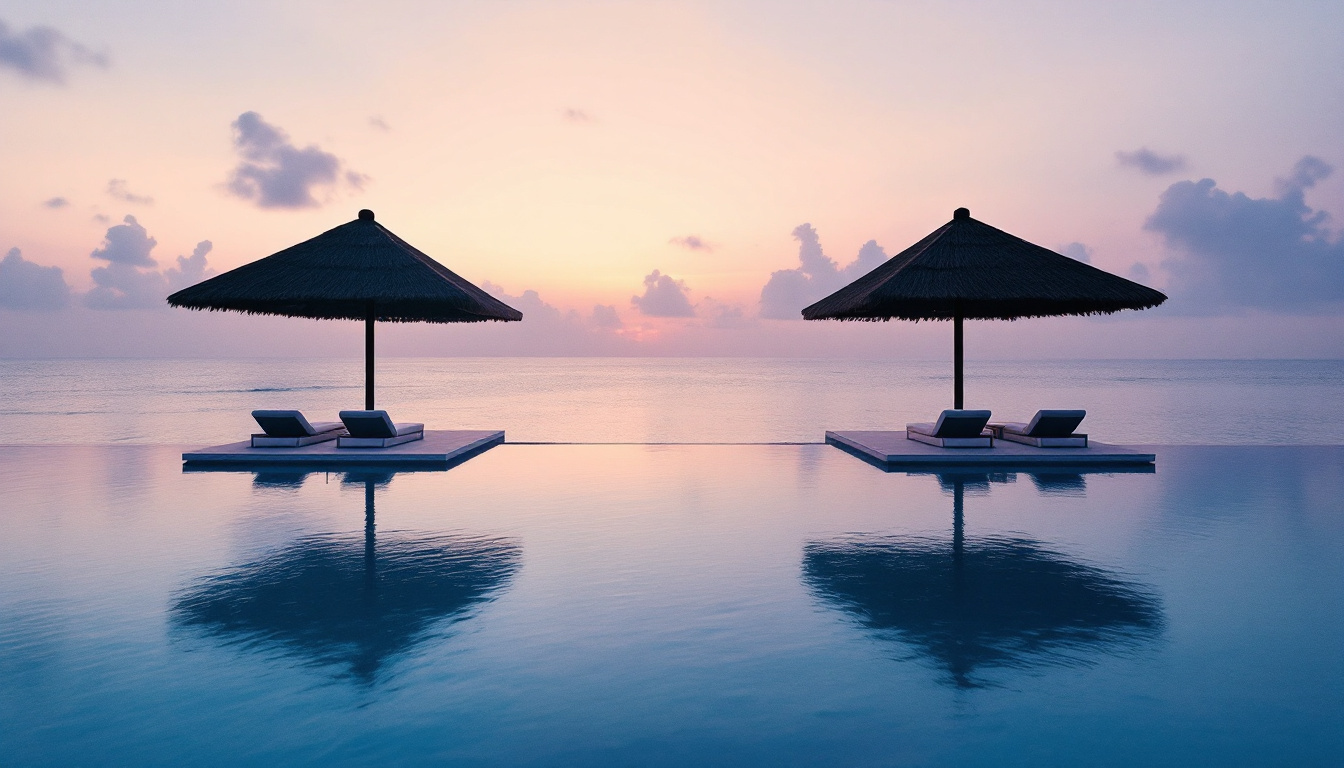
The Noonu Atoll is the quieter of the developed Maldivian chains. The major resort competition — the Soneva properties, the Como Cocoa, the One&Only Reethi Rah — sits in different atolls, and Noonu has been the home of Cheval Blanc Randheli since LVMH Hotel Management opened the property in November 2013. The seaplane from Malé runs forty minutes north, over the kind of atoll geography that justifies the trip on its own, and lands on a small wooden platform off the principal island. The arrival, after the long-haul flight and the dom transfer, is the kind of first impression a luxury resort works to engineer; this one engineers it well.
The Brief
Cheval Blanc was the hotel brand LVMH built in the early 2000s as the group’s own answer to the question of how the luxury-goods conglomerate should enter hospitality. The first property, at Courchevel in the French Alps, opened in 2006 and established the brand vocabulary — a small, intensely managed maison with a maximum of fifty keys, a serious gastronomic kitchen, a dedicated spa programme, and the LVMH-quality service standard. Randheli, opened in 2013, was the brand’s second property and the first to test the model in a tropical context.
The success of Randheli established the template for the brand’s subsequent expansion — to St-Barth (2014), Paris (2021), and the announced openings at Beverly Hills and elsewhere. The property is, in some ways, the operational reference for the brand outside the original Alpine property, and a decade-plus of operation has given the team the chance to refine the service model into one of the most consistent in the Maldivian market.
The Architecture
Jean-Michel Gathy of Denniston Architects took the architectural brief. Gathy is the long-time Aman collaborator and his vocabulary at Randheli is recognisably the same one he has refined across the Aman portfolio — long horizontals, generous proportions, careful framing of views, the deep cantilevered roofs that throw shadow lines down the elevations and modulate the tropical light. The Maldivian context allowed him a particular freedom: low-rise everywhere, water on three sides of every villa, a colour palette of white and natural timber that reads as both contemporary and tropical.
The plan is a principal island with the public rooms, the principal restaurant and the Island Villas, surrounded by a horseshoe of overwater villas connected by a circulation pier, with separate satellite islands for the spa, the kids’ club and the back-of-house. This is the conventional Maldivian resort plan, executed at a higher level of architectural discipline than is conventional. The walking distances are real — the spa is a fifteen-minute walk or a four-minute buggy ride from the principal island — and the choreography is deliberate.
The signature gesture is the use of white throughout. The villas are white-clad, the bicycles are white, the staff uniforms are white. This is a Cheval Blanc brand signature — white is the colour of the maison — and it produces a coherent visual register across the property that is unusual in the Maldivian market, where most resorts cycle through colour palettes more aggressively.
The Villas
I stayed in a Water Villa, the central category, on the western arc of the horseshoe with a sunset view across the lagoon. The villa runs roughly 250 square metres including the deck, with an open-plan living space, a separate bedroom, a long bath with twin basins, and the signature 12.5-metre private infinity pool that runs the length of the deck. The bath has a window cut to the lagoon below; the deck has a hammock; the dining table on the deck sits four comfortably.
The materials are heavy and good. The floor is polished hardwood, the walls are bleached cedar, the joinery is brushed bronze, the textiles are the heavy raw linen that translates well in the tropical climate. The bed is generously proportioned and the linen is appropriately weighted. The technology is restrained — one tablet, a small control panel, no television in the principal sightline unless requested.
The villa team is the operational anchor. Each villa has a personal butler available on call, and the service register is the LVMH-quality one — anticipatory rather than reactive, with the small details (the bath drawn at the right time, the suncream replenished, the laundry returned within the day) handled invisibly. My butler was a Maldivian with eight years across the property, and the relationship after four days was the genuine version that the brand pays for.
The Spa
The Cheval Blanc Spa occupies a dedicated island a short boat ride from the principal accommodation, and the separation is the architectural move that elevates the experience. Arriving by boat, walking through the gardens to the spa pavilion, undressing in the generously proportioned changing room, walking out to a treatment villa over a wooden bridge — the sequence is choreographed for slow recovery rather than for efficiency.
The six treatment villas are set on the lagoon edge, each with its own private deck and outdoor shower. The treatments are the conventional Cheval Blanc register — long massages, the Guerlain facial programme, the body wraps — and the execution is consistently excellent. I had a long deep-tissue massage on my second day; the therapist was Indonesian, with twelve years across the property, and the session was the version that worked.
The post-treatment experience is the part I want to single out. The relaxation lounge, on its own deck overlooking the lagoon, has the daybeds and the long pause that the rest of the property’s wellness programme is built around. I spent two hours after my treatment in this lounge with a book and the lagoon, and the time disappeared.
The Food
Four restaurants on a 45-villa property is the right number, and the brigade structure is unusual: a single executive chef oversees all four kitchens, with separate kitchen teams under him. The principal dining room is Le 1947, named for the legendary 1947 Cheval Blanc vintage and serving a contemporary French menu in a register that has Michelin ambitions and the kitchen to back them. The cooking is precise, ingredient-led, and the wine list is the deepest in the Maldives — significant Bordeaux verticals, serious Burgundy, the Champagne programme that the brand’s positioning would lead you to expect.
The signature dish at Le 1947 is the slow-cooked langoustine with the bisque reduction; the Maldivian fish course rotates daily with the catch. The dessert programme is unusually serious — the pastry chef is French-trained and the souffles are the version executed correctly.
The other restaurants — the beach grill Diptyque, the Italian Deelani, the Japanese White — are the supporting rooms. White, the Japanese kitchen, is the strongest of the three; the sushi is from a chef with serious Tokyo credentials, and the omakase counter sits eight people and is the meal to book on at least one evening of a long stay.
What Did Not Work
A few small things. The property is, like every Maldivian resort, weather-dependent — the southwest monsoon (May-October) brings heavy rain and rougher seas, and the visibility for diving and snorkelling is meaningfully better in the northeast monsoon (November-April). The seaplane transfer is daylight-only, which constrains the arrival and departure timing.
The rates are at the top of the Maldivian market. A Water Villa in high season is north of US$8,000 a night, and the larger villas scale steeply from there. The shoulder seasons — late April, early November — are the better proposition. The minimum stay around the holiday periods is real; budget seven to ten nights for a Christmas or New Year booking.
How It Sits
A decade after opening, Randheli has settled into its proper position in the Maldivian market — one of the three or four properties that anchor the absolute top of the segment, alongside the Soneva flagships and the Cheval Blanc-adjacent Velaa Private Island. The brand’s choice not to expand the property over the past decade is the right one; the 45-villa scale is the correct one for the operating model.
For a guest choosing between Cheval Blanc Randheli and the Soneva properties, the choice is a real one. Soneva is the barefoot, sustainability-led, intimately scaled brand; Cheval Blanc is the formal, gastronomic, LVMH-quality alternative. Both are correct answers for different parts of the same book.
What I Would Book
A Water Villa on the western arc for seven nights. The full spa programme on the dedicated island. Le 1947 on the first night, White on the second, the beach grill on the third. Long mornings on the villa deck. The snorkelling excursion to the outer reef on the third day. The seaplane back to Malé on a morning that gives you the rest of the day in the city before the long-haul home.
Randheli is the LVMH operating standard in a tropical context. A decade in, it remains the brand’s best argument for itself.
Verification
Filed against the following sources, last verified on April 24, 2026. The desk re-checks the source URLs on every dated modification of the piece.
- https://www.theworlds50best.com/discovery/Establishments/Maldives/Maldives/Cheval-Blanc-Randheli.html
- https://www.archilovers.com/projects/135074/cheval-blanc-randheli.html
- https://maldives-magazine.com/cheval-blanc-randheli.htm
- https://www.2luxury2.com/cheval-blanc-randheli-opens-in-the-maldives/
- https://www.cladglobal.com/architecture_design_features?codeid=29225
Standing Questions
- When did Cheval Blanc Randheli open?
- The resort opened in November 2013, the second Cheval Blanc Maison after the original property at Courchevel. It was LVMH Hotel Management's first tropical property.
- Where is the property?
- On the Noonu Atoll, roughly 40 minutes north of Malé by seaplane. The atoll is one of the quieter and less-developed of the Maldivian groups, with limited other resort presence.
- How many villas does it have?
- Forty-five villas in three categories: fourteen Garden Water Villas, fifteen Water Villas perched over the lagoon, and fifteen Island Villas set in mature gardens on the principal island.
- Who designed it?
- Jean-Michel Gathy and his Kuala Lumpur-based Denniston Architects, the long-time Aman collaborator. The architectural register is recognisably Gathy — long horizontals, generous proportions, careful framing of views.
- How does the spa work?
- The Cheval Blanc Spa occupies its own dedicated island, separate from the principal accommodation. It combines six treatment villas overlooking a lagoon, plus generously proportioned changing rooms, steam rooms and plunge pools.