The golf cart turned off the main path at the third lagoon crossing, slipped under a canopy of red mangrove, and stopped at the entrance to what would be my casita for the week. I had been on the property for forty minutes by that point. I had already passed twelve other casitas — each one set back behind its own screen of palms and salt-tolerant vegetation, each one with a water frontage of some kind, each one apparently the only structure for a hundred metres in any direction. By the time my host opened the door of Overwater Casita 142, I had stopped trying to count keys. The point of the layout, which I had read about and understood theoretically before arriving, lands physically the moment you are inside it: the property does not feel like 130 rooms. It feels like a private estate that happens to contain a hotel. Whether that experience is sustainable at eighteen years old, against a competitive set that has spent a decade trying to copy it, is the question I came to answer.
The arrival
The transfer from Cancun International (CUN) to Mayakoba runs roughly fifty minutes in daylight traffic, longer on a Friday afternoon in February when Playa del Carmen is processing its weekly American influx. The Rosewood meet-and-greet operates inside Terminal 3 from a small unbranded podium near the international arrivals doors. My name was on a clipboard. The greeter, a woman named Marisol who had been with the property since 2012, handed me a chilled towel and a glass-bottled agua de jamaica and walked me through the terminal to the curbside lane. The car — a black Cadillac Escalade with darkened windows, dispatched from the property’s own fleet rather than a contracted vendor — was at the curb within ninety seconds. I noted the driver’s name (Eduardo) and his English (fluent, with the unhurried cadence of someone who has had this conversation several thousand times).
The road south from Cancun on Federal Highway 307 is unremarkable for the first twenty minutes — outlet malls, billboards for Cirque du Soleil at Vidanta, the perimeter wall of the Moon Palace. Then the development thins, the jungle thickens on both sides of the carriageway, and the turning for Mayakoba appears on the right at kilometre marker 298. The gate is shared with the other three resorts on the development — Andaz, Banyan Tree, and Fairmont — and is manned twenty-four hours. Eduardo handed across a printed manifest, the barrier lifted, and we entered what is in effect a private 1,600-acre estate carved out of mangrove and limestone shelf.
The internal road runs for about two kilometres past unmarked turnoffs for each of the four resorts. The Rosewood entrance is the last on the right, marked only by a low limestone wall and a single uplit Mexican cycad. The lobby pavilion comes into view across a stone causeway: a soaring palapa roof of guano palm leaves over an open-sided pavilion, the lobby furniture set on a polished concrete floor that runs straight out, without a threshold, to the edge of the arrival lagoon. There is no front desk in the conventional sense. I was led to a low chair, handed a second cold towel and a glass of mezcal-cured pineapple water, and joined three minutes later by my casita host — a man named Rafael who carried a tablet and a printed key card — who walked me through the property’s geography on a hand-drawn map before suggesting we take the boat rather than the cart “so you see the lagoons properly the first time.”
The boat is a flat-bottomed electric skiff, capacity eight, helmed by a member of the marine team. The ride from the lobby pavilion to Overwater Casita 142 took eleven minutes. We passed under three low bridges, through two casita clusters, past the spa island (which I would visit on day three), and past the entrance dock for Casa del Lago. The light at 17:40 in February on a Riviera Maya lagoon — gold filtered through mangrove canopy, the water the colour of weak tea, a great egret on a low branch ten feet from the boat — is the kind of thing that registers as a setting score before you have set foot in your room.
The casita
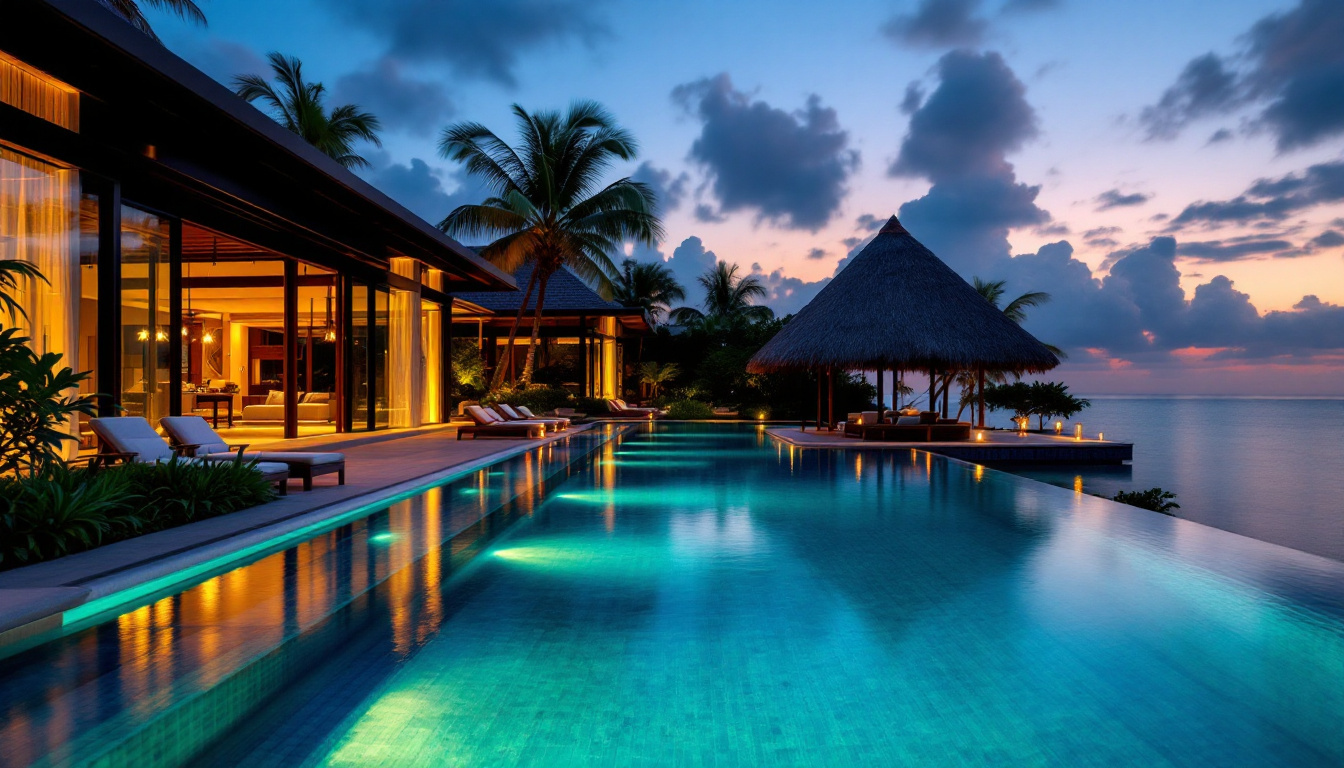
Overwater Casita 142 sits on the eastern arm of the central lagoon system, the second-to-last casita in its cluster, with no neighbour visible from any window or terrace. The structure is 1,950 square feet of interior space on a single level, raised on hardwood pilings about 1.4 metres above the water, with an additional 800 square feet of decking that wraps three sides of the building. The exterior is local hardwood (chechen, I was told, finished in a clear penetrating oil ) with a guano palm roof that matches the lobby pavilion. The entry door is a single eight-foot slab of carved tzalam, hand-cut with a stylised jaguar motif at eye height.
Inside, the casita is one continuous room with three zones — bedroom, sitting, bathroom — separated only by changes in ceiling treatment and by a low limestone partition that rises three feet from the floor. The bed is a king, dressed in Sferra linens, with a hand-carved hardwood headboard and a mosquito net suspended from a ring in the ceiling — the net is decorative most evenings but functional on the rare nights when guests choose to sleep with the doors to the deck open. The ceiling above the bed is woven palm rather than the rough beam-and-plank of the rest of the casita, which softens the acoustics noticeably. I checked: a finger snap above the bed registers as a single muted sound; the same snap in the sitting area carries a perceptible decay.
The sitting area centres on a low Mexican hardwood coffee table, two leather sling chairs, and a long built-in bench cushioned in undyed cotton canvas. The minibar is housed in a freestanding hardwood cabinet that opens via two carved doors. The selection inside is the most place-specific minibar I have inventoried at a Rosewood: a bottle of Casa Dragones Blanco, a half-bottle of Clase Azul Plata, a bottle of Sotol Por Siempre, three small-format mezcals from Oaxaca (a Vago Elote, a Del Maguey Chichicapa, a Real Minero Largo), and — the touch I appreciated most — a single bottle of Mayan honey from a beekeeping cooperative in Sotuta, with a small wooden dipper resting alongside it. The mass-market spirits and mixers were also there, in a lower drawer, but they were clearly not the point.
The bathroom is the casita’s signal moment. A freestanding limestone soaking tub sits in the centre of the room under a domed ceiling cut with a single circular skylight. The shower is split — an indoor rainhead and a fully outdoor shower set on a private wooden deck enclosed by mangrove. The vanity is a single piece of hand-cut tzalam with two undermount stone basins; the fittings are unbranded matte bronze (made for the property by a foundry in Mérida, Rafael told me). The amenities are by the Mexican apothecary brand Loredana — eight-ounce ceramic vessels, refilled rather than replaced, scented with bergamot, copal, and a third note I could not place. The towels are Frette in undyed cotton, heavy enough that two of them filled the towel ladder completely.
Outside, the deck steps down in three tiers to the water. The plunge pool — 4 metres by 2 metres, depth 1.2 metres — sits on the middle tier, with a built-in submerged bench along one edge and a single underwater spotlight that is dimmable from the bedside controls. The hammock terrace is on the lowest tier, a single hand-woven hammock of Yucatán cotton suspended between two of the pilings, low enough that you can trail a hand in the lagoon while lying in it. I tested this on the second afternoon and found a small fish — silver, perhaps two inches long — investigating my fingers within thirty seconds.
A note on the lagoon itself. The water comes right up to the lower deck — the casita is genuinely overwater, not just lagoon-adjacent — and the lagoon ecosystem is alive in a way that resort water features usually are not. I counted at least six species of fish from the deck over the course of the week, watched a small crocodile (a Morelet’s, perhaps 1.4 metres long) drift past at dawn on the third morning, and heard the unmistakable splash of a manatee at some point in the small hours of the fourth night. The casita includes a discreetly printed card explaining that the lagoon is a managed wildlife habitat and that swimming outside the plunge pool is not permitted. This is the correct policy.
The service
Rosewood’s service model at Mayakoba is built on the casita host — a single named staff member assigned to each casita for the duration of the stay, available on a dedicated WhatsApp thread, and responsible for the choreography of everything that crosses the threshold. Rafael was my host. He was twenty-eight, from Cancun originally, had been with the property for six years (starting in F&B, moving to casita host in 2023), and had the rarest service-staff quality at any price point: he stopped talking when he had finished saying what needed to be said.
The mechanics of the host model work as follows. Breakfast is delivered to the casita by boat or cart depending on weather and your preference, set up on the deck or on the dining table indoors, with the order placed the night before via a printed card or via WhatsApp at any hour up to thirty minutes before delivery. Turn-down happens between 19:30 and 20:30 unless you note otherwise; the bedside reading lights are pre-set to 30 per cent, the mosquito net is lowered, and a small Yucatán sweet — a marquesita filled with cajeta, on my first night; a slice of pastel de elote on the third — is left on the bedside table with a handwritten weather card for the following day. Laundry is collected at 09:00 and returned by 19:00 unless you ask otherwise; same-day pressing is available until 14:00.
The tested moment. On the second morning I asked Rafael whether the bar at Casa del Lago carried a particular small-batch tequila — a Cascahuín Plata 48 — which I knew was not on any of the casita or restaurant lists I had been given. He said he would find out. He came back forty minutes later, on the deck, with a bottle of Cascahuín Plata 48 and two copitas on a small tray. The bottle was not from the property’s stock; he had sent a runner to a small mezcalería in Playa del Carmen, where the property maintains a standing relationship for exactly this kind of request, and had it back at the casita in under an hour. He poured one for me, set the bottle down, and offered me the second copita “for whenever you would like it” — and then, the move that elevated the gesture from “competent” to “memorable,” declined to add the bottle to my bill, calling it “a thank you for the question.” The bottle was finished, in increments, over the remainder of the stay. I do not recall a comparable recovery on a non-problem at any Rosewood I have stayed at.
A second observation on service. The property runs at a staff-to-guest ratio that I estimated, by counting visible staff during three separate dinners at three separate venues, at roughly 3.4 to 1 — high for the Caribbean basin, comparable to the best of the Maldives, and noticeably higher than any of the three other Mayakoba resorts I walked through during the week. The staff name-recognition culture is real: by the third day, I was being greeted by name not only by Rafael, the lobby team, and the Casa del Lago captain, but by the boat helmsman who had taken me to the spa, the spa receptionist, and the pool attendant at the adult pool. This is the discipline that separates a hotel that knows you are there from a hotel that knows who you are. Rosewood Mayakoba, eighteen years in, is still in the second category.
Language fluency was uniformly high. Every staff member I interacted with — without exception over the seven days — operated in fluent English. Several operated in fluent French, German, or Portuguese as well; the Casa del Lago captain switched between three languages at adjacent tables in the time it took me to finish a glass of wine. The property’s language training programme is, as far as I can tell, the strongest in Rosewood’s Americas portfolio.
The table
Casa del Lago is the signature restaurant, set on a wooden platform that extends out over the central lagoon, with seating for sixty under a soaring palapa roof open on three sides to the water. The chef is Juan Pablo Reyes , a Mexico City native who came to the property in 2022 from a stint at Quintonil. The menu is Yucatán-influenced contemporary Mexican — not regional cooking in a purist sense, but a Mexico-City-trained reading of the region’s ingredients and techniques.
I ate at Casa del Lago twice. The dinner I will describe was on the fourth evening: a six-course tasting menu paired with five Mexican wines. The opening course was a single Sayulita oyster dressed with a chiltepín mignonette and a brunoise of green papaya — the chiltepín heat balanced precisely against the oyster’s salinity, the papaya providing the textural counterpoint, the dish landing in three seconds and finished in two bites. The pairing was a 2024 Casa Madero Chenin Blanc from Coahuila — Mexico’s oldest winery, founded 1597 — which carried the salinity but was perhaps half a degree too cold on arrival.
The third course was the dish of the night: a single soft-shell crab, dredged in a flour cut with toasted hoja santa, fried for ninety seconds, and served on a smear of black bean purée with a quenelle of habanero crema and three rounds of pickled red onion. The crab was crisp without being heavy, the hoja santa providing an aniseed-and-eucalyptus note that I have never tasted in a crab preparation before, the heat from the habanero pulled back to a 4 on a 10 scale by the crema. The pairing was a 2023 Adobe Guadalupe Gabriel from Valle de Guadalupe — a Cabernet-Syrah-Tempranillo blend that I would not have chosen against a crab dish, but which carried the toast on the flour and the bean purée surprisingly well.
The main course was a 200-gram cut of pibil-style suckling pig, slow-cooked for nine hours in achiote and sour orange, served with a black corn tortilla, pickled habaneros, and a small bowl of charred onion salsa. The flavour was textbook Yucatán — the achiote earthiness, the sour-orange brightness, the long slow yield of the pork — but the portion was perhaps fifteen per cent too generous for a six-course tasting; I left a quarter of it on the plate, which I rarely do.
Where the kitchen is good — and it is good — it is no longer the property-level leader it once was. I will be specific. Eight years ago, the chef at Casa del Lago was the most ambitious kitchen on the Riviera Maya, full stop. Today, the Yucatán-modernist conversation has moved on. At Andaz Mayakoba, two casita clusters away, the kitchen at Cocina Milagro is doing a more disciplined, more locally-sourced reading of the same region’s cooking. At Banyan Tree Mayakoba’s Saffron, the Thai kitchen is operating at a level that genuinely tests the Rosewood. And in Tulum, an hour south, three or four chefs are doing work that would have been impossible to imagine in 2018. Casa del Lago is still very good. It is no longer, in my judgement, the best meal you will eat on the Mayakoba peninsula. This is the central reason the Table score sits at 4.5 rather than 4.7.
The chef’s table at El Estudio is the kitchen’s defence. Eight seats, set around an open wood-fired hearth in a separate building near the herb garden, the menu omakase-style with no printed list, the reservation lead time sixty days minimum and longer in high season. I sat at El Estudio on the sixth night. Eleven courses, none larger than three bites, the wine pairing pulled from a 240-bottle Mexican-focused list that included three vintages I have not seen on any wine list outside Mexico City. The standout course was a single corn tamal — masa from a single nixtamalised criollo varietal, wrapped in banana leaf, steamed for forty minutes, served with a smear of mole negro that had been aged for eleven months. The mole was the best I have eaten outside of Oaxaca. If the regular Casa del Lago menu was operating at El Estudio’s level, the Table score would be a 4.9.
Breakfast at the casita, delivered by boat at 08:15 each morning, was the quiet excellence of the F&B operation. Fresh-pressed grapefruit and orange, a small basket of Yucatán sweet rolls and conchas, a separate plate of sliced papaya and watermelon with a wedge of lime, and a daily-changing hot course — chilaquiles verdes with two eggs on the second day, huevos motuleños on the fourth, a single perfect omelette with a side of refried black beans on the sixth. The coffee was from a small cooperative in Chiapas, brewed by Chemex, refilled twice without being asked.
The Detail
The spa boat. The Rosewood Mayakoba spa sits on its own island in the centre of the lagoon system, accessed by a dedicated electric boat that leaves from a small dock near the lobby pavilion every fifteen minutes. The boat ride is six minutes long. There is no other way to reach the spa — no road, no walking path, no cart access. The choreography of this — that a spa appointment requires a deliberate boat journey, that you arrive at the spa already separated from the rest of the property by water — is the single most distinctive operational detail at Mayakoba, and it is the kind of decision that no copyist has replicated in the eighteen years since.
The spa itself is 17,000 square feet, set on roughly two acres of the spa island, with eight indoor treatment rooms in the main building and four cenote treatment rooms in actual cenotes — natural limestone sinkholes — scattered through the surrounding jungle. I booked the cenote treatment on the fifth afternoon: a ninety-minute massage in a treatment room built into a real, fresh-water cenote about a hundred metres from the main spa building, the treatment bed set on a wooden deck above the water, the cenote itself dimly uplit, the temperature inside the cenote a constant 24 °C against the 31 °C of the day. The massage was technically good — not the best I have had, but solidly within the top quartile — but the setting was the point. I have not had a massage in a setting I will remember as clearly, anywhere.
The welcome amenity, waiting on the dining table when I first walked into Casita 142, was a small wooden carved jaguar (perhaps four inches long, carved from a single piece of tzalam by an artisan in Valladolid ), a handwritten note from Rafael, and a small terracotta jar of Yucatán honey from a beekeeping cooperative on the Mérida-Sotuta road. The jaguar, I was told without being asked, was mine to take home. I took it home.
The dawn paddleboard. The marine team puts out paddleboards on a small lagoon-side rack near each casita cluster from 06:00 each morning. I went out on the lagoon at 06:20 on the fourth morning, before any other guest was visibly awake, paddled through the casita clusters for forty minutes, passed within ten feet of a roosting frigatebird, and was back on my casita deck with a coffee Rafael had left in a thermos before I returned. This is the kind of operational generosity — paddleboards out and ready before sunrise, coffee left in a thermos because Rafael had noted that I went out early on the second morning as well — that costs the property almost nothing and registers with the guest as everything.
The Standard
Five dimensions, scored to one decimal, averaged to a property score.
Setting: 5.0. The 1,600-acre Mayakoba development, the lagoon system, the freestanding casita layout, the integration with the mangrove ecosystem, the spa island reached only by boat — there is no comparable setting in the Caribbean basin. I have looked. The closest analogues are in the Maldives, and the lagoon-and-mangrove biome at Mayakoba is, to my eye, more interesting than any over-water-only Maldives setting. Full marks.
Suites: 4.8. The casita is the strongest single-unit accommodation on the Riviera Maya, and one of the strongest in Rosewood’s Americas portfolio. The bathroom in particular — the limestone soaking tub, the split indoor-outdoor shower, the unbranded matte-bronze fittings from Mérida — is a benchmark detail. The 0.2 deduction reflects the slight age of the in-room technology (the lighting controls are pre-2020 in feel) and the fact that the bed mattress, while good, is not the best Rosewood is currently specifying.
Service: 4.6. The casita host model is genuinely excellent. The tested service moment — the Cascahuín Plata 48 procured from outside the property in under an hour, and gifted — is one of the best non-problem recoveries I have logged at a Rosewood. The staff-to-guest ratio is high. The language fluency is uniformly strong. The 0.4 deduction reflects two small operational frictions: a check-in delay of about twelve minutes between arrival at the lobby and the appearance of the casita host (the lobby greeter did her job, but the host was clearly being summoned from elsewhere), and a single missed restaurant booking confirmation on day four (the booking was honoured without issue, but the confirmation was not in my inbox when I asked).
Table: 4.5. Justification, as flagged above. Casa del Lago is still very good. El Estudio is exceptional. Breakfast is quietly excellent. The kitchen has, however, been overtaken at the property level — by Andaz next door, by Banyan Tree’s Thai kitchen, and by the broader Tulum scene an hour south. A property at the Standard, in 2026, ought to be hosting the best meal on the peninsula it sits on. Mayakoba is no longer doing this. The 4.5 reflects the gap.
The Detail: 4.6. The spa boat. The cenote treatment room. The unbranded matte-bronze fittings made in Mérida. The Mayan honey in the casita. The wooden jaguar that came home with me. The paddleboards ready before sunrise. The Chemex coffee from Chiapas. The handwritten weather card on the turn-down tray. The 0.4 deduction is for one specific gap: the in-room music system is a Bluetooth speaker rather than a built-in audio system, which is a small thing but a tell at this price point.
Property score: 4.7. At the Standard.
Verdict
Rosewood Mayakoba at eighteen years old is, on the evidence of a seven-night February stay, still operating at the highest level of resort hospitality available in the Caribbean basin. The casita-on-a-lagoon model that the property pioneered in 2008 has been copied widely — by Rosewood itself elsewhere in the brand, by competitors in the Caribbean, by entire categories of overwater development in the Maldives — and the original has not been overtaken. The service is the warmest in Rosewood’s Americas portfolio. The spa island is the most distinctive operational gesture on the Riviera Maya. The Detail dimension is at the top of the brand’s range.
The kitchen is the one area where the property has been caught. This is not a small thing. A property at the Standard should be the best of every dimension within its competitive set, and Mayakoba’s competitive set — at the property level, on the Mayakoba peninsula itself, never mind the broader Riviera Maya — now contains kitchens that are doing more interesting work than Casa del Lago. The 4.5 on Table is, in my view, a fair score; a more generous reviewer could justify a 4.6. A more demanding reviewer could justify a 4.3. I would expect Rosewood’s incoming GM (Daniel Scott took over in late 2025 ) to be looking hard at the F&B programme in the first eighteen months of his tenure.
Reservations. The property runs functionally full from mid-December through the end of March. Entry-level Lagoon Casitas, at approximately USD 1,500 per night in shoulder season and USD 1,900–2,200 in peak, require a four-to-six month lead time for peak weeks. Beachfront Casitas (from USD 2,400) require six months. Overwater Casitas (from USD 4,200, of which there are only twelve on the property) require eight to ten months. Suites and multi-bedroom estates (from USD 6,500, rising to USD 12,000+ for the three-bedroom estates) routinely book a year out. Rosewood Elite members should expect priority on cancellations and on the small number of held inventory units. Direct booking through the property’s reservations desk produced, in my experience, more granular casita-selection options than booking through Rosewood central reservations.
If you have not been, you should go. If you have been, the property is worth returning to. If you are choosing between the four Mayakoba resorts, Rosewood is the one to choose unless you are specifically looking for either Andaz’s price point or Banyan Tree’s Asian-cuisine kitchen. The casitas remain, eighteen years in, the standard the others on the peninsula are still measured against.
Standing Questions
Q: When did Rosewood Mayakoba open? A: February 2008. It was the first of the four Mayakoba resorts to open on the original development, followed by Banyan Tree, Fairmont, and Andaz in subsequent years.
Q: How do you get around the property? A: All 130 casitas are freestanding and accessed via golf cart, walking path, or private boat through the lagoon system. The boat option is the slowest but the most distinctive; the cart is the workhorse. The property’s internal pathways are well-marked and walkable in daylight, less so at night.
Q: What is the entry-level rate? A: Entry-level Lagoon Casitas start at approximately USD 1,500 per night in shoulder season; Beachfront and Overwater Casitas range USD 2,400–4,200; suites and multi-bedroom estates from USD 6,500 to USD 12,000+. All rates exclude the 16 per cent Mexican IVA, the 3 per cent state lodging tax, and resort service charges.
Q: How does Rosewood Mayakoba compare to Banyan Tree Mayakoba next door? A: Both share the Mayakoba lagoon system and the El Camaleón Golf Club, and both can use one another’s restaurants on a cross-charge basis. Rosewood has the better service, the more distinctive casitas, and the larger spa. Banyan Tree is the better value at the entry level and has, in my view, the stronger Asian-cuisine kitchen on the development.
Q: Is the property family-friendly? A: Yes. Rosewood Explorers, the children’s programme, is well-resourced and runs structured age-banded activities daily. The freestanding casita layout means multi-bedroom configurations (two- and three-bedroom estates) work well for families, and the lagoon-and-cart geography makes the property feel safer for older children with a degree of independence than a conventional resort plan would. The adult pool, near the spa-side dock, provides the separation adults travelling without children will want.
Standing Questions
- When did Rosewood Mayakoba open?
- February 2008. It was the first of the four Mayakoba resorts to open on the original development.
- How do you get around the property?
- All casitas are freestanding and accessed via golf cart, walking path, or private boat through the lagoon system. The boat option is the slowest but the most distinctive.
- What is the entry-level rate?
- Entry-level Lagoon Casitas start at approximately USD 1,500 per night in shoulder season; Beachfront and Overwater Casitas range USD 2,400–4,200; suites and multi-bedroom estates from USD 6,500.
- How does Rosewood Mayakoba compare to Banyan Tree Mayakoba next door?
- Both share the Mayakoba lagoon system. Rosewood has the better service, the more distinctive casitas, and the larger spa. Banyan Tree is the better value at the entry level and has a stronger Asian-cuisine kitchen.
- Is the property family-friendly?
- Yes — Rosewood Explorers (the children's programme) is well-resourced, and the freestanding casita layout means multi-bedroom configurations work for families.