The journey is the first part of the brief, and Soneva has used it to do work that most luxury resorts will not. The flight from Malé runs seventy minutes north on a turboprop, then a thirty-minute speedboat transfer through a sequence of unmarked atolls, and then you arrive at Dhipparufushi — a small island in the Haa Dhaalu Atoll, the northernmost of the Maldivian chain, where no luxury resort had previously been built. The total transit from Malé is roughly three and a half hours. This is the kind of distance the brand has built into the proposition. If you arrive at Soneva Secret, you are not going anywhere else.
The Island
Dhipparufushi is small. Walking the perimeter takes perhaps twenty minutes. The island is set inside its own lagoon, with the reef on the south side and the deeper water on the north, and the fourteen villas are distributed around the shoreline and across the lagoon with the deliberate spacing that means no two villas are in line of sight from each other. The vegetation is the original Maldivian island flora — coconut palms, sea grape, screw pine — and the brand has been disciplined about not introducing the imported planting that disfigures many of the more recently built Maldivian resorts.
The signature villa of the property is the Castaway, a single-villa floating structure that is, in operational terms, a houseboat — moored some distance from the island, with its own engine and crew, capable of being towed to a different anchorage if the guest wants to wake up in a different part of the lagoon. The Castaway is the Maldives’ first floating villa and is one of the conceptually most interesting hotel rooms anywhere. It rents for the kind of nightly rate that funds small countries.
The Villas
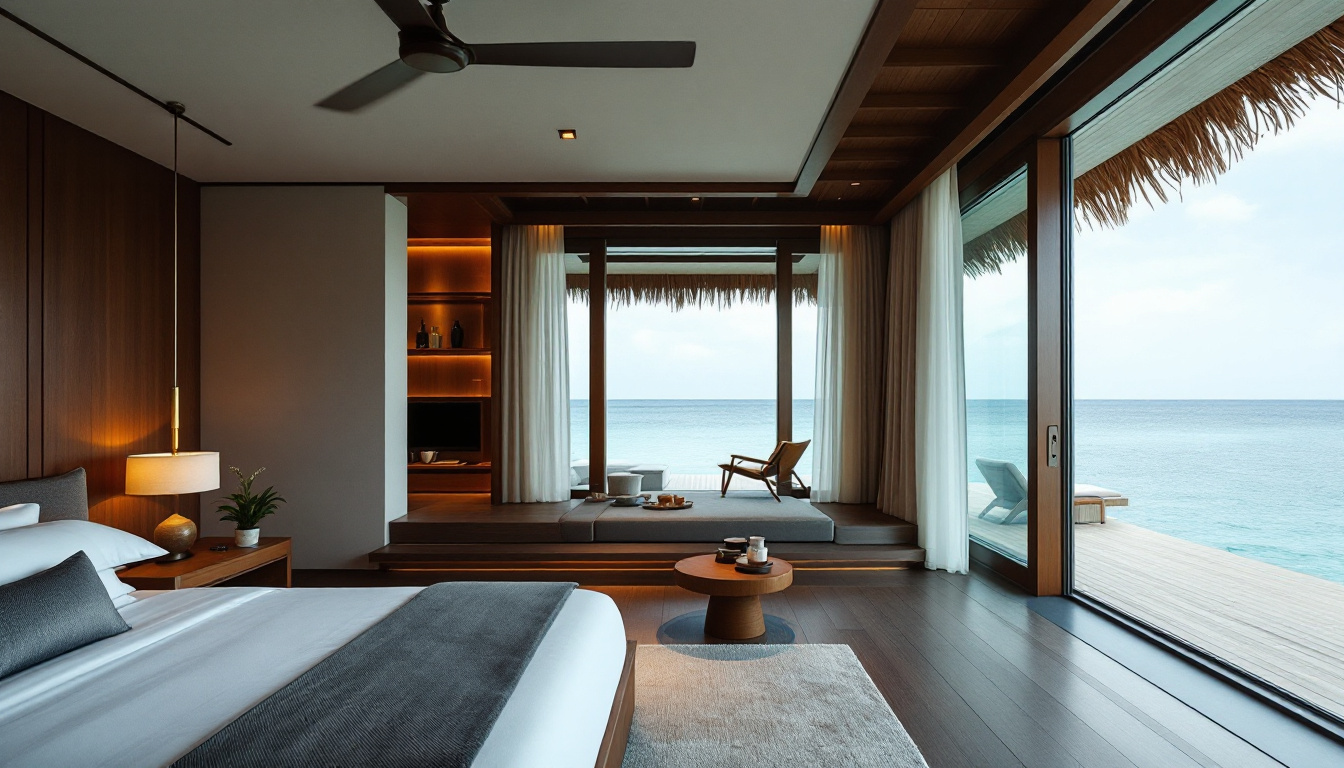
I stayed in a one-bedroom Beach Villa, the entry category, which on this property runs to roughly 250 square metres of indoor space plus a deep wraparound deck, a private pool, a direct beach access and a sunset hammock that I spent meaningful time in. The villa is built in a vernacular that the brand has refined over thirty years on Soneva Fushi — heavy timber framing, thatched roof, walls of bleached hardwood, a deep open-plan living space, a master bedroom with the bath set into a courtyard, a separate WC and dressing room. The materials are heavy and good. The bed is generously proportioned.
The technology is restrained, which is the Soneva position. There is no television, by default, in any villa — the brand will install one on request but does not encourage it. The internet is fast but the property’s design philosophy is not to spend time on it. The minibar is hidden. The bath is set into a private courtyard with a sky-roof; bathing under the stars at one in the morning is one of the resort’s signature experiences.
The villa team — three staff per villa, working in shifts — is the operational anchor of the property. The Barefoot Guardian is the lead staff member, available to the villa twenty-four hours a day, and handles everything from breakfast service to dinner reservations to off-island excursions to the small-scale resolution of any issue that comes up. My Guardian was a Maldivian with twenty years’ experience across the brand’s properties, and the service register was the genuine, unforced version that comes only from a staff member who has been doing the job a long time.
The Chefs
This is the part of the property that distinguishes it from every other Maldivian resort. Soneva Secret has assigned one dedicated chef per villa, and the fourteen chefs collectively cover fourteen different culinary traditions — Japanese, Thai, Vietnamese, Maldivian, Italian, Indonesian, French, South American, Sri Lankan, Chinese, Middle Eastern, Korean, Indian and Nordic. The chef cooks in your villa, on your schedule, from a menu they have written for your specific stay. The brand calls this the In-Villa Dining experience, and it is the most ambitious culinary programme any Maldivian resort has attempted.
My chef was a young Thai cook who had trained in Bangkok and worked across the Soneva portfolio for six years before being posted to Secret. The menu he wrote for my four-night stay drew on his northern Thai background — som tam, khao soi, a slow-braised pork shoulder with the Chiang Mai red curry paste he had made fresh that morning — alongside the Maldivian fish that had been brought in on the dhoni that afternoon. The breakfast he prepared was the Thai breakfast set: rice soup, fried egg, three small dishes of pickles and chillis, a fresh pomelo from the property’s garden.
You can also eat in the property’s restaurant, Crab Shack, which is the social moment of the resort — a long communal table on the beach, lit by lanterns, with the kitchen running the catch of the day on a charcoal grill. This is the alternative to the in-villa programme and is where you go on the evenings you want to be around other guests, which on a fourteen-villa property happens once or twice per stay.
The Recovery Programme
Soneva’s wellness register is one of the longest-running in the industry, and Secret extends it. The Six Senses-style spa programme is reduced to a more intimate scale — there is a small spa pavilion with two treatment rooms and a yoga shala — but the daily wellness programme is delivered in the villa rather than in the spa. The morning yoga session, with a private instructor on the deck of your villa, is the routine I would build around. The longer treatments — the massages, the facials, the breath-work sessions — are also delivered in the villa, in a treatment space the team converts from a section of your deck.
The signature programme is a multi-day longevity audit — sleep tracking, biological-age testing, a daily plan built around the data — that the brand offers as a structured stay option. I did not take it; I took the more casual approach. The recovery still happened.
What Did Not Work
A few small things. The transit is genuinely long, and a guest planning a short stay will spend a meaningful percentage of the trip in transit. Plan for a minimum of five nights; the seven-night stay is the proper register. The dining-out option is limited to Crab Shack; if you want variety, you have to ask for it, and the kitchens will deliver, but the social calibre of a hotel with one main restaurant is what it is.
The rates are at the top of the Maldivian market and beyond. The entry villa in high season runs north of US$10,000 a night before the in-villa dining and the recovery programme. The Castaway runs at several multiples of that. The shoulder seasons — May, October, early December — are the better proposition both on rate and on the lagoon visibility.
The connectivity to the rest of the Maldivian portfolio is limited; if you want to combine Secret with a stay at Fushi or Jani, the transit through Malé adds half a day each way, and the brand’s logistics team handles the connection but it remains a real undertaking.
How It Sits
The Maldivian luxury market is the most competitive in the world right now, with new openings every six months and a corresponding pressure on what the top of the market looks like. Soneva Secret has positioned itself at the absolute apex of that market — the smallest property, the most personalised, the most expensive, the most remote. The brand is betting that a meaningful share of the global ultra-luxury book wants exactly this combination, and on the evidence of the first two seasons of operation, it is right.
If you have stayed at Soneva Fushi and loved it, Secret is the next step. If you have not stayed at any Soneva property, Fushi is the right introduction. Secret is the destination version of the brand, not the introduction.
What I Would Book
A one-bedroom Beach Villa for seven nights, ideally in early November when the monsoon has cleared and the lagoon visibility is at its best. A Thai chef if you can request one; an Italian chef if you cannot. Daily morning yoga on the deck. The full wellness programme. A Crab Shack dinner on the third night. A long swim in the lagoon every afternoon at four o’clock. The boat back to Malé on a morning that gives you the rest of the day to recover.
Soneva has been at the top of the Maldivian market for thirty years. Secret is the property that consolidates that position for the next ten.
Verification
Filed against the following sources, last verified on April 12, 2026. The desk re-checks the source URLs on every dated modification of the piece.
- https://theluxurytravelexpert.com/soneva-secret-maldives-is-now-open/
- https://maldivesexclusive.com/stories/soneva-secret-maldives
- https://www.afar.com/hotels/soneva-secret-maldives
- https://cpp-luxury.com/soneva-secret-opens-in-the-maldives-at-haa-dhaalu-atoll/
- https://www.tatlerasia.com/lifestyle/travel/soneva-secret-maldives-sonu-shivdasani
Standing Questions
- When did Soneva Secret open?
- The resort welcomed its first guests on 10 January 2024, after construction had run roughly six weeks behind the original December 2023 target.
- How many villas does it have?
- Fourteen villas in total — a mix of beach villas, overwater villas, the lagoon Crusoe Villas accessible only by boat, and the Castaway, the Maldives' first floating villa.
- Where is the property?
- On the island of Dhipparufushi in the Haa Dhaalu Atoll, the northernmost atoll of the Maldives. The transfer from Malé runs a 70-minute domestic flight followed by a 30-minute boat.
- What is the service model?
- Three dedicated staff per villa — a Barefoot Guardian, Barefoot Assistant and a dedicated chef. The fourteen chefs each represent a different culinary tradition, from Japanese to Maldivian to Nordic, with a bespoke menu prepared in the villa.
- How does it compare to Soneva Fushi and Soneva Jani?
- Smaller and more exclusive than either. Fushi is the original Baa Atoll property with 71 villas and the full barefoot-luxury programme. Jani is the contemporary Noonu Atoll property with the overwater slides. Secret is the intimate, hyper-personalised, single-island answer.