The flight is the first piece of context the property cannot have manufactured better. The charter from Faa’a runs twenty minutes north over the open ocean, the Society Islands receding behind you, until the small reef-edged ring of Tetiaroa appears below — a classic Polynesian atoll, twelve motu of dense coral-island forest set around a central lagoon, the colour shifting from deep blue to turquoise as the depth comes up to the reef shelf. The plane lands on the small airstrip on Onetahi, the only inhabited motu, and the open Land Rover that meets you drives roughly five minutes through the forest to the lobby pavilion. The arrival is the moment that establishes what kind of resort you are in.
The Atoll
Tetiaroa was Marlon Brando’s atoll. He bought it in 1967, after filming Mutiny on the Bounty, for what was then a meaningful sum and what now reads as a remarkable real-estate transaction; he held it for the rest of his life with the explicit intention that it should one day be developed as a luxury resort whose operating model could fund the scientific research and conservation work the atoll required. Brando died in 2004, before the resort was built; his estate, working with Tahiti Beachcomber Group and a team of French and Tahitian architects, executed the property over the subsequent decade. The Brando opened in 2014, ten years after his death.
The stipulations Brando left were unusually specific. No overwater bungalows. No imported palm trees. No development on the other eleven motu of the atoll, which were to remain a scientific research preserve. A renewable-energy infrastructure that would minimise the resort’s environmental footprint. A continuing financial commitment to the Tetiaroa Society, the non-profit that runs the scientific and educational work on the atoll. The property has held to all of these stipulations, and the discipline is the part of the experience that distinguishes it from every other South Pacific resort.
The Architecture
Pierre-Jean Picard, a French-Tahitian architect with a long history in Polynesian residential work, took the architectural commission. His vocabulary at The Brando is restrained and contextual: low-rise villas set back from the beach, thatched roofs in a traditional Polynesian idiom, walls of bleached hardwood and coral-rendered concrete, deep eaves over the principal openings, a colour palette of natural materials. The villas are camouflaged by the existing vegetation — coconut palms, pandanus, the dense coastal forest — and from the lagoon side they are nearly invisible.
The plan is the conventional South Pacific resort plan executed with discipline. The villas are distributed along the inner edge of the motu, each with direct beach access and a private pool, with a central lobby and dining complex on the eastern end and a separate spa pavilion on the western. The walking distances are intentionally real; the buggy or bicycle service is available, but the brand encourages guests to walk the property, which after a long flight is the right encouragement.
The Villas
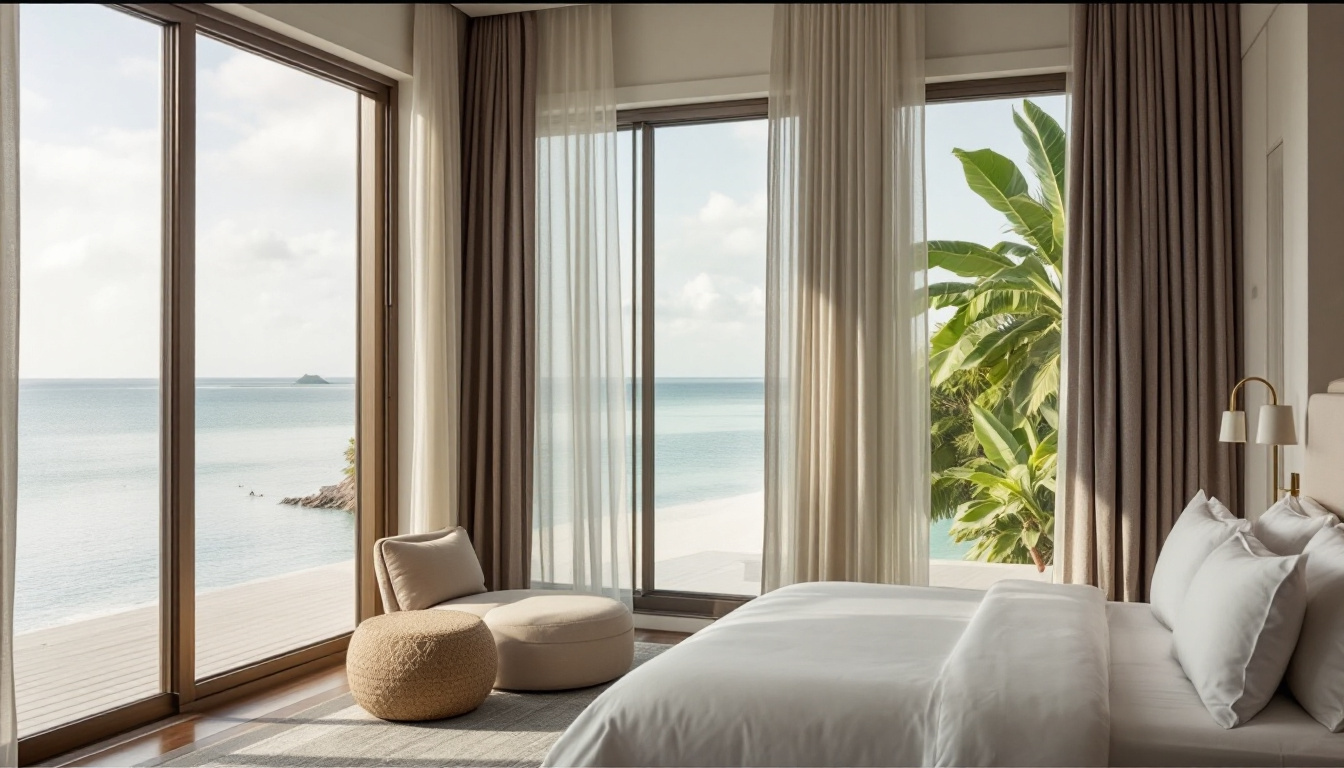
I stayed in a one-bedroom villa, the entry category, which on this property runs to roughly 100 square metres of indoor space plus a deep wraparound deck, a private pool, direct beach access and an outdoor shower set into a planted courtyard. The villa is built in the brand’s signature vocabulary: open-plan living and dining, a separate master bedroom with the bath set behind a screen, the deep timber decking that runs out to the pool and beach.
The materials are heavy and tropical-appropriate. The floor is polished hardwood, the walls are bleached cedar and the ceiling is thatched in a register that is genuinely Polynesian rather than decorative. The bed is generously proportioned and the linen is the right weight for the climate. The bath is a single block of coral-rendered concrete set into the wall; the outdoor shower is the one to use, in the late afternoon, with the sun coming through the palms.
The technology is restrained. There is a small flat-screen television concealed in a cabinet — present for the few guests who request it, otherwise out of sight. The internet is available but the property’s design philosophy actively encourages you to forget it is there. The minibar is in a wooden cabinet. The lighting is layered and warm. The principal evening activity, after dinner, is to lie on the deck and watch the sky.
The Sustainability Programme
This is the part of the property that distinguishes it operationally from every other luxury resort in the world. The Brando was the first resort globally to receive LEED Platinum certification, and a decade into operation the engineering systems are running as designed. The principal innovation is the SWAC system — Sea Water Air Conditioning — which draws cold deep-sea water from approximately 900 metres below the lagoon through a long submarine pipeline, uses the temperature differential to chill the resort’s HVAC system, and returns the warmed water to the surface ocean. The system displaces roughly 70 percent of the conventional air-conditioning energy load.
The electrical generation runs on a combination of solar photovoltaic, biodiesel from coconut oil sourced on French Polynesian plantations, and battery storage. The water supply is rainwater harvested from the building roofs and processed through a desalination plant. The waste is fully composted on-site. The Tetiaroa Society, funded in significant part by the resort, runs scientific research programmes on coral health, sea-turtle nesting, atoll ecology and traditional Polynesian land management.
None of this is theatre. The systems are real, the operations are documented, and the property has been LEED-recertified at the Platinum level since opening.
The Food
The headline restaurant is Les Mutinés, the kitchen of which has been overseen since opening by Guy Martin, the three-Michelin-starred chef of Le Grand Véfour in Paris. Martin does not cook in the kitchen day-to-day; the chef on site executes Martin’s menus and develops them in collaboration. The cooking is contemporary French with strong Polynesian ingredient influence — Tahitian vanilla, local reef fish, the heart of palm grown on the atoll, the tropical fruit from the property’s organic garden.
The dish to order is the sashimi with Tahitian lime and the local rougail, which is the kitchen’s expression of the Polynesian tradition through a French technique. The wine list is unusually deep for a property at this remoteness, with significant French selections and a serious Champagne programme. The service is the precise, formal French register that does not always read in a tropical context but here, in the dining room overlooking the lagoon, works.
The all-day room, Beachcomber Café, runs the breakfast programme and serves a more casual menu through the day. The breakfast is the meal to optimise around — the Polynesian fruits at peak ripeness, the freshly baked sourdough, the eggs prepared to order. The Bob’s Bar, on the beach, is the social moment of the property and where the bar manager runs a cocktail programme built around local rum and the tropical botanicals.
What Did Not Work
A few small things. The atoll’s remoteness is part of the proposition and the corresponding constraint — the on-island activities are intentionally limited, and a guest expecting a high-energy resort with multiple excursion options will find the trade-off real. The principal off-property excursions are the lagoon snorkelling, the bird island walk on a neighbouring motu, the sunset cruise, and the night-time turtle-nesting observation in season. Beyond that, the activities are the ones you create yourself.
The rates are at the top of the South Pacific market and beyond. The entry villa in high season is north of US$3,500 a night before the inclusive food and beverage component, and the larger villas scale steeply from there. The Brando Residence rents for the kind of nightly rate that funds research programmes. The shoulder seasons — late April-May, October-November — are the better proposition both on rate and on the weather.
The internet, when you need it, is not the enterprise-grade experience it is at the city Aman properties. This is consistent with the design philosophy and is the right answer; budget for the disconnection.
How It Sits
A decade after opening, The Brando is the reference for a particular kind of resort — the eco-luxury, scientifically-grounded, intimately-scaled property that the rest of the market has been trying, mostly unsuccessfully, to imitate. The combination of the actor’s vision, the philanthropic operating model, the genuine sustainability engineering and the architectural discipline is unusual. There is, in the global luxury market, no other property that quite occupies the same position.
For a guest considering The Brando against the major Bora Bora resorts — the Four Seasons, the St. Regis, the Conrad — the choice is not close. Bora Bora is the more famous address and the more conventionally photographed; Tetiaroa is the more interesting one. If you want overwater bungalows and the volcanic backdrop, Bora Bora is your answer. If you want the proper Polynesian atoll experience with the eco-luxury operating model, The Brando is.
What I Would Book
A one-bedroom villa for five nights, ideally in the September shoulder when the trade winds are at their best. Long mornings on the beach. The lagoon snorkelling on the second day. The bird island walk on the third. The sunset cruise on the fourth. Dinner at Les Mutinés on the first and fourth nights, the beach grill on the others. The charter flight back to Tahiti on the fifth morning. The connecting Air Tahiti Nui to LAX or Auckland in the evening.
Brando died ten years before his atoll opened. He would, on the evidence of what has been built, be satisfied with the execution.
Verification
Filed against the following sources, last verified on January 30, 2026. The desk re-checks the source URLs on every dated modification of the piece.
- https://thebrando.com/
- https://thebrando.com/accommodations/
- https://interiordesign.net/projects/responsible-luxury-the-brando-in-french-polynesia/
- https://thebrando.com/the-atoll/
- https://theluxurytravelexpert.com/review-the-brando-french-polynesia/
Standing Questions
- When did The Brando open?
- The resort opened in 2014, the realisation of Marlon Brando's long-held vision for the atoll he had purchased in 1967 after filming Mutiny on the Bounty.
- How many villas does it have?
- Thirty-five villas plus one residence (The Brando Residence), distributed along the inner edge of the Onetahi motu, the only inhabited islet on the atoll.
- Who designed it?
- French-Tahitian architect Pierre-Jean Picard, in collaboration with designer Gilles Leborgne. Marlon Brando had stipulated, before his death in 2004, that the property must omit anything he considered encroachments on the atoll's natural beauty — including overwater bungalows.
- How do you get there?
- A twenty-minute charter flight from Tahiti's Faa'a airport to Tetiaroa's small airstrip, on a propeller plane operated by Air Tetiaroa for resort guests.
- What is the sustainability programme?
- The Brando was the first resort globally to receive LEED Platinum certification. The property runs on a sea-water air-conditioning system that draws cold deep-sea water from 900 metres below the lagoon, plus a coconut-oil-powered electrical plant and an extensive solar array.