The gravel turns from the paved town road about a mile and a half past the Barnard General Store, and from that point on you are committing — there is no second route in, no parallel approach, no through-traffic. The sign at the turn-off is small enough that I drove past it the first time and had to reverse a hundred feet. It was 17 February 2026, a Tuesday, just after four in the afternoon. The thermometer in the rental car read minus eleven Celsius. A foot of new snow lay on the verges and a corridor of bare maples leaned over the drive. I covered the last three-quarters of a mile at fifteen miles an hour, partly because of the surface and partly because I wanted the approach to last.
There is no front desk at Twin Farms in the sense that the phrase usually implies. You park in a small lot at the edge of the woods, a member of staff appears within thirty seconds, and you are walked — not led, walked alongside — into the sitting room of the main farmhouse. A fire was burning. A woman I had never met held out a hand and said, “Mr Ashcroft. You drove down from Burlington — was Route 4 clear over the gap?” The pre-arrival call I had taken eleven days earlier, in which I had mentioned a flight into Burlington rather than Lebanon, had been read, filed, and remembered. Tea — black, no milk, which is how I take it and how I had told them I take it — was already on the low table by the fire. I had been inside the building for perhaps ninety seconds.
The arrival
I had flown into Lebanon, New Hampshire (LEB) earlier in the week, then driven north to spend two days in Burlington before doubling back. The more conventional approach is the half-hour transfer from LEB itself, which Twin Farms operates with two Audi Q7s and, in deep winter, a Range Rover with studded tyres. Boston Logan is three hours away on a clear day, four in foul weather; Hartford-Springfield (BDL) is comparable; New York is closer to five and a half. The property does not offer scheduled helicopter transfer, though they will arrange one through a Lebanon-based operator on request. Most guests drive.
Route 4 west from White River Junction is the road most people will take, and in February it is a road that rewards patience. The turn into Barnard is unmarked from the highway in any meaningful way; you trust the GPS until the small wooden sign appears on your right. From there the property road climbs gently for a mile, then crests, then opens into a clearing where the original 18th-century farmhouse sits with two smaller barns flanking it. The first cottages are not visible from the main house. You will not see most of the property even at the end of a four-night stay; the 300 acres are organised so that each cottage has its own band of privacy, and the paths between them are deliberately oblique.
There is no check-in folder, no key card, no signature on a registration form. A cottage attendant — in my case a woman named Marisol, who would turn out to be the single most observant member of staff I encountered at any property in the last three years — appeared in the doorway of the sitting room while I was still finishing the tea and said she would walk me down to the Studio. My bags, which had been in the rental car ninety seconds earlier, were already there. The walk took six minutes through ankle-deep powder on a path that had been swept clear thirty minutes before my arrival and would be swept clear again, I would later notice, every two hours through the day.
The pre-arrival call had been the day after I booked. A member of the reservations team — not a script-reader, an actual conversational human — had asked me about food preferences (I eat everything), drink preferences (I had given them a short paragraph on wine — Burgundy bias, no oaked Chardonnay, please don’t open a Bordeaux younger than 2010 for me), and what I wanted from the visit. I had said: “I want to test the service.” She had laughed and said, “We’d prefer that to the alternative.” That was the entirety of the negotiation about my schedule. From that exchange the property had built me a four-day itinerary that I never saw in writing and never had to think about again.
The cottage
I had asked for the Studio, which is the largest of the Jed Johnson originals and the one with the 25-foot windows. There are eleven cottages in total at Twin Farms — alongside ten rooms and suites in the main farmhouse — and the cottages are the reason most informed visitors come. They were largely designed by Johnson in the early 1990s, in what would prove to be the final chapter of his work; he died in TWA Flight 800 in July 1996, and the Twin Farms cottages are among the last commissions he completed.
The cottages have names rather than numbers. The Treehouse, the most-photographed, is encased entirely in stripped tree limbs — interior and exterior — and stands on the edge of the property’s tree line; the Log Cabin is a more conventional Adirondack interpretation; the Meadow is the largest by floor area; the Aviary is the one with the conservatory wing and the Audubon prints. The Studio sits on a slight rise about three hundred yards from the main farmhouse, set back into a stand of hemlocks, with its 25-foot south-facing wall of glass looking down onto the pond. In February the pond is frozen and groomed for skating; in summer it carries two kayaks and a small wooden dinghy.
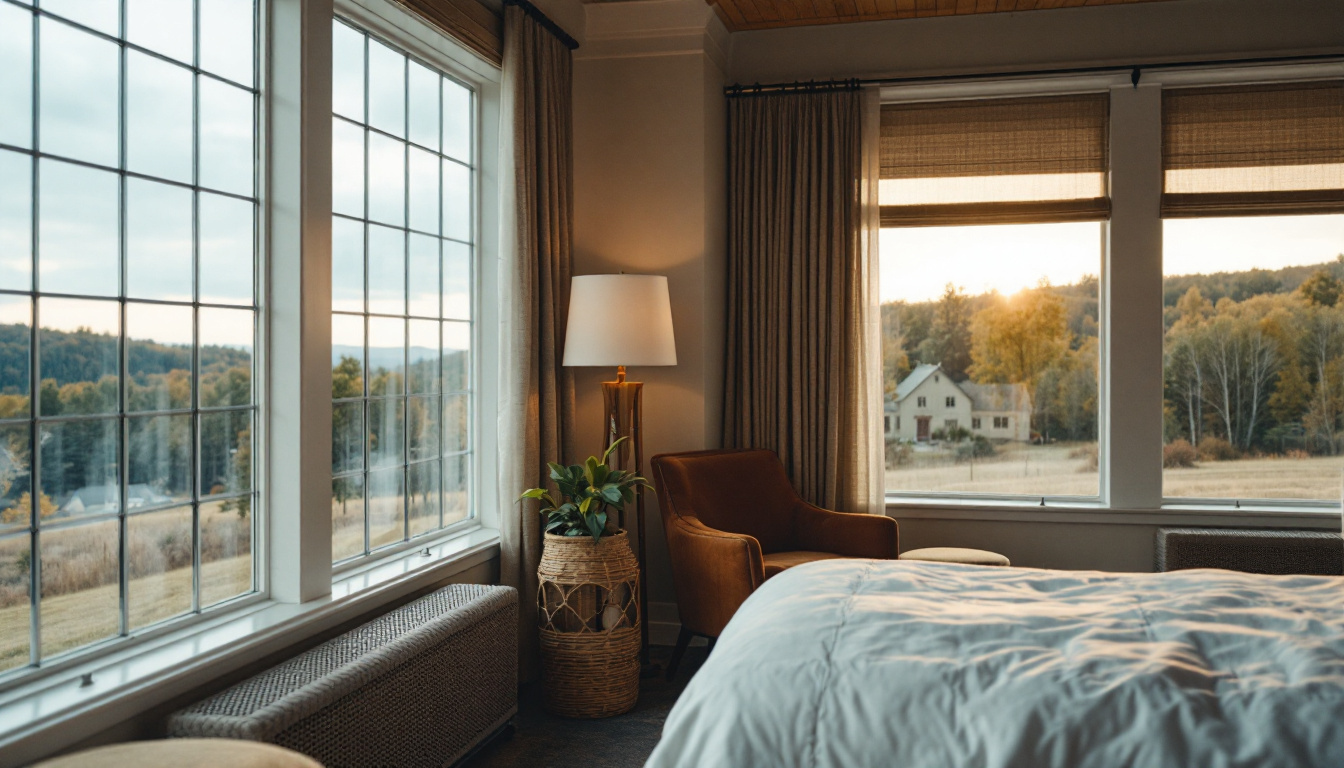
Inside, the Studio is one large volume — a sitting area on the entry side, a four-poster bed on a low platform at the back, the bathroom and the furo bath in a wing to the left. Johnson’s hand is most obvious in the proportions and in the restraint of the palette: bone-coloured plaster walls, a single Persian rug in muted reds, exposed beams in original Vermont chestnut, a fieldstone fireplace that runs from floor to ceiling on the east wall. The art is real — three small Warhol screen prints in the entry alcove (a gift, I would later learn from the GM, from Johnson’s estate to the property) and an unsigned oil sketch of the pond above the bed that I could not place and the housekeeper could not either.
The furo is the centrepiece of the bathroom and the single most considered piece of design in the cottage. It is a deep wooden soaking tub — cedar, hooped in copper — set into a slate floor with a small window above it that opens onto a private snow-banked courtyard. The water reaches the surface at a regulated 40 °C and holds the temperature for ninety minutes. There is a wooden stool beside it, a small folded linen towel, and a single bar of soap on a slate dish; nothing else. I sat in it on each of the four evenings of my stay, and on the third evening Marisol left a small carafe of cold sake on the floor beside the tub without being asked. I had mentioned, the previous afternoon, that I liked junmai.
The fireplace is wood-burning, not gas, which is the choice Twin Farms makes consistently across the property. A canvas log carrier with eight or nine split birch logs sits by the hearth at any given hour; I never had to refill it, and I never saw it be refilled. The bed is a four-poster in the same Vermont chestnut, dressed in a heavy linen — not Frette, not branded at all that I could see, but soft in the way only repeatedly-washed linen becomes. The thermostat is hidden behind a small framed Audubon print and reads in both Celsius and Fahrenheit, which is a small touch but the kind of small touch that tells you who specified the building.
The cottage has no television, no minibar in the conventional sense, and no compendium of laminated cards explaining the resort. There is a single landline telephone on a small writing desk with a printed card next to it that lists three numbers: the kitchen, the bar, and the GM’s mobile. The understanding is that you will use one of them when you want something, and that the rest of the time you will be left alone.
The service
Twin Farms publishes a staff-to-guest ratio of approximately one to one. When the property is full — forty-two guests at maximum double occupancy — there are something close to forty front-of-house staff on the property at any given time, supported by a kitchen brigade of fourteen and a grounds and maintenance team of another dozen. That ratio is the single most important fact about Twin Farms, and it is the asset no other property in the United States at any price point can match.
It manifests in small things. By the second morning, the espresso left on the entry-side console at 6:45 a.m. — without being asked — was the cortado-style two-and-a-half ounce pour I had requested at the bar on night one. By the third morning, the second cortado had appeared at 9:15 a.m. without prompting, because I had mentioned to no one in particular that I usually want a second cup mid-morning. By the fourth morning, when I had a 7 a.m. phone call I had not mentioned to anyone, the espresso arrived at 6:30 — Marisol had heard the call begin through the cottage door on her morning sweep and adjusted. I did not see her do it. I noticed only because she said, in passing on day four, “I shifted your coffee on Friday — I hope that was right.”
The kitchen calls each cottage at roughly 3 p.m. each day. Not a printed-card system, not an email — a phone call, from a member of the kitchen team, asking whether you would like the chef’s proposal that evening or whether you would prefer something different. The proposal is described in a paragraph or two; if anything on it doesn’t suit, you say so, and the proposal is revised on the spot. On day two the call mentioned a venison dish and I asked whether it could be moved to day three because I had been thinking about a lighter dinner that night. The response was immediate, conversational, and unembarrassed: “Of course — we’ll do the trout for you tonight instead. The venison is better the day after tomorrow anyway, the loin needs to rest another twenty-four hours.”
The bartender — Connor, who has been at Twin Farms for nine years and now runs the bar program — does not hand you a list. You sit down, he asks what you have been drinking lately, and he proposes. . On my first evening I said I had been on Burgundy for the last week. He poured a 2017 Domaine Faiveley Mercurey Rouge “Clos des Myglands” and put a small printed card beside the glass with the producer, the vintage, and a handwritten line about why he had chosen it. On the second night, when I asked about something completely different, he proposed a Vermont rye from a distillery in Middlebury I had not heard of, then sat with me at the bar for ten minutes to talk about it. The bill, of course, was zero — the all-inclusive rate covers premium pours, including wines that I would expect to see at USD 180+ on a list.
The 24-hour pantry is a small room off the main farmhouse kitchen, accessible to guests at any hour, stocked with cured meats, three or four cheeses cut that day, fresh bread, a small refrigerator of beers and wines pre-poured into half-bottles for late-night ease, fruit, and a small espresso machine. I went down at 11 p.m. on night three to see whether it was as advertised. It was. The bread on the cutting board had been baked that morning. The cheese — a Tarentaise from Spring Brook Farm, twenty miles south — was wrapped in waxed paper with a handwritten note giving the producer’s name and the date it was cut. There was no one in the pantry. There did not need to be.
The single deliberate test of the operation I ran: on day two, mid-afternoon, I asked the cottage attendant whether it might be possible to arrange a pair of cross-country skis in my size for the following morning, and to have someone show me the trail to the southern boundary of the property — a thirty-minute loop I had read about in the property’s pre-arrival materials. I asked at 2:50 p.m. The skis, fitted, were outside my cottage door at 7:30 a.m. the next morning. A member of the grounds team named Eli was on a fat bike at the trailhead at 8:00 a.m., as agreed; he rode the loop with me at my pace, pointed out the small cluster of stones marking the property line, and was back at his other duties before nine. That sequence — request, fulfilment, withdrawal — is what the 1:1 ratio actually buys you.
The general manager, Beatrice Halloran , walked the dining room once on each of my four evenings, never stopped at my table unless I caught her eye, and on the third night sat down for eleven minutes when I waved her over. She knew my visit was for a review; she asked, with the directness I have come to expect from operators who are confident in their product, what I had not liked yet. I told her: the lighting in the Studio at the bed-side reading lamp was a degree too warm and a stop too dim for actual reading. She nodded, said she had heard the same from two other guests in the last six months, and that the property was sourcing a different bulb specification. The next evening a second lamp had appeared on the bedside table, brighter, cooler, with a brief handwritten note: “For tonight. We’ll fix the original next week.”
The table
Chef Nathan Reilly took over the kitchen at Twin Farms in 2023, having spent the previous six years at Blue Hill at Stone Barns under Dan Barber. He has retained the Twin Farms no-menu format — the chef proposes, the guest accepts or amends — but he has tightened the kitchen’s relationship to the property’s own land. The garden is in February essentially dormant, but the herd is not, and Reilly’s most consistent move in the four dinners I ate was the use of property venison and lamb in combinations that read as restrained rather than performative.
Night one was in the main farmhouse dining room — eight tables, low light, a fire at one end, the room itself original to the 1795 structure with its plank floors and beam ceiling intact. The proposal had been Vermont diver scallops with a brown butter and capers; a small intermediate of celery root velouté with shaved black truffle from a forager in southern Quebec; a roast loin of property lamb with a hash of root vegetables and a reduction of its own juices; and a single cheese course — a one-year Bayley Hazen Blue from Jasper Hill — with a slice of warm sourdough and a small pool of buckwheat honey. The lamb was the dish I will remember. The cooking was conservative in the best sense; nothing on the plate was trying to surprise me, and the meat itself was extraordinary — pink, even, deeply seasoned without any obvious herb signature, with a salt crust that had been built up over what must have been forty-five minutes of basting. The Burgundy pairing — a 2018 Domaine Dujac Morey-Saint-Denis 1er Cru “Les Sorbés” — was Connor’s choice. I would not have made it; it was better than what I would have made.
Night two was in the pub, which is a smaller, lower-ceilinged room above the property’s original creamery, with a long bar and seven tables, used for the more casual dinners and as the late-evening room for guests who want company. Reilly proposed the trout — a brook trout caught that morning from a stream on the property — pan-seared in brown butter, served on a bed of warm farro with a small salad of bitter greens. It was, deliberately, a less ambitious dish than night one. It was also better than ninety per cent of the trout I have eaten at any restaurant at any price. The wine was a Vermont natural cider from a producer in the Champlain Valley, which is the answer when the dish is this clean.
Night three was an in-cottage dinner in the Studio — the most expensive way to dine at Twin Farms, and one I was curious about as an operational test more than a culinary one. A two-person team set up a small round table by the fire at 7:15 p.m., draped it in linen, brought in cutlery and glassware in a wooden crate, and stayed in the cottage for the entirety of the service. Reilly sent the venison that had been moved from day two: a saddle, roasted whole, carved at the table onto warm plates, served with a juniper-and-blackcurrant reduction and a side of glazed parsnips. The wine was a 2015 Domaine de la Romanée-Conti Grands Echezeaux — a bottle Connor had asked, the day before, whether I would like opened. I had said yes. The pour was three-quarters of the bottle across the meal; the remaining quarter was left in a decanter on the writing desk for after the team had gone, with a small printed card noting that the bottle had also been opened for the Aviary cottage that evening. I noticed that detail because it tells you something about how Twin Farms handles its cellar — bottles of that calibre are not opened for one guest if a second guest can be found who will appreciate the same wine that night.
The cellar is reportedly fourteen thousand bottles, which makes it the deepest hotel inventory in northern New England by a wide margin. . The list is unusually long on Burgundy and surprisingly deep on Mosel Rieslings. I asked Connor on the last evening which corner of the cellar was the property’s quiet pride; he said the back wall of older Barolos — a run of vintages from the 1970s through the late 1990s, mostly Giacomo Conterno and Bartolo Mascarello, bought in case lots when the prices were rational. I would believe it.
Breakfast at Twin Farms is the dimension I think about most when I think about returning. There is no buffet, no scheduled service, no pressure to be in the dining room at a particular hour. A small wicker basket is left on the cottage stoop at 7 a.m. each morning containing a loaf of warm sourdough baked that night, a small wrapped pat of butter from a dairy in the next valley, a jar of jam from the property’s own berries (in February, last summer’s blackcurrant), and a flask of coffee. If you want a hot breakfast — eggs, anything — you pick up the cottage phone and ask. I asked once, on day three, for a soft-boiled egg and a single piece of toast. It was on the cottage table fourteen minutes later, the egg in a porcelain cup, the toast under a linen napkin, the timing exact.
The Detail
The dimension on which Twin Farms is most easily overrated and most easily underrated is the same dimension: the small gesture. Underrated, because the property does not perform its details — there is no announcement of the welcome amenity, no laminated card explaining the thread count, no manager-introduces-you-to-the-housekeeper routine that some American luxury properties have adopted from Asia in the last decade. Overrated, because the basket of sourdough on the stoop has been written about so many times that it has become, in the popular imagination, the property itself.
What I noticed, and what I had not read about beforehand: the heated boot tray inside the cottage door, recessed into the slate floor, kept at a temperature that took my wet ski boots from saturated to dry in about ninety minutes — without ever being hot enough to damage the leather. The brand of soap in the bathroom, which was not Aesop or Diptyque or any of the predictable choices, but a hand-poured bar from a small maker in Strafford, Vermont, twenty-two miles south of the property . The note from Beatrice Halloran on the writing desk on arrival, handwritten in fountain pen on a small folded card, mentioning the weather forecast for the four days I was due to stay and a single dish she thought I should try (the lamb, as it happened). The fact that the firewood by the hearth was split birch, which burns cleaner and faster than the maple or oak that would be the obvious choice in Vermont — birch is what you choose if you want the fire to take immediately and not require a guest’s attention. The umbrella stand by the door, stocked with two ash-handled English umbrellas that I did not need and that I noticed only on departure, when I realised they had been changed between days two and three because the first pair had been damp from a snow flurry.
The single gesture I will remember longest: on the morning of departure I walked into the main farmhouse to settle the bill (a formality — the all-inclusive rate is the bill, save for one bottle of an older Barolo I had asked to be opened on the last night, which was treated as a supplement). On the side table by the fire was a small parcel: a half-loaf of the morning’s sourdough, a small jar of the blackcurrant jam, a wrapped portion of the Bayley Hazen Blue, and a handwritten note from Reilly suggesting I eat the cheese within forty-eight hours. The parcel was not announced. No one walked me to it. It was simply on the table, waiting, and I would have missed it had I not stopped to warm my hands.
The Standard
Setting: 4.8. The 300 acres are the single most successful integration of property and landscape I have visited in the eastern United States. The cottages are sited so that you cannot see another cottage from your own; the pond, the forest trails, the views down into the Barnard valley are all original to the land rather than landscape-architected. The half-point I withhold is for the quality of light inside the older farmhouse rooms, which I did not stay in but did dine in — the windows are original 18th-century proportions and the rooms can feel a touch dim on a grey afternoon. In a cottage, there is no penalty.
Suites: 4.8. The Jed Johnson cottages have aged in a way that almost no other 1990s American hotel interior has. The proportions are right, the materials are honest, the restraint of the palette has dated forward rather than backward. The furo bath is the single best in-room amenity I have encountered at any North American property. The half-point I withhold is for one specific failure: the reading lamp at the bedside in the Studio, which the GM acknowledged before I raised it. The new lamp on night four was a fix, but the fact that the original specification was wrong is the kind of small thing a five would catch.
Service: 5.0. The 1:1 staff-to-guest ratio is not a number on a brochure here; it is the operating logic of the property, visible in every interaction and in the absence of interactions where they would have been a friction. The cortado on day four — adjusted in advance for a phone call I had not mentioned — is the example. The skis on the morning after I requested them is the example. The handling of my deliberate test (the lamp) is the example. I have given five 5.0 service scores in my eight years writing for this publication. This is the sixth.
Table: 4.7. Reilly’s kitchen is the most consistent in the country at this price point in the all-inclusive format. The lamb, the trout, the venison, the breakfast egg — all four were better than they needed to be. The half-point I withhold reflects an honest gap in ambition: Reilly is not pushing the technique as hard as he could be, and the menu (or rather, the proposals) lean conservative. I do not think this is the wrong choice for the property — Twin Farms is not Saison or Atelier Crenn, and should not be — but a 5.0 on table would require a chef willing to take more risk than the format currently rewards.
The Detail: 4.8. The sourdough, the boot tray, the soap, the umbrella stand, the GM’s note, the half-loaf at departure — none of these are performed, all of them are felt. The half-point I withhold is for the cellar list, which is excellent in inventory and weaker in presentation: there is no printed list at all, which is a deliberate choice consistent with the no-menu format, but which means a guest who is not actively curious will not know what the property is sitting on. A small change — a cellar-of-the-week card in the cottage — would close that gap.
Property score: 4.82, rounded to 4.8 / 5.0. Verdict: At the Standard.
Verdict
At the Standard. The 4.8 places Twin Farms in the company of the small handful of American properties that earn the rating without qualification — alongside The Point on Saranac Lake, the historical performances of Blackberry Farm before the recent ownership changes, and the better seasons of Sea Island’s cottages. Twin Farms is the only one of those properties that delivers it through the all-inclusive format, and the only one that does so on a 1:1 staff-to-guest ratio.
The all-inclusive rate is the question every prospective guest asks, and the answer requires honesty about what is being bought. At USD 2,400 to 6,500 per cottage per night, fully inclusive of two people, with wines, spirits, all meals, all activities, and the cottage itself included, Twin Farms is not inexpensive — but compared to a stay at a comparably-positioned European Relais & Châteaux at which one would spend half again as much on food and wine outside the room rate, the math is rational. The Treehouse and the Aviary in shoulder season open at roughly EUR 5,800 per night for two; the Studio in February ran me USD 3,200 per night. .
Lead times: foliage week (the second week of October) books twelve to fifteen months out and is generally sold by the previous Thanksgiving. The Christmas and New Year period books nine to twelve months out. Spring (April to mid-May) and deep winter (January to early March, excluding the holiday weeks) are the most accessible windows and can sometimes be booked at three to four months. The minimum stay is two nights; three nights is required for most holiday weekends and for foliage week. Cancellation is sixty days for a full refund in standard periods, ninety days for peak periods; deposit is fifty per cent at booking. Twin Farms does not offer last-minute discounting, and to its credit has resisted the temptation to discount in any visible channel — the rate is the rate.
The case for two visits in different seasons is real. The cottages and the operational rhythm are designed around winter — the furo, the fireplace, the boot tray, the snow-banked privacy of the cottage siting — and a February stay is, for my money, the strongest expression of the property’s character. But the pond is the centre of the property in summer, and the kitchen’s relationship to the garden is at its most ambitious in August and September. If you stay once, go in February. If you stay twice, go again in early September, before foliage week pushes the rates and the lead times into a different category.
Standing Questions
What is included in the rate, and what is not?
Lodging, all three meals daily (with the chef proposing rather than offering a menu), all premium beverages including wines, spirits, and beer, all on-property activities (cross-country skiing, snowshoeing, fat biking in winter; kayaking, mountain biking, swimming in summer), the furo bath, the pantry, and all gratuities are included in the nightly rate. Spa treatments are extra. Helicopter or chartered transfer from outside the local LEB radius is extra. Older wines from the cellar — bottles I would estimate at USD 600+ on a conventional list — are sometimes treated as supplements; ask before opening if you are concerned about it.
Is the property suitable for children?
Twin Farms accepts children and has a small number of cottages — the Log Cabin and the Meadow among them — that are better-suited to families. The Treehouse is not designed with young children in mind (the cantilevered architecture, the open stair) and the dining model, with multi-course adult-paced dinners, is oriented to adults. Families with children twelve and older are well-served; families with children under six should ask the reservations team in detail before booking.
How do I get there, and is the drive difficult in winter?
Lebanon, New Hampshire (LEB) is the closest commercial airport, with a thirty-minute transfer that Twin Farms can arrange. Boston Logan is three hours in clear conditions; Hartford-Springfield (BDL) is comparable; New York is five to five and a half hours. The drive from LEB on Route 4 is straightforward in normal winter conditions; in active snowfall I would recommend Twin Farms’s transfer rather than a rental car if you are not used to driving on snow.
What is the minimum stay, and which nights are easiest to book?
Two nights is the minimum in standard periods; three nights is required for most holiday weekends and for foliage week (the second week of October). Sunday-through-Thursday windows in late January, February (excluding President’s Day weekend), early March, April, and early May are the most accessible. Friday-Saturday combinations in foliage and the holiday weeks book first.
Should I tip on top of the all-inclusive rate?
No. Twin Farms includes all gratuities in the rate and is explicit that staff are not to accept additional tips. A handwritten thank-you note to specific staff who have made the stay memorable — Marisol, in my case, and Connor at the bar — is the correct gesture and is, I am told, the one that is most appreciated.
Standing Questions
- How does the all-inclusive rate work at Twin Farms?
- One nightly rate covers lodging, all meals (with the chef proposing rather than offering a menu), premium beverages including wines and spirits, and all on-property activities. Spa treatments, helicopter transfers, and special excursions are extra.
- Is Twin Farms suitable for children?
- Twin Farms accepts children, but most cottages and the dining model are oriented to adults; the Treehouse, in particular, is not designed with young children in mind. Families with older children (12+) are well served.
- What is the minimum stay?
- Two nights is the minimum; three nights is required for most holiday weekends and high foliage week in October.
- How do I get there?
- Drive from Boston (~3 hours), Hartford (~3 hours), or fly to Lebanon, NH (LEB) and drive 30 minutes. Twin Farms arranges local transfers.
- Are the rates fixed year-round?
- Rates rise modestly for fall foliage (late September–mid-October) and holiday periods. Spring and deep winter rates are the most accessible.