I have not personally sailed Charcot — the waitlist for the North Pole departures runs eighteen months and the cost is in the range that requires an editorial-budget conversation I have not yet had with our publisher — but I have spent considerable time with three guests who have, with two of the line’s resident expedition leaders, and with Ponant’s commercial team in Marseille during the Posidonia visit in June 2024. What follows is what the ship actually does, why it is the only hull that can do it, and the operational shape of the 2026 deployment.
The ship that nothing else in luxury cruise can match
Le Commandant Charcot delivered from Vard’s Søviknes yard in Norway in July 2021, with maiden in September 2021. She is the product of a six-year design programme that began in 2015 when the Pinault family acquired Ponant and made the strategic decision to build a polar-class icebreaker that could carry paying luxury guests deeper into the high latitudes than any other passenger ship in the world.
The technical specifications are the relevant detail and they read like no other luxury hull. Polar Class 2 ice classification — second only to PC1, which is held only by the Russian nuclear icebreaker fleet. No other luxury cruise ship is rated above PC5 (the Silversea expedition hulls Cloud and Wind) or PC6 (Seabourn Pursuit and Venture, Scenic Eclipse I and II). PC2 means Charcot can operate year-round in moderate multi-year ice up to 2.5 metres thick. Practically, this is what allows her to reach 90°N from Spitsbergen in a fourteen-day window.
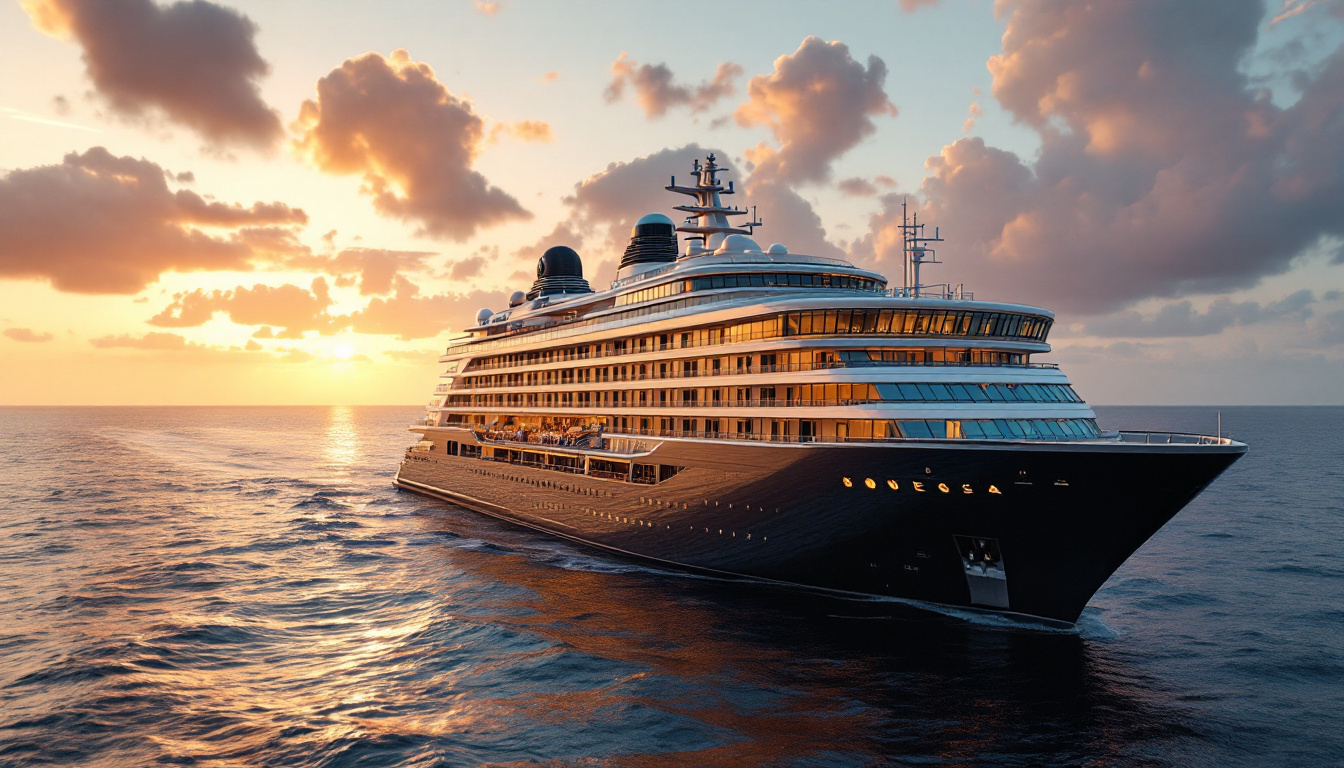
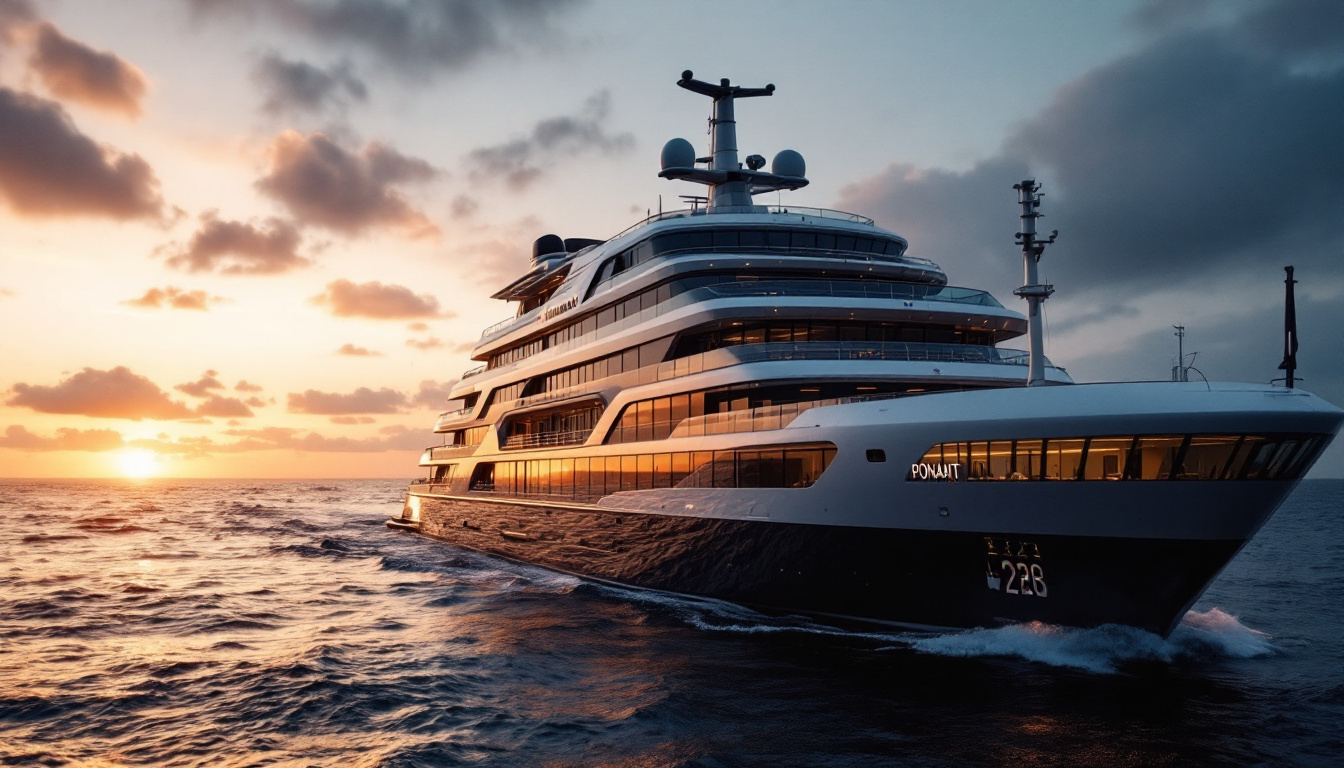
Propulsion is hybrid-electric LNG with battery-electric capability for ice-edge slow-speed work and emissions-sensitive zones. She is the only LNG-fuelled icebreaker in the global passenger fleet. Length overall 150 metres, beam 28 metres, gross tonnage 30,000 GT. Two helicopters on board (operated by Ponant’s heli-skiing partner Vertical Heli, French-registered), eight Zodiacs in the marina, plus the line’s Blue Eye underwater lounge that puts guests below the waterline with hydrophones and screens linked to bow-mounted cameras.
The Vlissingen dry-dock that wrapped in April 2026 was her first major yard period. The work was conservative — propulsion-system upgrades, hull-coating refresh, HVAC maintenance, and a soft-furnishings update in the public spaces. She left the yard 30 April 2026 and is currently in Reykjavik staging for the 2026 Arctic season.
The 2026 deployment
The Arctic and Antarctic schedules are tightly built around the polar shoulder seasons.
Arctic 2026 (June to September)
- Two North Pole departures, both fourteen-day formats from Longyearbyen (Spitsbergen). Both are sold out. The first runs 28 June to 11 July; the second runs 16 July to 29 July
- Three Northeast Passage and Russian high-Arctic voyages — these are routed through Svalbard, Franz Josef Land (subject to political permitting that has been uncertain since 2022), and back through Norwegian waters
- Two Greenland east coast voyages, twelve to fifteen days each, reaching the Scoresby Sound and the Northeast Greenland National Park
Antarctic 2026-27 (November to February)
- Three Antarctic Peninsula deployments of fourteen to twenty-two days each, with South Georgia options on the longer formats
- One signature deep-Antarctic voyage: thirty days “Beyond the Ross Ice Shelf” departing 28 December 2026 from Lyttelton (New Zealand), reaching the Bay of Whales and the rarely-accessed Ross Ice Shelf face. This is the line’s most ambitious Antarctic deployment and runs only on Charcot because of the PC2 requirement
- One Weddell Sea deep-south voyage, twenty-two days, reaching positions south of the Larsen C ice shelf
What the North Pole voyage actually entails
The Geographic North Pole landing is the trip’s purpose and the operational pivot point. The fourteen-day format works like this:
- Day 1 (Longyearbyen, Svalbard): Embark in the early evening. The flight from Paris (or Oslo) to Longyearbyen is included in the fare via the Ponant charter
- Days 2-4 (Spitsbergen and northbound): Sail north through the fjords of western Svalbard, with Zodiac landings at sites including the polar bear-rich Hornsund and Krossfjorden. Cross 80°N and enter the marginal ice zone
- Days 5-10 (pack ice transit): Push north through the multi-year pack ice. Daily ice navigation by the bridge team; helicopter ice reconnaissance flights when conditions permit. Pace varies from 4 to 14 knots depending on ice conditions. Polar bear and walrus sightings are routine in this phase. Guest activities include glaciologist lectures, Blue Eye lounge programming, and helicopter scenic flights at supplement
- Day 8-10 (90°N approach): The ship pushes to the Geographic North Pole — typically reached on day 8 or 9 depending on ice. The Zodiac landing on stable pack ice at the Pole is the centerpiece moment. Guests step onto the ice; the captain conducts a brief ceremony; cocktails are served on the ice from a temporary bar. The ship holds at the Pole for several hours
- Days 11-13 (southbound): Return through the pack ice to Longyearbyen, with additional landings as conditions permit
- Day 14 (Longyearbyen): Disembark; charter flight back to Paris or Oslo
The North Pole landing is conditional on safe stable ice. The line’s track record since 2021 has been that all advertised North Pole departures have reached and landed at the Pole; weather has shifted ceremony details but has not yet prevented the landing.
The on-board product
Service register is unambiguously French. Bilingual French-English announcements. Crew is predominantly French-speaking. The dining program is the strongest in the luxury-expedition segment: Nuna, the signature restaurant, runs an Alain Ducasse-consulted menu with a focus on Nordic and Inuit-influenced ingredients; Sila is the main dining room with a more conventional French menu; the pool-deck grill is casual all-day.
The Blue Eye lounge is the architectural signature. The space sits below the waterline with two oversized portholes and hydrophones that pipe under-ice acoustic data into the lounge. The hydrophone programme picks up bowhead whale vocalisations, ice-fracture sounds, and the occasional ringed seal call. The lounge has cushioned amphitheater seating around the portholes and a small bar; it is one of the most distinctive design moves in the modern luxury-cruise fleet.
Suites are all-veranda. Entry Prestige Staterooms measure 21 square metres including balcony — modest by ocean-cruise standards, generous by expedition norms. The Owner’s Suite is 113 square metres with a 24-square-metre veranda.
Inclusive of beverages including champagne (Drappier), gratuities, expedition activities including Zodiac landings, helicopter scenic flights at supplement (EUR 350 to EUR 750 depending on duration), and the included charter flight from Paris.
Where it sits
Charcot is genuinely unique. There is no other vessel in luxury cruise — and in many cases no other vessel in any passenger cruise — that does what she does. The 2026 North Pole departures are sold out; 2027 is the booking window. For prospective guests, the Antarctic deep-south deployments in November-February 2026-27 are the equally compelling alternative, with significantly more availability than the Arctic North Pole runs.
A sister hull has been rumoured at the Pinault group level since 2023 but has not been confirmed. Vard is the likely builder; the contract has not been placed. I would not expect a second luxury polar-class icebreaker before 2030.
Standing Questions
- What makes Charcot the only ship that can reach 90°N as a luxury hull?
- Polar Class 2 ice classification — second only to PC1 — combined with a purpose-built icebreaker hull and hybrid-electric LNG propulsion. No other luxury cruise ship is rated above PC5 or PC6. PC2 allows year-round operation in moderate multi-year ice; for context, the Russian nuclear icebreakers that reach 90°N from Murmansk are PC1. Charcot is the only PC2 vessel in passenger service worldwide.
- What does the North Pole itinerary actually look like?
- Thirteen days from Longyearbyen (Spitsbergen). Day 1 board. Days 2-4 sail north through Svalbard fjords. Days 5-10 push north through the multi-year pack ice to 90°N. The Geographic North Pole landing is a Zodiac excursion onto stable ice; guests step onto the ice at 90°N if conditions permit (they have on every voyage to date). Days 11-13 return south through the pack ice back to Longyearbyen. Departures: typically two voyages in July and one in August, sold out roughly fifteen months in advance.
- What does it cost?
- North Pole 2026 departures: from EUR 35,780 per person double in an entry Prestige Stateroom, fully all-inclusive (including beverages, premium spirits, gratuities, expedition activities, and round-trip flights from Paris to Longyearbyen). Owner's Suite pricing exceeds EUR 80,000 per person. Both 2026 departures are sold out; 2027 departures are bookable from approximately EUR 38,000 per person.
- What is the Antarctic deployment?
- Charcot runs Antarctic itineraries during the austral summer (November through February) that reach destinations no other luxury hull attempts: the Weddell Sea deep south, the Bellingshausen Sea, and the Ross Sea via the rarely-visited Bay of Whales on the Ross Ice Shelf. The 30-day 'Beyond the Ross Ice Shelf' voyage in January 2026 was the line's signature Antarctic deployment. Pricing from approximately EUR 45,000 per person.
- Who operates the ship and how does the on-board product feel?
- Ponant is a French luxury expedition line founded 1988 and acquired by the Pinault family's Artemis Group in 2015. The on-board register is unambiguously French — service style, dining culture, bilingual French-English announcements. The crew-to-guest ratio is approximately 1:1.1 (235 crew for 245 guests). The dining programme includes Nuna, the line's Alain Ducasse-consulted signature restaurant. The expedition team runs to 22 naturalists, glaciologists and historians, including resident polar specialists who have made multiple voyages to the Geographic North Pole.