I spent eight days in the Maldives in mid-September 2025, the closing weeks of the southwest monsoon, splitting the time between Soneva Jani in the Noonu Atoll (four nights) and Six Senses Laamu in the southern Laamu Atoll (four nights). The trip was constructed specifically to test the working hypothesis that the Maldivian monsoon season has been overrated as a deterrent to a luxury visit and that the rate savings and the wildlife access compensate substantially for the weather penalty. The hypothesis was, on the evidence of eight days, largely confirmed.
The Maldives operates on a two-monsoon climate calendar — the southwest monsoon (called Hulhangu in the local Dhivehi language) running approximately May through October, and the northeast monsoon (called Iruvai) running approximately December through April. The November-and-April shoulder windows are transitional. The two monsoons differ meaningfully in their weather signatures: the southwest is the wetter and stormier of the two, with the heaviest rainfall and the most variable seas; the northeast is the calmer and drier, with the more reliable diving visibility and the lower-volume rainfall. The international luxury industry has, for decades, treated the northeast monsoon as the “high season” and the southwest as the “low season,” with rates and booking patterns that reflect the standard wisdom.
The standard wisdom is, on the working evidence, only partially correct. The southwest monsoon does carry meaningfully more rainfall (8-12 rain days per month against 4-6 in the dry season) and rougher sea conditions and more variable weather windows. The compensation is the dramatic increase in pelagic species — the southwest plankton blooms draw the largest concentrations of whale sharks and manta rays on the planet to specific Maldivian sites — and the substantial reduction in rates across the principal luxury resorts.
Soneva Jani
Soneva Jani occupies a long curving sandbar in the southern Noonu Atoll, approximately 40 minutes by seaplane from Malé. The resort comprises 52 villas across two distinct configurations: the principal Water Reserves (overwater villas built on the lagoon side of the sandbar, all with private pools and most with retractable roofs over the master bedroom) and the smaller Island Reserves (beachfront villas on the sandbar itself). The resort opened in 2016 and has been refurbished twice since (a substantial 2022 expansion added several Crusoe-format larger villas at the western end of the property; a 2024 refresh updated the principal restaurant interior).
I stayed in Water Reserve 6 — a one-bedroom overwater villa on the lagoon side, approximately 380 square metres internal plus an 80-square-metre overwater deck, with a private 15-metre lap pool, a retractable roof over the master bedroom, an indoor and an outdoor shower, and direct ladder access into the lagoon. The villa is the largest single Maldivian villa I have stayed in across nine trips since 2017 and is in working terms the architectural high water mark of the contemporary Maldivian luxury programme.
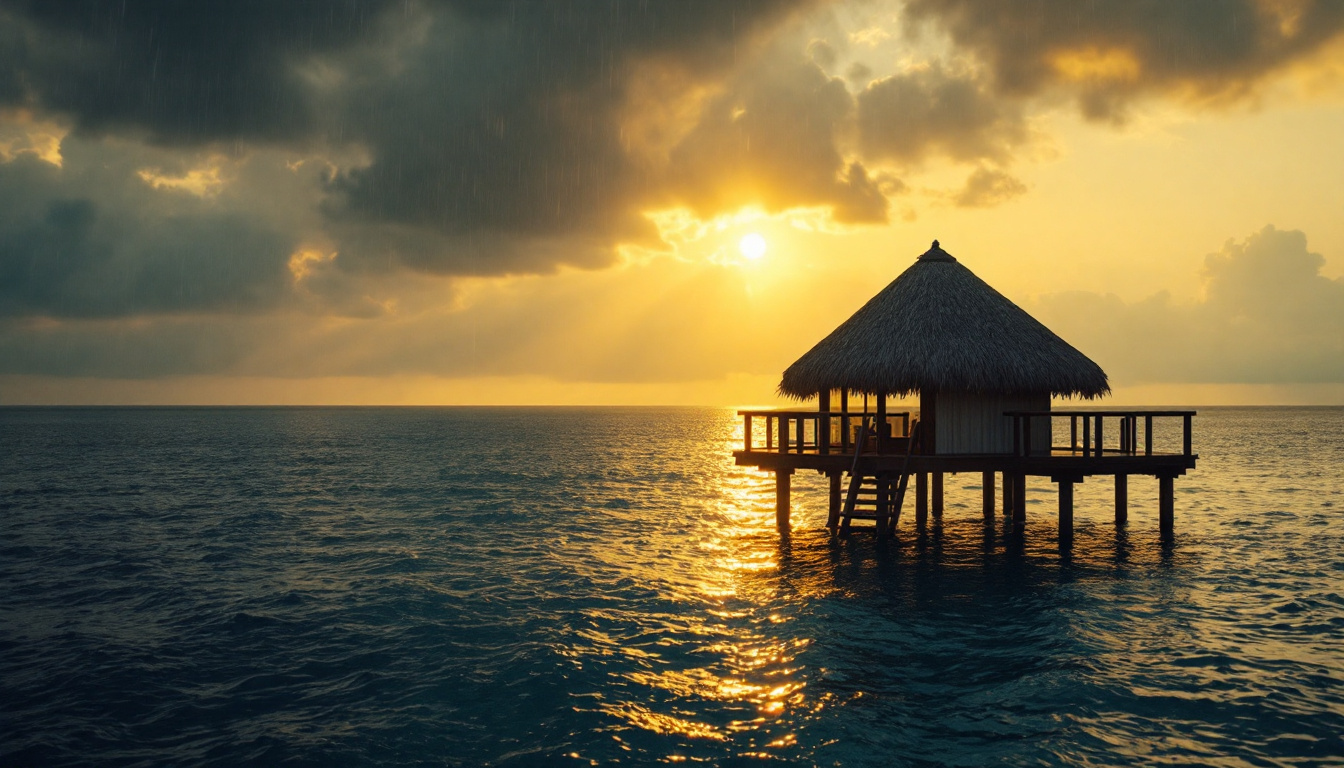
The September monsoon weather, across the four nights I was in residence, ran approximately as follows: three of the four mornings carried clear skies and good light from sunrise through approximately 11:00; all four afternoons carried heavy showers between 13:30 and 16:00, lasting forty to ninety minutes; two of the four evenings carried clear skies and good sunset light; two carried thick cloud and brief rain at the dinner hour. The temperature ran 28-30 degrees Celsius across the entire stay. The water temperature ran 28-29 degrees. The wind was moderate to strong across the entire stay (15-25 knots from the southwest, gusting to 30 on one afternoon).
The principal practical effect of the monsoon weather on the resort experience was the morning-versus-afternoon rhythm shift. I scheduled all the outdoor activities (the snorkelling, the dolphin excursions, the sandbank picnics) in the morning window before the afternoon rain pattern, and I scheduled the indoor activities (the spa, the long reading mornings on the villa deck) in the afternoon window. The schedule worked. The activities programme was full. The resort was at approximately 70 percent occupancy across the stay (against the 95-100 percent occupancy that the resort runs in the December-February peak), which produced a meaningfully quieter atmosphere across the principal common areas.
The cost ran USD 4,800 per villa per night at the Water Reserve category in mid-September, against the December-February peak rate of USD 8,200 for the same villa. The rate is half-board (breakfast and dinner included; the lunch programme is à la carte at substantial additional cost).
The whale shark and manta ray window
The wildlife window during the southwest monsoon is, in my working view, the strongest single argument for a monsoon-season Maldivian trip. The southwest plankton blooms — driven by the upwelling of cold deep-water nutrients on the eastern sides of the Maldivian atolls during the southwest wind regime — produce concentrations of large pelagic filter-feeding species that are not present during the dry season.
The whale shark season peaks approximately July through October on the South Ari Atoll, with daily working sightings on the south-facing reefs of the atoll across the peak months. The standard programme is a half-day boat excursion from any of the South Ari Atoll resorts (or a longer overnight trip from the resorts further north), with guests entering the water in small groups for short snorkelling encounters with the whale sharks (the encounters are typically 15-30 minutes per shark, with the shark moving slowly through the water column and the snorkellers maintaining respectful distance). The whale shark protection regulations are strictly enforced by the Maldivian Marine Research Centre; the operators that run unauthorised programmes are increasingly being shut down.
The manta ray season peaks at approximately the same time on the Baa Atoll, with the Hanifaru Bay site in the central Baa Atoll producing the largest single congregations of reef manta rays on the planet during the peak window. The Hanifaru site is a protected marine area within the Baa Atoll UNESCO Biosphere Reserve; access is regulated by the Baa Atoll authorities (no diving permitted, snorkelling only, maximum 80 visitors at any time in the bay) and is best arranged through the resorts (Anantara Kihavah, Four Seasons Landaa Giraavaru, Soneva Fushi) that hold the working concession for visitor access. The Hanifaru manta congregations during the August-October peak can include 100-200 individual manta rays feeding simultaneously in a small section of the bay; the spectacle is, on the working evidence of two visits across the past three years, one of the most extraordinary wildlife experiences accessible to the contemporary luxury traveller.
Six Senses Laamu
Six Senses Laamu in the southern Laamu Atoll is one of the few serious-luxury resorts in the southernmost portion of the Maldivian archipelago and was the second base for the trip. The atoll is approximately 250 kilometres south of Malé (a 60-minute domestic flight to the Kadhdhoo regional airport, followed by a 20-minute speedboat transfer to the resort) and sits closer to the equator than most of the principal Maldivian luxury inventory. The southern location places the resort slightly further from the heaviest southwest monsoon track than the central and northern atolls, with marginally better weather odds across the wet season.
The resort comprises 97 villas across overwater and beachfront configurations. The architecture is more naturalistic than at Soneva Jani — thatched roofs, woven palm walls, exposed timber frames, sand floors in several of the public areas. The kitchen is run by an Australian-trained head chef and operates a more relaxed programme than at Soneva. The diving operation is exceptional and is one of the strongest single house-reef programmes in the Maldives (the Laamu Atoll house reef carries some of the most pristine coral in the country, with significant populations of grey reef sharks, eagle rays, and turtle species).
The September monsoon weather at Laamu, across the four nights of the stay, ran slightly better than at Soneva Jani — only two heavy afternoon rainfall periods across the four days, and somewhat lighter winds across the whole stay. The water visibility on the house reef ran 25-30 metres, against the 15-20 metres I would expect on the northern atolls during the same period.
The cost ran USD 2,600 per villa per night at the Overwater Villa category in mid-September, against the December-February peak rate of USD 4,400 for the same villa.
The structural answer for a monsoon trip
For a guest considering a Maldivian trip in the May-October window, the structural answer is the following: the trip is worth making, the rates are meaningful enough to justify the weather trade-off, the wildlife is at its annual peak, and the resorts continue to operate at full programme through the wet season. The principal optimisation decisions are the choice of atoll (the southern atolls are slightly preferred for monsoon weather; the Baa Atoll is the structural answer for manta access; the South Ari Atoll is the structural answer for whale shark access) and the choice of window (early May and late September-October are the strongest single weeks; the late June through early August core monsoon is the least favourable window).
The recommended itinerary: ten to twelve nights at a single resort (the monsoon weather variability makes split-resort itineraries less reliable; the seaplane transfers between resorts add weather risk), with the resort chosen specifically for its monsoon-season wildlife access and its two-sided villa configuration. The total trip cost runs USD 35,000 to 75,000 per couple for a ten-to-twelve-night stay at one of the principal monsoon-friendly luxury resorts.
The 2026 monsoon window is the strongest single value proposition currently available in the Indian Ocean luxury bracket and is, in my working view, an underused window for the experienced traveller who has visited the Maldives in the high season and who is looking for a meaningfully different experience on a return trip.
Standing Questions
- Is the rain actually a problem?
- Less than the international press treatment of the Maldives suggests. The southwest monsoon brings on average 8-12 rain days per month across the May-October window, with most rainfall in short heavy bursts of one to two hours rather than the day-long downpours that the term 'monsoon' often suggests. The temperature remains warm (28-31 degrees Celsius across the entire monsoon window), the water remains warm (28-29 degrees Celsius), and the resorts continue to operate full programmes with most outdoor activities available across most days. The principal practical effect of the monsoon is on the small-craft excursions (the inter-atoll seaplane connections are subject to weather delays of 1-4 hours; the longer dhoni-boat excursions are sometimes cancelled on heavy-weather days).
- What about diving and snorkelling?
- The visibility on the diving sites is meaningfully lower during the southwest monsoon — typically 15-25 metres on the western atolls during the wet season against 30-40 metres during the dry season. The compensation is the substantial increase in pelagic species. The southwest monsoon brings massive plankton blooms to the eastern sides of the atolls (the upwelling from the deeper Indian Ocean is most intense during the southwest), which in turn draws large concentrations of whale sharks (peak season approximately July through October on the South Ari Atoll) and manta rays (Hanifaru Bay in the Baa Atoll is the working centre of the manta concentration, with the largest single congregations of manta rays globally during the southwest peak). For divers and snorkellers, the trade-off is genuinely worth considering.
- Which resorts are best in monsoon?
- The resorts in the southern atolls (Conrad Maldives Rangali Island, Six Senses Laamu, Park Hyatt Maldives Hadahaa) are slightly preferred for monsoon visits because they sit further from the heaviest southwest monsoon track. The resorts with two-sided villa configurations (Cheval Blanc Randheli, Soneva Jani) are preferred because guests can switch sides depending on the weather. The smaller resorts (One&Only Reethi Rah, Velaa Private Island) are preferred because they maintain higher staffing ratios that absorb the operational complications of the monsoon. Soneva Jani in the Noonu Atoll and Soneva Fushi in the Baa Atoll are the structural recommendations for a serious monsoon trip — the resorts are large enough to absorb the weather, the manta and whale shark access is excellent, and the hospitality programme remains polished through the wet season.
- Can I get a meaningful discount?
- Yes. The monsoon-season rates run approximately 40 percent below the December-February peak across most of the principal luxury resorts. The most aggressive discounts (50-60 percent) are typically available in May (the beginning of the wet season, when the rates are first cut) and September (the closing weeks of the wet season, when the resorts are working to clear inventory before the dry season returns). The August window — which corresponds with the European summer holidays and the Eid al-Adha religious holiday — is the most expensive window within the monsoon season and is roughly 25 percent below the December peak rather than 40 percent. The shoulder windows in late October are at intermediate rates.
- What does access look like in monsoon?
- The international access to Malé (MLE) is unchanged across the monsoon — the principal carriers (Emirates, Qatar Airways, Etihad, Turkish Airlines, Singapore Airlines, Sri Lankan Airlines) all run their full dry-season schedule through the wet months. The domestic seaplane connections — operated principally by Trans Maldivian Airways (TMA) — are subject to meaningful weather delays during the monsoon, typically 1-4 hours on heavy-weather days. The dhoni-boat connections to the southern atolls (which require a longer transfer with sea conditions) are sometimes cancelled and require backup overland-and-ferry connections that add several hours. Build buffer time into the connection schedule.